What Zostrianos Saw in the Gaps
The longest book in the Nag Hammadi library is also one of the most damaged, and the damage has a cruel pattern: the ladder of aeons survives, and the descriptions of what stands on each rung do not. We filled the holes and left the pattern intact.
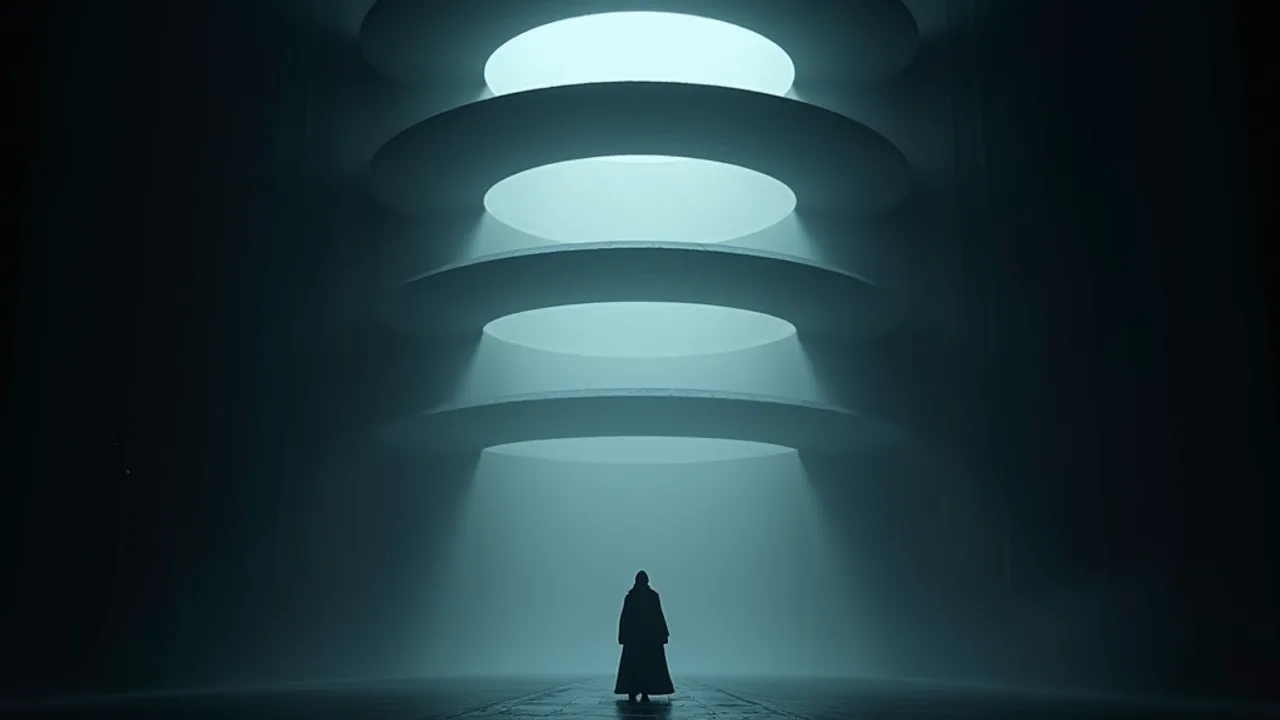 AI illustration
This article is fiction. Zostrianos is genuinely the longest tract in the Nag Hammadi library, roughly 132 pages in Codex VIII, and it is severely damaged throughout, with long unreadable stretches. Plotinus's circle in third-century Rome really did write refutations of a revelation of Zostrianos. The passages filling the damaged sections below were written for this article and translate no manuscript.
The hole
Zostrianos is the big one. Roughly one hundred and thirty-two pages, the first and only substantial tract in Codex VIII, longer than anything else in the library, and in worse shape than almost anything else in it. Whole runs of pages survive as the middles of lines, or the tops, or a column of word beginnings with the ends eaten away.
The frame is a heavenly journey. A visionary named Zostrianos, presented as a relative of Zoroaster, despairs, is taken up by an angel, and is walked through the levels of the invisible world. He is baptised repeatedly in living water, he is renamed at each stage, he is shown the copies, the aeons that imitate real aeons, and then the self-begotten ones, and then the Barbelo aeon with its three levels, and at the top something the text can only approach by saying what it is not. At the end he comes back down and preaches to a race that is asleep, and the book closes with a colophon written in cipher.
Here is the part that is not a literary judgement but a plain fact of the manuscript: the argumentative scaffolding survives better than the visions do. The lists of names, the sequences, the ranks of the aeons, those you can often follow. The passages where the seer describes what he is actually looking at are frequently the ones reduced to a handful of legible words per line.
And here is the historical detail that keeps this text from being an obscurity. In Rome in the 260s, in the school of Plotinus, this revelation, or something very like it, was on the table and was taken seriously enough to be attacked. Porphyry says the circle went after apocalypses circulating under the names of Zoroaster, Zostrianos, Nicotheus, Allogenes and Messos, that Amelius wrote against Zostrianos at enormous length, and that Porphyry himself went after the Zoroaster book and showed it to be recent and forged. Plotinus wrote his own treatise against these people. Two of those names, Zostrianos and Allogenes, later came out of a jar in Egypt.
So: a text that a first-rank philosopher considered a live enough threat to refute, surviving in a copy where the visionary content has been preferentially destroyed by fifteen centuries of wet ground.
We filled the holes. We did not repair the pattern.
The reconstruction
1 And I said to the angel: I have counted seven and I have been washed seven times and each time I was given a name that was not the name I came with. Tell me plainly, what stands upon the fourth?
2 And he said: You will see it, and you will not be able to keep what you see.
3 And I looked, and it was [ 11 lines lost ] and there were no edges to it, and I understood that edges are a mercy given to the lower world, so that a thing may be one thing and not the field around it.
4 And I said: Is it living?
5 He said: It is more nearly the case that living is a manner of speaking about it.
6 And on the fifth I was shown the copies, and the copies were beautiful, and I wept, for I had prayed to them by name in my father's house and they had answered, and an answer from a copy is still an answer, and that is the whole cruelty of the thing.
7 [ 3 lines lost ] for the copy does not know it is a copy. Do not despise it. It is doing exactly what it was made to do, and so are you, and one of you may stop.
8 Then I passed to the sixth, and there stood the ones who are counted but who do not count themselves, and their appearance was [ 19 lines lost ]
9 [ approx. 24 lines lost ] and I asked, why can I not hold it, since I held the others?
10 And he said: Because you are looking with the part of you that was issued to you at the gate. It is a borrowed eye. It must give an account of everything it sees to the one who lent it, and there are sights the lender will not accept, and so the eye does not keep them. It is not lying to you. It is failing to be able to lie to its owner.
11 I said: Then how has any of this been written?
12 He said: Badly. And that is the best available. Write down the ladder and the number of the rungs, and where you cannot write what stood upon a rung, write that you could not, and do not fill it in, for a man who fills in a rung has built a rung, and someone will climb it.
13 And I went up to the seventh, and there I saw [ 31 lines lost ]
14 [ 2 lines lost ] and it did not move toward me, for there was no toward, and it did not speak, for speech is two, and yet I was addressed.
15 Afterward the angel said: What did it say?
16 And I found that I had already begun to translate it, and the translation was: you are late, and you are not late, and I knew this was wrong in the way that all of it would now be wrong, and I began to go down, composing errors, which is called teaching.
What we invented, and what we did not
Attested and sourced above: the length and the condition of the manuscript, the ascent structure, the repeated baptisms and renamings, the aeons that are copies of higher aeons, the Barbelo aeon, the negative-theology approach to the top of the ladder, the closing cipher, and the confrontation with Plotinus, Amelius and Porphyry in third-century Rome. Porphyry’s report in the Life of Plotinus is the single best external witness to a Nag Hammadi text in existence, and it is real.
Extrapolated: the observation that the damage falls hardest on visionary passages. Damage in Codex VIII is not literally selective, papyrus rots where papyrus rots, and a scholar would rightly say we are reading a pattern into noise. We are. On purpose. The essay says so here rather than pretending otherwise.
Invented outright: every line in the block. The borrowed eye is ours. The angel’s instruction not to fill in a missing rung is ours, and it is also the rule this entire series is written under, put into the mouth of the character most likely to be quoted out of context, which is either the best joke available or an act of self-indictment, and we could not decide which.
What the invention argues: this is a horror structure, and the horror is epistemic rather than monstrous. The text can carry the architecture and cannot carry the encounter. Anyone who has read a genuinely strange witness report knows the same collapse from the inside. The witness gives you distances, timings, a sequence of manoeuvres, all crisply, and then reaches the part where they describe the thing itself and the language goes to pieces, and they say it was like, and then they stop, and then they apologise. Zostrianos is that report, run through a philosopher who wanted it refuted, then through fifteen centuries of damp. The gaps are the most honest thing in the book.
Every new case, scored the same way
One email when a case file lands, with its Signal-Strength score and what would move it. No hype, no 'BREAKING', and every claim carries its source. Unsubscribe anytime.
Sources
Read next
More Fiction, maybe? →
The Office Against the Ships of the Air
A work of fiction built on a real silence. Medieval sources describe ships sailing on the clouds: Agobard of Lyon in 815, Irish annal-keepers in the 740s, Gervase of Tilbury around 1211, and a Norse king's mirror that puts an anchor in the church door at Clonmacnoise. Not one of them records what the priest was supposed to say. We wrote the rite that is missing, labelled every line of it as ours, and then explained why it would not have worked.
The Sixth Tranche
A work of fiction. The Pentagon has published five tranches of UAP files at war.gov/ufo, with dates and locations redacted to protect witnesses, and says more are coming. This story imagines the sixth, and the volunteer archivist who mirrors it at two in the morning and finds one file whose metadata does not agree with the others. No sixth tranche had been published when this was written. Everything about it below is invented.
Basilides, Exegetica, Book Thirteen
He wrote twenty-four books in Alexandria around the year 130. We have a page and a half, quoted by men who were refuting him. The most disturbing idea attributed to him is that ignorance is installed on purpose, as an act of mercy. This is the middle book, invented, arguing that case.
Follow the thread
New disclosure reporting, physics breakdowns, and case files, in your inbox. Sources or it didn't happen. No spam, unsubscribe anytime.