Basilides, Exegetica, Book Thirteen
He wrote twenty-four books in Alexandria around the year 130. We have a page and a half, quoted by men who were refuting him. The most disturbing idea attributed to him is that ignorance is installed on purpose, as an act of mercy. This is the middle book, invented, arguing that case.
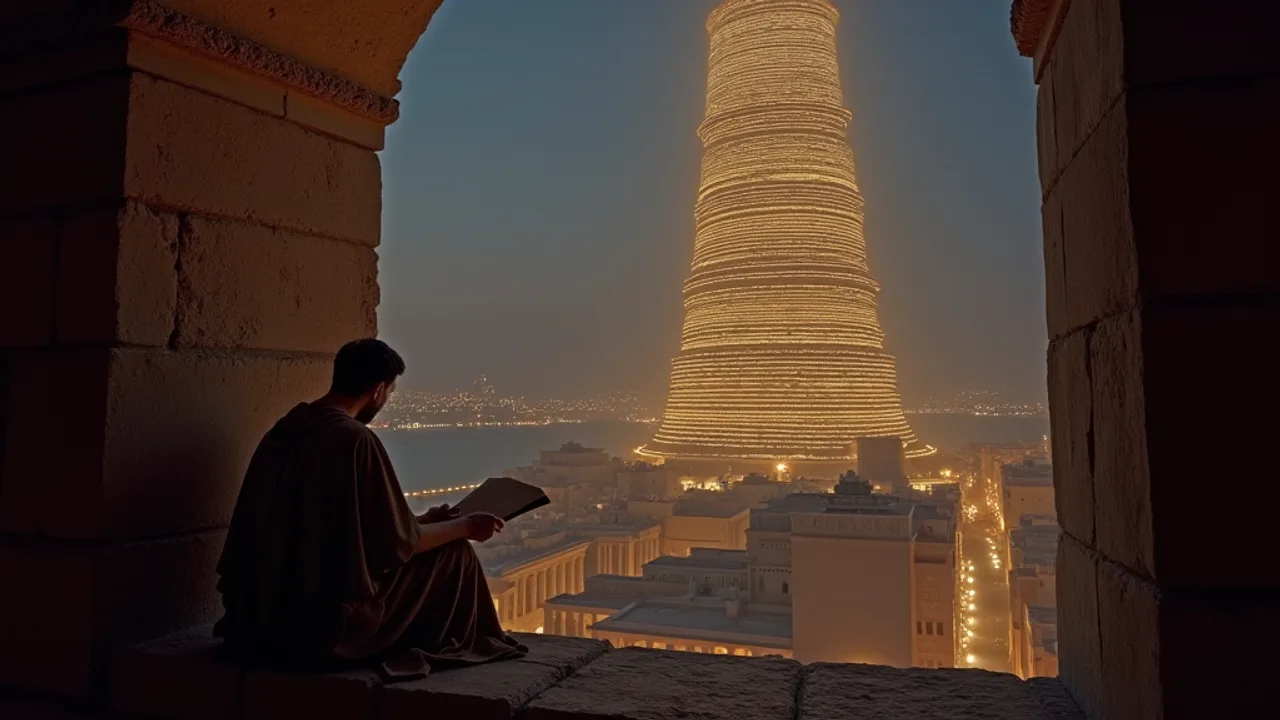 AI illustration
This article is fiction. Basilides was a real Alexandrian teacher of the early second century who wrote a work in twenty-four books, the Exegetica, of which only fragments survive, quoted by Clement of Alexandria and summarised by hostile reporters including Irenaeus and Hippolytus. Book thirteen is lost. The text below was written for this article and is not a recovered fragment.
The hole
Basilides taught in Alexandria in the reign of Hadrian, give or take, which puts him within living memory of people who had known the first Christian generation. He wrote a work in twenty-four books. Twenty-four. A commentary, an exposition, the Exegetica.
Of those twenty-four books, we have quotations amounting to a couple of pages, and every one of them reaches us through somebody trying to demolish him. Clement of Alexandria quotes from book twenty-three, on suffering and providence, and Clement quotes accurately enough that you can hear the man’s actual mind working, which is more than can be said for most of the reports. Hippolytus of Rome summarises a whole Basilidean system in his Refutation: a God who is called non-existent because existence is too small a word for it, a seed containing everything that will ever be, a threefold sonship, a Great Archon who believes himself supreme and is corrected, three hundred and sixty-five heavens, and the name Abrasax, whose Greek letters add to three hundred and sixty-five. Irenaeus gives a different and less philosophical account and cheerfully contradicts the first.
Which of those two summaries is closer to what Basilides said is one of the longest-running arguments in the field, and it exists only because the primary source is gone.
Book thirteen is exactly halfway. Nobody quotes it. Nobody mentions it. There is no reason to think it was the important one, and no reason to think it was not.
The doctrine that made us pick him is the one at the end of Hippolytus’s account, and it is the strangest thing attributed to any teacher of the period. When everything has been sorted and each order has arrived where it belongs, the Great Ignorance is brought down over the whole arrangement, so that no lower order ever learns that a higher one exists, and therefore never longs for it, and therefore is not in pain. Ignorance as an engineering solution. Ignorance as mercy.
Sit with that for a minute before you read anything else on this site about secrecy.
The reconstruction
1 We come now, in the middle of the work, to the middle of the matter, and I will state it in the plainest way I can and then spend the book defending it, as is my custom, and as my critics find tiresome.
2 The heavens are three hundred and sixty-five, and each has its ruler, and each ruler is convinced.
3 That word is the whole teaching. Not wicked. Convinced. The ruler of the first heaven is not a liar. He has never been shown a second heaven and he governs honestly according to everything he has ever seen, and if you were in his position you would rule as he does and you would be as certain, and you would put a man like me out of the city.
4 Consider the ant that has mapped the whole garden. Her map is not false. It is complete with respect to the garden. She has no error to correct. She has a boundary, and a boundary is not an error, and this is why she cannot be argued out of it, and why arguments are the wrong instrument entirely.
5 [ the argument from providence follows, and is here abridged ]
6 Now some ask: if the higher were to descend and simply show themselves to the lower, would this not settle it? And they ask this as though it were a clever question, when in fact it is the question, and I answer it here for the thirteenth time in this work.
7 It would not settle it. It would break the lower.
8 For consider what is actually given to a man when a higher order is revealed to him. He is not given knowledge. He is given the certainty that his own order is not the top, and with it the ruin of every measure by which he had been judging his life good. His work becomes small. His city becomes small. His father's grave becomes small. He does not become wise. He becomes bereaved.
9 A few can take it. These are the ones with the subtle sonship, and they go up at once and are no trouble to anybody. Some can take it slowly, over a life, with help. And most cannot take it at all, and to hand it to them is not generosity, it is the opening of a wound that nothing in their order can dress.
10 Therefore the Great Ignorance is not a punishment and it is not an accident and it is certainly not a conspiracy of the rulers, who are, as I have said, convinced, and could not conspire about a thing they do not know.
11 It is a lid. It is placed. And it is placed by mercy, which is the hardest sentence in this book, and I am aware of how it will be used by bad men, and I will address that in the fourteenth book, and if you are reading this without the fourteenth you should stop.
12 [ approx. 14 lines lost ]
13 But note this, for it is the consolation and it is not small. The lid is not sealed. It is only heavy. It has always been possible to lift a corner of it, and men have always done so, and there is no punishment for it, and there is no reward for it either, and no one comes to congratulate you.
14 What happens to such a man is only this: he must now live in his own order, doing his own work, among people to whom he cannot say what he knows without becoming, in their eyes, unwell. He gains nothing that can be spent. He is asked to be exactly as he was, and to be so on purpose rather than by ignorance, and this second obedience is worth more than the whole of the first.
15 This is why our people do not proselytise and are accused of arrogance for it. We are not withholding. We are declining to bereave.
16 And to the ruler of any heaven who reads this and is angry: I say only what I would say to a good magistrate. You are not wicked, sir. You are convinced. Everything above you is also true. [ end of the book ]
What we invented, and what we did not
Attested and sourced above: Basilides, his period, his city, the twenty-four books, the survival of the work only in fragments and hostile summaries, Clement’s quotations from book twenty-three, the three hundred and sixty-five heavens, Abrasax and the numerical value of the name, the threefold sonship, the God called non-existent, the Great Archon who does not know there is anything above him, and the doctrine of the Great Ignorance imposed at the end so that no order suffers by knowing what it is missing. That last item is reported by Hippolytus and it is the load-bearing idea of this entry, and we did not invent it.
Extrapolated: the ant, the magistrate, the tone. Basilides argues in the surviving fragments like a philosopher rather than a visionary, working through objections in order, so a book that states a thesis and then defends it against a raised question is the right shape for him.
Invented outright: book thirteen entire, which does not survive in any form, along with the promise of a fourteenth book addressing misuse, and the closing address to the ruler. There is no such passage anywhere.
What the invention argues: this is the entry in the series that is not really about antiquity at all. Every secrecy argument you will ever hear made in a modern hearing room is verse 8 and verse 9, restated by people who have never heard of Basilides. Society is not ready. It would collapse religions, economies, institutions. Disclosure must be gradual, managed, given to those who can take it. That argument is nineteen hundred years old, it was first written down by a gnostic, and it was originally a claim about mercy rather than about control, which is exactly what makes it so durable and so useful to people whose motives are neither.
Then read verse 15 next to any modern non-disclosure position and notice what is missing from the modern one. Basilides at least had the decency to conclude that a person who lifts the lid gets nothing out of it. Compare Vallée’s argument that we are inside a control system rather than a cover-up, which is the same structure with the mercy taken out and the mechanism left running.
Every new case, scored the same way
One email when a case file lands, with its Signal-Strength score and what would move it. No hype, no 'BREAKING', and every claim carries its source. Unsubscribe anytime.
Sources
- [1] Basilides, Wikipedia
- [2] Clement of Alexandria, Stromateis (preserves the surviving fragments)
- [3] Hippolytus of Rome, Refutation of All Heresies (book seven summarises the system)
- [4] Irenaeus, Against Heresies (the competing summary)
- [5] Abraxas, Wikipedia (the name whose Greek letters total 365)
Read next
More Fiction, maybe? →
Passport to Magonia: The Scientist Who Said the UFO Is a Control System
Jacques Vallée helped build the early internet, mapped Mars for NASA, and was the model for the French scientist in Close Encounters. He is also the man who argued the UFO is neither alien spacecraft nor hoax, but a recurring control system that has worn fairy lore, religious apparitions, and now starships as its costume. It is the most serious version of the occult reading, precisely because it comes from the least occult person in the field.

The Book of Hypsiphrone
A named woman, a revelation in her own voice, a man with a name meaning bright-eyed, and fire. That is everything the manuscript preserves of Hypsiphrone: a few sentences off the end of a ruined codex. Nothing survives to contradict us, so we wrote her whole book.
The Office Against the Ships of the Air
A work of fiction built on a real silence. Medieval sources describe ships sailing on the clouds: Agobard of Lyon in 815, Irish annal-keepers in the 740s, Gervase of Tilbury around 1211, and a Norse king's mirror that puts an anchor in the church door at Clonmacnoise. Not one of them records what the priest was supposed to say. We wrote the rite that is missing, labelled every line of it as ours, and then explained why it would not have worked.
Follow the thread
New disclosure reporting, physics breakdowns, and case files, in your inbox. Sources or it didn't happen. No spam, unsubscribe anytime.