Passport to Magonia: The Scientist Who Said the UFO Is a Control System
Jacques Vallée helped build the early internet, mapped Mars for NASA, and was the model for the French scientist in Close Encounters. He is also the man who argued the UFO is neither alien spacecraft nor hoax, but a recurring control system that has worn fairy lore, religious apparitions, and now starships as its costume. It is the most serious version of the occult reading, precisely because it comes from the least occult person in the field.
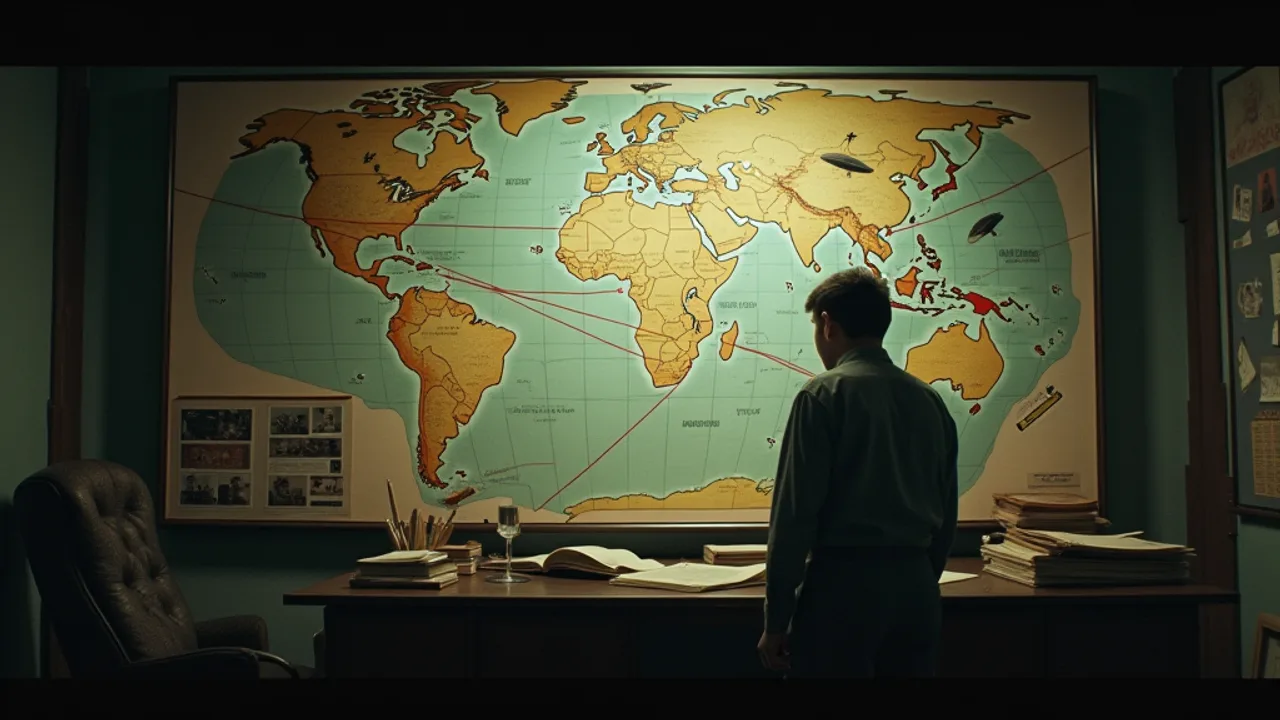 AI illustration
The usual problem with the “UFOs are really paranormal / occult” argument is who makes it. It tends to arrive from people with an obvious stake in the supernatural being true. Jacques Vallée is the exception that makes the idea hard to wave away, because nothing about his résumé wants it to be true.
He has a master’s in astrophysics and a doctorate in computer science. As a young astronomer at the Paris Observatory he helped compile one of NASA’s first detailed maps of Mars. He later worked under Douglas Engelbart at SRI and was a principal investigator on one of the early networked-conferencing systems built on top of the ARPANET, the proto-internet. Steven Spielberg used him as the model for Claude Lacombe, the French scientist played by François Truffaut in Close Encounters of the Third Kind. This is not a man who needs the cosmos to be enchanted.
And his conclusion, after decades inside the data, is stranger than either camp’s: the UFO is real, it is not a hoax, and it is almost certainly not a spaceship from another planet.
Magonia: the phenomenon is not new
Vallée’s 1969 book Passport to Magonia made the case that the modern UFO encounter is a very old story wearing new clothes. The title comes from a real ninth-century complaint by Agobard, Archbishop of Lyon, about a peasant belief he wanted stamped out: that “there is a certain region, which they call Magonia, whence ships sail in the clouds” to carry off the fruits of the earth. Cloud-ships and sky-people, a thousand years before radar.
The book lines up modern abduction reports against the European fairy-faith and finds the same furniture in both:
- The taboo on their food. In the fairy tradition, “once they take you and you taste food in their palace you cannot come back.” Abductees report the same instinctive refusal.
- Lost time. A Welsh account has a man insisting he was gone three hours; he is told, “Three weeks? Is it three weeks you call three hours?” The missing-time motif is the spine of the abduction era.
- The taken ones. Of the fairy “Gentry”: “They take young and intelligent people who are interesting.” Selection, not randomness.
- Paralysis. In the 1965 Valensole case, farmer Maurice Masse reported that one of the beings pointed a small tube at him and he “found himself suddenly incapable of movement.” The standard freeze of a thousand later reports.
Same encounter, same rules, different century’s vocabulary. Where a medieval peasant met the Good Folk and a Marian visionary met the Virgin, the twentieth-century witness meets a Grey and a saucer. Vallée’s point is not that fairies were aliens. It is that something keeps producing the same shape of experience and letting each age name it.
The control system
By 1975, in The Invisible College, Vallée had a name for that something. He wrote, plainly:
“I propose to examine the hypothesis that UFOs may constitute a control system; that they are not necessarily caused by extraterrestrial visitors, nor the result of misidentifications and hoaxes on the part of deluded witnesses.”
His analogy was a thermostat. A thermostat does not care about temperature; it sits in a feedback loop and nudges a system back toward a set point. UFOs, he suggested, might do that to human belief:
“Similarly, UFOs may serve to stabilize the relationship between man’s consciousness needs and the evolving complexities of the world which he must understand.”
The later chapters are titled, without irony, “The Schedule of Reinforcement” and “The Conditioning of Homo Sapiens.” The framework is operant conditioning. Whatever the phenomenon is, it behaves less like an expedition and more like a teacher, delivering experiences absurd enough to resist proof, spaced out enough to keep a culture leaning in, shaping what humans are ready to believe. The horror of the idea is that it implies we are being trained, and have no access to the trainer.
Why he rejected the spaceship too
This is the part that keeps Vallée from being a simple mystic: he turned the same skeptical knife on the alien hypothesis. In a 1990 paper for the Journal of Scientific Exploration, “Five Arguments Against the Extraterrestrial Origin of Unidentified Flying Objects”, he argued the nuts-and-bolts model fails on the evidence’s own terms. Close encounters are far too numerous to be any sane survey of one planet. The reported “aliens” are suspiciously humanoid and ill-suited to actual space travel. The “experiments” make no scientific sense. The phenomenon runs through all of recorded history. And its apparent command of space and time points at something “radically different and richer” than a ship crossing a distance.
He is, in other words, a double heretic, too rigorous for the believers, too willing to take the data seriously for the debunkers. That is exactly why his position is the one worth sitting with.
The bridge, and the catch
Vallée is the cleanest hinge between the occult tradition and the modern disclosure conversation, because he refuses to keep them in separate rooms. To him the fairy abduction, the Marian apparition, the demonic incubus, and the bedroom Grey are one data stream, mis-sorted by the prejudices of each era. In Messengers of Deception (1979) he went further and walked into the UFO-contact cults directly, Raël, the group that became Heaven’s Gate, the “Order of Melchizedek”, and described their recruiting as “waves of tepid, pseudo-scientific prose” designed to lull people into a “semi-somnambulist state.” The control system, in that book, has very human operators willing to ride it.
The honest catch is the one Vallée never closes. A control system implies a controller, and he never names one, not aliens, not spirits, not a government, not God. The thesis explains the shape of the phenomenon beautifully and its source not at all. (And his more recent, unverified claim to hold proof that the CIA faked some abductions as psychological warfare, evidence he won’t show anyone, is a reminder that even the field’s most careful mind is not immune to the field’s worst habit.)
But that open end is also why Magonia outlasts the spaceship story. “It’s aliens” is an answer that the evidence keeps embarrassing. “It’s a recurring control system we don’t have the vocabulary for” is not an answer at all, it is a description of the discomfort, written down by the one person in the room with no reason to want it true.
Every new case, scored the same way
One email when a case file lands, with its Signal-Strength score and what would move it. No hype, no 'BREAKING', and every claim carries its source. Unsubscribe anytime.
Sources
- [1] Jacques Vallée, Wikipedia (biography)
- [2] Jacques Vallée, Passport to Magonia (1969 / 1993 ed.), full text, Internet Archive
- [3] Jacques Vallée, The Invisible College (1975), full text, Internet Archive
- [4] Jacques Vallée, "Five Arguments Against the Extraterrestrial Origin of UFOs," Journal of Scientific Exploration 4(1), 1990
- [5] "Five Arguments…", academic record, Semantic Scholar
- [6] Magonia Magazine, review of Messengers of Deception (Order of Melchizedek)
Read next
More Esoterica →
DMT Entity Contact: The Most Repeatable Encounter Report in the Field
Thousands of people describe meeting the same kinds of beings, on schedule, under laboratory conditions. That is either the strongest contact data we have or the clearest proof that consistency is not corroboration.
'Taken' at 24: The 2002 Spielberg Abduction Series That Now Reads Like a 2026 Briefing
Steven Spielberg Presents Taken, a 20-hour, Emmy-winning miniseries from 2002 about Roswell, a hidden government program, and a multi-generational hybrid breeding project, now lines up unnervingly well with what whistleblowers are telling Congress in 2026. We score it element by element: where the fiction matches the current claims, where it's still pure TV, and the uncomfortable possibility nobody raises, that the resemblance runs backwards.
The Office Against the Ships of the Air
A work of fiction built on a real silence. Medieval sources describe ships sailing on the clouds: Agobard of Lyon in 815, Irish annal-keepers in the 740s, Gervase of Tilbury around 1211, and a Norse king's mirror that puts an anchor in the church door at Clonmacnoise. Not one of them records what the priest was supposed to say. We wrote the rite that is missing, labelled every line of it as ours, and then explained why it would not have worked.
Follow the thread
New disclosure reporting, physics breakdowns, and case files, in your inbox. Sources or it didn't happen. No spam, unsubscribe anytime.