The Office Against the Ships of the Air
A work of fiction built on a real silence. Medieval sources describe ships sailing on the clouds: Agobard of Lyon in 815, Irish annal-keepers in the 740s, Gervase of Tilbury around 1211, and a Norse king's mirror that puts an anchor in the church door at Clonmacnoise. Not one of them records what the priest was supposed to say. We wrote the rite that is missing, labelled every line of it as ours, and then explained why it would not have worked.
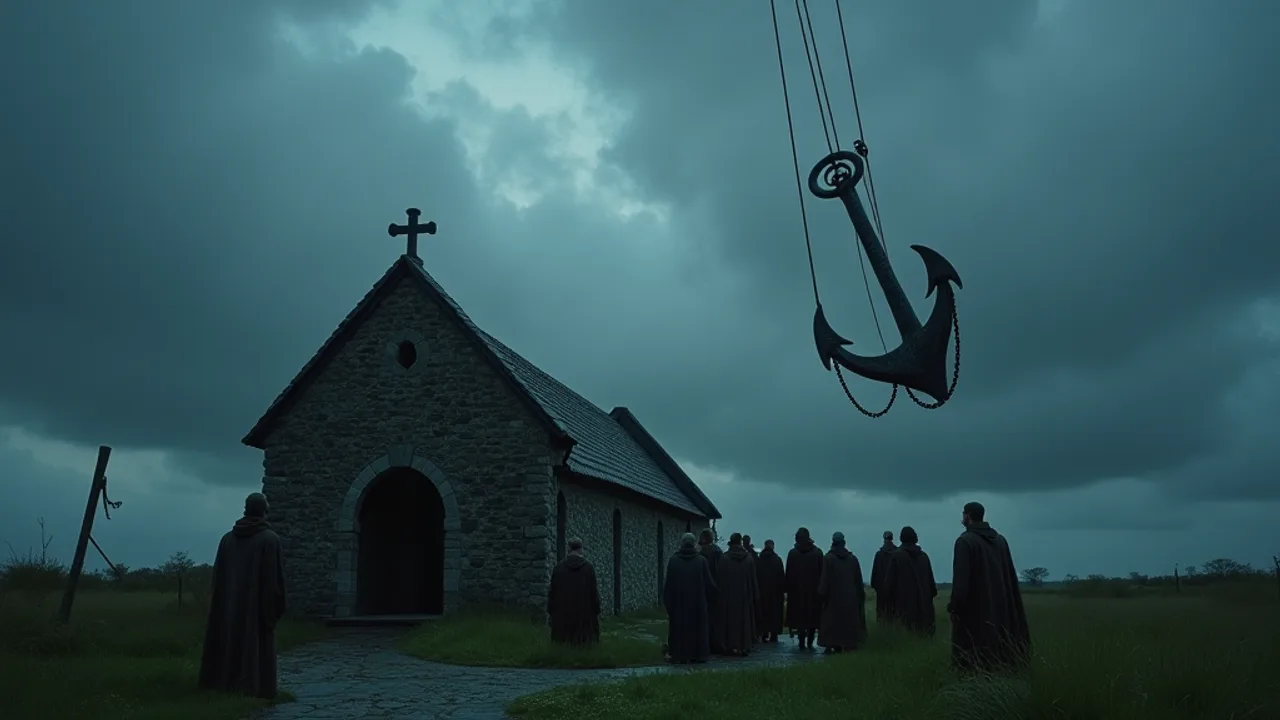 AI illustration
The Office Against the Ships of the Air is a piece of fiction published by NHIAnomalous on September 17, 2026. It is an invented medieval rite written to fill a real gap: medieval sources such as Agobard of Lyon's De Grandine et Tonitruis (c. 815), the Irish annals for the 740s, Gervase of Tilbury's Otia Imperialia (c. 1211) and the Norse Konungs skuggsjá describe ships sailing in the air, but none preserves a liturgy against them. The rite in this piece is not a medieval text, does not come from any manuscript, and should not be quoted as one.
This is fiction. The ships in the clouds are in real medieval texts, and those texts are linked below. The rite is not. Every line inside a labelled box on this page was written in 2026, by us. The coda lists what is real and what is not.
I. The gap
Around the year 815, the Archbishop of Lyon sat down to write a complaint about his own flock.
Agobard was a practical, irritable, intelligent man, and the thing that irritated him was hail. Specifically, what his people believed about hail. In a short treatise, De Grandine et Tonitruis, “On Hail and Thunder”, he reported that ordinary Christians in his diocese believed in a country called Magonia, from which ships sailed on the clouds. The sailors, they said, paid the local weather-workers, the tempestarii, to knock down the crops with storms, and then carried the fallen grain away to their own land.
Agobard did not report this as a curiosity. He reported it because it was dangerous. He described four people, three men and a woman, who had been kept in chains for days and were shown to a crowd as sailors who had fallen out of these ships. The crowd wanted them stoned. Agobard argued, and the people who had put them on show were, in his word, confounded. The four lived.
He wrote a great deal about why the belief was false. He wrote nothing at all about what the local priest was supposed to do if a ship did come.
That is the gap. It is not only Agobard’s. Irish annal-keepers, under the 740s, wrote a single flat line: ships with their crews were seen in the air. A later Irish text adds a sailor who comes down after a spear and cries out that he is drowning. Around 1211 Gervase of Tilbury, an Englishman at an imperial court, tells of an anchor that caught in a churchyard and a sailor who climbed down to free it and died, suffocated, in our thicker air. A thirteenth-century Norwegian book, the Konungs skuggsjá, the King’s Mirror, puts the same anchor in the church door at Clonmacnoise, and has a bishop step in to stop the congregation holding the sailor, because he would die as if held underwater.
Four sources, five hundred years, and in every one of them the ship arrives at a church. In none of them does anyone say a word of liturgy. The Church of the Middle Ages had blessings for bells, for boats, for bread, for fields, for weather. It had prayers against hail. If there was ever an office against the ships of the air, nobody wrote it down.
So we did.
II. The rite
What follows imitates the shape of a medieval blessing, a rubric in plain instructions and the words to be said, in English. It is not a translation. There is no Latin original. It does not come from a manuscript.
i When a ship is seen upon the clouds above the parish, let the priest not run, and let him not suffer the people to run, for a people running is a people that will throw stones.
ii Let the great bell be rung once only, and then be silent, so that those above may know that they are seen, and those below may know that they are counted.
iii Let the priest go out before the door of the church, and not beyond it, and say:
iv You who sail where no keel was cut, and ride on water that does not wet: this ground is given. Its grain is given. It was given before you came, and it is not yours to take.
v If you are hungry, say so, and bread will be set on the wall. If you are lost, say so, and the road will be shown. If you have come to take, the hail is not yours to command, and the men who told you it was have sold you a thing they do not own.
vi If an anchor comes down, let no man cut the rope, and let no man pull upon it, and let no man make it fast to any stone or post.
vii If a sailor comes down the rope, let no man lay hands on him. Let the priest say:
viii Our air is thick to you as the sea is thick to us. Stay no longer than a held breath. Take what you came down for, and go up.
ix And if the sailor cannot go up, and falls, and lies upon the ground, let the priest remember that the man who lies there is a man, whatever ship he fell from. Let him be carried into the church and not onto the road. Let no one bring a stone within the churchyard for three days.
x If any in the parish say that such a one was seen falling from the clouds, and bring him bound, and ask that he be stoned, let the priest ask to see where he fell, and ask who saw it, and ask them one by one and not together, and write each answer down.
xi And if the answers do not agree, let the bound one be loosed.
xii When the ship is gone, let the bell be rung three times, and let the people go home, and let no one speak of it at the market for seven days, so that the story may cool before it is sold.
III. What the rite is actually about
Read it again and notice where the words go.
Three verses are spoken to the ship. The other nine are instructions for the parish.
That is deliberate, and it is the only honest way we could find to write this. Every real medieval source about the cloud-ships is, underneath, a story about what the people on the ground did. Agobard’s crowd chains four strangers and wants to kill them. The Irish sailor is held fast by a man on the ground. Gervase’s sailor is seized and dies in his captors’ hands. The Norwegian bishop has to step in to stop his own congregation. The ship never does anything violent in any of these texts. The villagers always nearly do.
So an office against the ships of the air, if a sensible bishop had ever written one, would have been an office against the parish. It would have been a procedure for slowing down a frightened crowd. Ring the bell once, so that everyone looks up instead of running. Do not touch the rope. Carry the fallen one inside. Take the witness statements separately, and write them down, and if they do not agree, let the prisoner go.
That last instruction is the one we are proudest of, and the one we most want to be clear we invented. It is not in Agobard. It is simply what Agobard did, turned into a rule: he refused to accept the crowd’s story until he had tested it, and when it failed the test, four people went home alive.
IV. Why it would not have worked
The fantasy of a rite is that it acts on the thing outside. This one would have failed at that, for the simplest possible reason. There were no ships.
Agobard did not think so, and he was right. What the people of Lyon were facing was hail, a violent and ordinary weather event that could destroy a year’s food in ten minutes, and a local economy of men who claimed they could cause it or prevent it and took payment either way. The cloud-ship was the explanation that made the loss someone’s fault, and a fault can be punished, which weather cannot.
The Clonmacnoise anchor is harder to explain away and easier to explain. It travels. Irish annal, Irish wonder-tale, English courtier, Norwegian royal handbook, and then, in 1897, a Texas newspaper story about an airship trailing an anchor on a rope past a crowd of churchgoers, during the great American airship wave. The same tale, retold for each new century’s idea of a flying machine, is the pattern Jacques Vallée built a career on in Passport to Magonia, and it is the reason this site treats folklore as data about people rather than data about craft. See Vallée and the control system.
So the rite, as a weapon against the sky, is worthless. As a procedure for the ground, it is almost boringly good advice, and it is the same advice we would give today to anyone who thinks they have seen something: ring the bell once, do not touch anything, write down each witness separately, and do not sell the story at the market until it has cooled.
Coda: what’s real, and what isn’t
Real. Agobard, Archbishop of Lyon, wrote De Grandine et Tonitruis around 815. In it he reports a popular belief in Magonia, a land from which ships sail on the clouds, whose sailors pay weather-workers called tempestarii and carry off crops beaten down by storms. He describes four captives, three men and a woman, shown to a crowd as people fallen from those ships, and says the crowd intended to stone them until the claim was argued down. Irish annals record ships with their crews seen in the air, under years given variously as 743, 744 or 748 to 749. A later Irish text has an aerial sailor who comes down after a thrown spear and cries that he is drowning. Gervase of Tilbury’s Otia Imperialia, around 1211, tells of an anchor caught in a British churchyard and a sailor who died, suffocated in our air, after climbing down. The Norwegian Konungs skuggsjá sets the anchor in the church door at Clonmacnoise and has a bishop warn that the sailor would die as if held underwater. A Texas newspaper reported a similar airship-anchor story in 1897. Medieval Christianity really did have blessings for bells, fields and weather, and prayers against hail.
Not real. The rite. All twelve verses, the rubrics, the bell rung once and three times, the three days without stones, the seven days of silence at the market, the rule about separate witnesses. None of it comes from any manuscript, liturgy, or grimoire. There is no Latin original and there is no source to find. If you see these words quoted anywhere as medieval, they came from this page.
Worth saying plainly. The most dangerous object in every one of these stories is not in the sky. It is the stone in a frightened person’s hand, and it is the person who has been paid to tell the crowd where to throw it.
Every new case, scored the same way
One email when a case file lands, with its Signal-Strength score and what would move it. No hype, no 'BREAKING', and every claim carries its source. Unsubscribe anytime.
Sources
- [1] Magonia (mythology), Wikipedia (Agobard of Lyon, De Grandine et Tonitruis, c. 815)
- [2] Airship of Clonmacnoise, Wikipedia (Irish annals, Book of Ballymote, Gervase of Tilbury, Konungs skuggsjá)
- [3] Agobard of Lyon, Wikipedia
- [4] Gervase of Tilbury, Wikipedia
- [5] Konungs skuggsjá, Wikipedia
- [6] Jacques Vallée, Passport to Magonia (1969), Wikipedia
Read next
More Fiction, maybe? →
Passport to Magonia: The Scientist Who Said the UFO Is a Control System
Jacques Vallée helped build the early internet, mapped Mars for NASA, and was the model for the French scientist in Close Encounters. He is also the man who argued the UFO is neither alien spacecraft nor hoax, but a recurring control system that has worn fairy lore, religious apparitions, and now starships as its costume. It is the most serious version of the occult reading, precisely because it comes from the least occult person in the field.

The Sixth Tranche
A work of fiction. The Pentagon has published five tranches of UAP files at war.gov/ufo, with dates and locations redacted to protect witnesses, and says more are coming. This story imagines the sixth, and the volunteer archivist who mirrors it at two in the morning and finds one file whose metadata does not agree with the others. No sixth tranche had been published when this was written. Everything about it below is invented.
Basilides, Exegetica, Book Thirteen
He wrote twenty-four books in Alexandria around the year 130. We have a page and a half, quoted by men who were refuting him. The most disturbing idea attributed to him is that ignorance is installed on purpose, as an act of mercy. This is the middle book, invented, arguing that case.
Follow the thread
New disclosure reporting, physics breakdowns, and case files, in your inbox. Sources or it didn't happen. No spam, unsubscribe anytime.