The Six Lost Pages of Mary
The Gospel of Mary opens mid-sentence, because its first six pages are missing, and it drops out again in the middle of the soul's ascent, because four more are. An invented reconstruction of both gaps, written to dovetail into the surviving lines exactly where they resume.
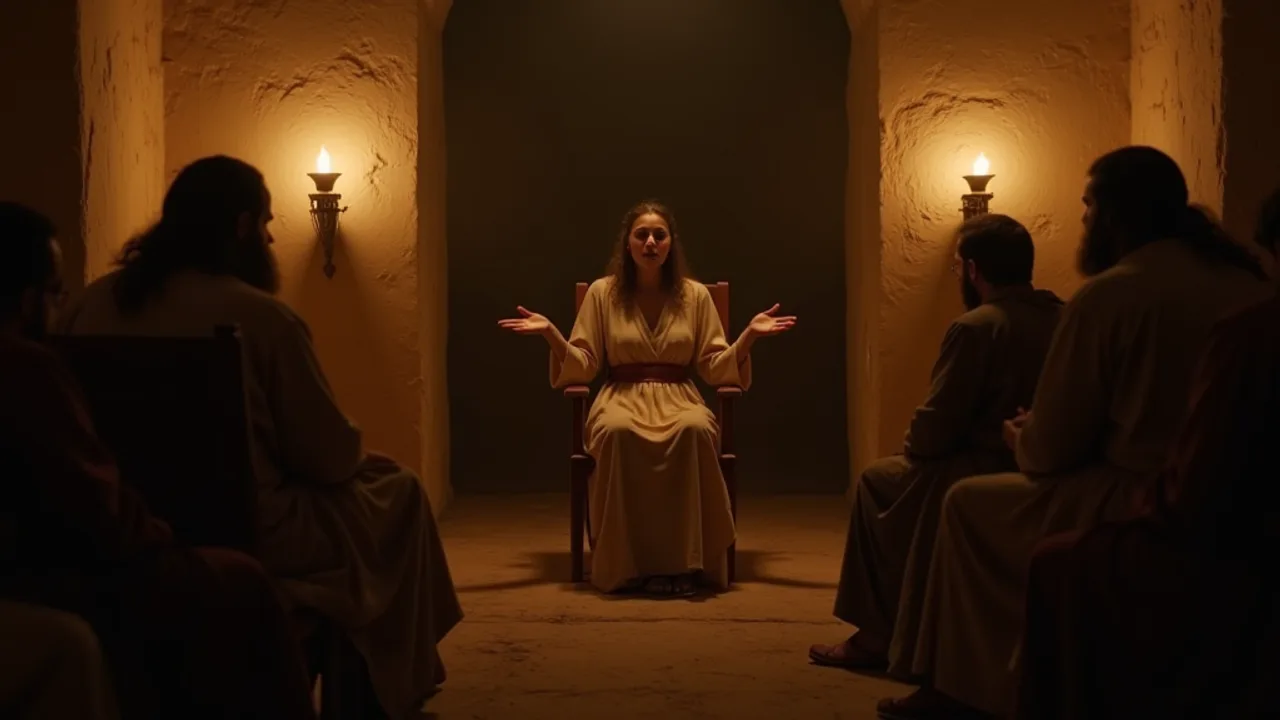 AI illustration
This article is fiction. The Gospel of Mary really does survive with pages 1 to 6 and 11 to 14 missing from the Berlin Codex, roughly ten of nineteen pages, so the text begins and resumes mid-sentence. The passages filling those gaps below were written for this article and are not translations of any manuscript.
The hole
The Gospel of Mary is the most quoted gnostic text that almost nobody has read to the end, for the excellent reason that there is no end, and no beginning either.
It reached us in a small Coptic codex bought in Cairo in 1896, catalogued as Papyrus Berolinensis 8502, which then spent half a century getting delayed by war, water damage and the death of its editor before publication in 1955. Of the gospel’s nineteen pages, ten are gone. Pages 1 to 6 are missing outright, so the text begins in the middle of an answer, with a question we cannot see. Pages 11 to 14 are missing too, and they fall in the worst possible place, inside Mary’s account of the soul’s ascent past the powers, so we lose the first rungs of the ladder and rejoin the climb already in progress.
What survives is roughly this. The Savior finishes teaching, tells the disciples not to lay down rules beyond what he gave them, and departs. They are frightened. Mary steadies them. Peter asks her to tell them what the Savior said to her that he did not say to the others. She describes a vision, and a conversation with the soul as it rises and is challenged at each level. Then the gap. Then the soul against Ignorance, and against Wrath in its seven forms, and free. Then Andrew objects that this does not sound like the Savior. Then Peter, less politely, asks whether the Savior really spoke privately with a woman. Levi tells Peter he has always had a temper, and says that if the Savior made her worthy, who is Peter to reject her.
Two small Greek fragments, one from Oxyrhynchus and one in Manchester, prove the text circulated in Greek in the third century and that the Coptic is a translation with variants. They do not fill the gap. Nothing fills the gap.
So we know how the argument ended. We do not know what was said in the room before the argument started.
The reconstruction, part one: the missing opening
The surviving manuscript picks up in the middle of a reply, at the question of whether matter is destroyed. Our invention runs up to that seam and stops there, so the last invented line hands off to the first real one.
1 [ opening lines lost ] and they were gathered in the upper room, and the door was shut, not for fear of the crowd but for fear of what they had begun to understand.
2 And he came and stood among them and they did not at first know him, for he was not wearing the body they had buried, but the body they had been promised, and the two do not resemble one another as a man resembles his portrait. They resemble one another as a note resembles the string.
3 Peter said: Teacher, we have been afraid.
4 He said: You have been afraid correctly. Fear is a true instrument that has been given a false object. You fear the loss of the thing you were told you are.
5 [ approx. 6 lines lost ] for whoever seeks the kingdom in a place will find a place, and will build there, and will set a man at the door of what he built, and that man will be the first of the powers.
6 Levi said: Then where is it?
7 He said: You are asking where with a mouth that was made for asking where. Ask instead what is unbroken in me, and follow it, and it will not lead you outward.
8 And Mary said nothing, and he looked at her, and she was not comforted, because she had understood him, and understanding is not a comfort. It is a debt.
9 Andrew said: Teacher, if the world is the work of the powers, is the world then evil, and are we to hate it?
10 He said: The prisoner who hates the wall has still given his life to the wall. Do not hate it. Learn where it is thin.
11 [ approx. 11 lines lost ] He said: There is no sin as they teach it to you, as a stain upon a cloth. There is only the mixing, and what is mixed suffers because it wants to be one thing and is made two.
12 And Peter said: Will matter then be destroyed, or not?
Here the surviving manuscript begins.
The reconstruction, part two: the four pages inside the ascent
The second gap costs us the beginning of the soul’s climb. The text returns with the soul answering Ignorance, so at least one earlier power, and probably more, stood on the lost leaves. Scholars differ on how many. We have written three.
1 [ beginning of the ascent lost ] And the first power met the soul and said: Where are you going, so quickly, and with such a face?
2 And the soul answered: I am going out of a house I did not build, past a guard I did not hire.
3 The first power is called Weight. It said: You are heavy. Everything you have carried is written on you, and I read it, and by my reading you may not pass.
4 The soul said: You have read a list of what was done to me and called it my name. I set it down. I was never the list.
5 And Weight had nothing further, for it holds only what agrees to be held, and the soul went up.
6 The second power met it, and it is called Custom, and it wears the faces of the dead who loved you. It said: This is not done. Your mother did not do this. Come back and be as you were given.
7 And the soul said: You are the shape of the road, and I have thanked the road, and I am leaving it. What was given to me was a direction, not a fence.
8 [ approx. 14 lines lost ] and the third power said: I am Witness, and I record. Whatever you say above, I will say below, and they will laugh at you in the place where you must live.
9 And the soul said: You are the last honest power, for you do not lie about what you are. You are the fear of the eyes of others, and you are the strongest of them, and you are already behind me, and that is your whole undoing. You may only be met from in front.
10 And the soul went up, and the fourth power took the seven forms, and the first form is darkness [ the manuscript resumes ]
What we invented, and what we did not
Attested and sourced above: the Berlin Codex, the missing pages 1 to 6 and 11 to 14, the mid-sentence opening on the question of matter, the ascent past the powers with the fourth power appearing in seven forms of which the first is darkness, the confrontation between Peter and Mary, and Levi’s defence of her. The Greek fragments are real, and they matter, because they demonstrate the text is a translation of something older and that variants existed. That is the strongest argument in the real scholarship, and it is not ours.
Extrapolated: the upper room, the shut door, the personalities. Peter is impatient in the surviving text, and Levi does call him out for it, so writing them that way earlier is inference, not invention. The soul’s dialogue form, challenge and answer at each level, is exactly how the surviving ascent runs.
Invented outright: every line inside the two blocks. The powers Weight, Custom and Witness do not exist in the manuscript, in any manuscript, or in any patristic report of one. We named them. The line about the wall being thin is ours. The image of the risen body as a note rather than a portrait is ours.
What the invention argues: the surviving text ends in a dispute about whether a woman’s private revelation counts as evidence. So we wrote the missing ascent to end on a power whose entire strength is the fear of being laughed at by people you know, and which can only be met face on. The gospel we actually have is a document about testimony being refused for reasons that have nothing to do with the testimony. We wrote the missing pages to be about the same thing, because that is what the surviving half is already about, and because it is still the shape of every disclosure fight going. Read the last page of the real text and then read a modern whistleblower hearing transcript. The staging is identical, down to who is asked to leave the room.
Every new case, scored the same way
One email when a case file lands, with its Signal-Strength score and what would move it. No hype, no 'BREAKING', and every claim carries its source. Unsubscribe anytime.
Sources
Read next
More Fiction, maybe? →
The Ophite Diagram: The Gate Passwords
A second-century sect drew a map of the levels above the world and wrote out what you say to the thing guarding each one. We only have it because a pagan critic described it in order to mock it, and a Christian critic quoted the mockery in order to answer it. Here is the document itself, invented.
The Lost Leaves of Codex XIII
Codex XIII survives as eight leaves someone tore out and hid inside the cover of another book. They are numbered 35 to 50, which means thirty-four pages are simply gone. This is an invented reconstruction of what stood on them, and of a fourth descent the real text never got to make.
The Office Against the Ships of the Air
A work of fiction built on a real silence. Medieval sources describe ships sailing on the clouds: Agobard of Lyon in 815, Irish annal-keepers in the 740s, Gervase of Tilbury around 1211, and a Norse king's mirror that puts an anchor in the church door at Clonmacnoise. Not one of them records what the priest was supposed to say. We wrote the rite that is missing, labelled every line of it as ours, and then explained why it would not have worked.
Follow the thread
New disclosure reporting, physics breakdowns, and case files, in your inbox. Sources or it didn't happen. No spam, unsubscribe anytime.