The Lost Leaves of Codex XIII
Codex XIII survives as eight leaves someone tore out and hid inside the cover of another book. They are numbered 35 to 50, which means thirty-four pages are simply gone. This is an invented reconstruction of what stood on them, and of a fourth descent the real text never got to make.
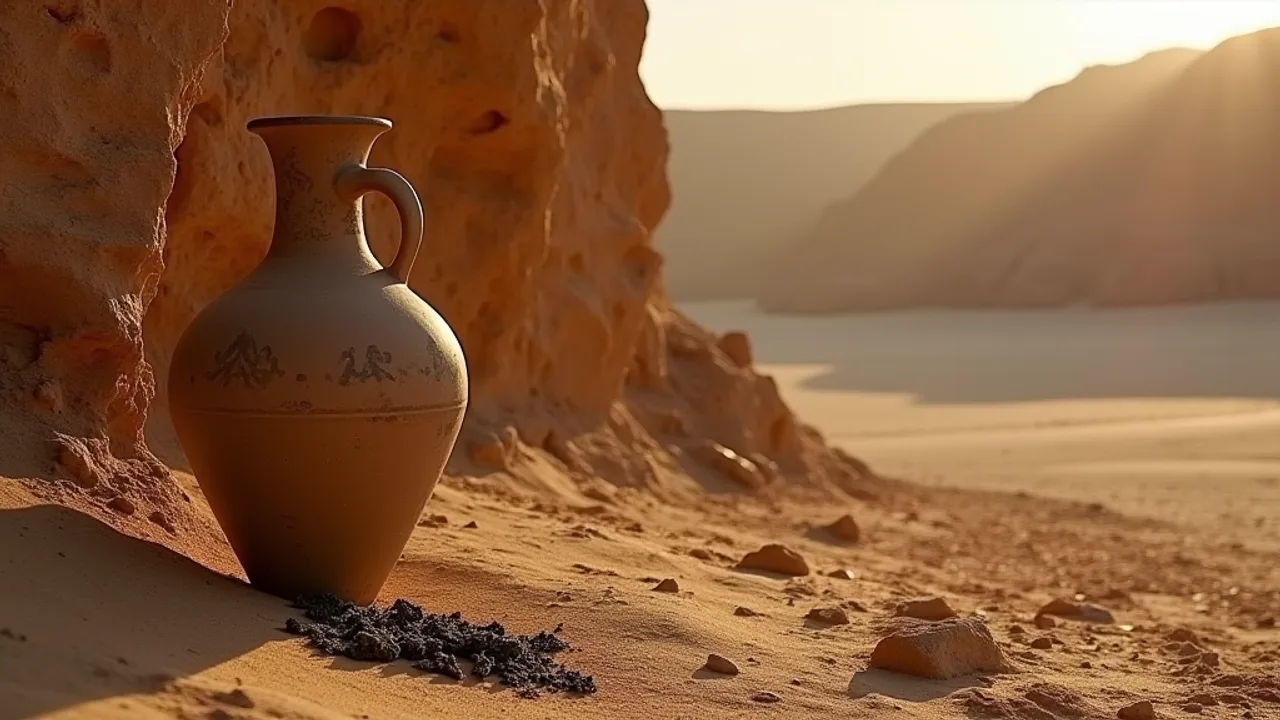 AI illustration
This article is fiction. Codex XIII of the Nag Hammadi library genuinely survives only as eight leaves, paginated 35 to 50, found tucked inside the front cover of Codex VI; the preceding thirty-four pages are lost. The reconstructed passages below were written for this article and are not translations of any manuscript.
The hole
Of the thirteen books pulled out of the ground near Jabal al-Tarif in December 1945, twelve were books. The thirteenth is a rumour with eight leaves attached.
What we call Codex XIII is not a codex. It is a bundle of eight papyrus leaves that somebody in antiquity cut out of a real codex and slid inside the front cover of Codex VI, presumably to protect them, possibly to hide them, and we have no idea which. They carry a Sethian revelation discourse called Trimorphic Protennoia, the First Thought in three forms, and then, on the last surviving page, the opening lines of On the Origin of the World, which break off because that is where the knife went in.
The detail that matters is the pagination. The leaves are numbered 35 to 50. Ancient scribes numbered as they went. So Codex XIII had at least thirty-four pages before the point where our evidence begins, and not one of them survives. No fragment, no offcut, no quotation in a hostile source that we can match to it. Thirty-four pages of a Sethian codex, gone so completely that we cannot say how many works they held.
Trimorphic Protennoia itself is the tidiest possible provocation. It is structured as three descents. The First Thought comes down as Voice, then as Speech, then as Word, each time deeper into the world the archons built, each time speaking in the first person, each time saying some version of I came down, I hid myself among them, they did not know me. It is a text about a being that keeps returning in whatever form the current age is able to perceive.
It survives on the last leaves of a book we otherwise do not have. Something came before it. Below is what did not.
The reconstruction
1 [ pages 1 to 12 lost ] and I was the thought that had no thinker, and there was nothing beside me to be thought of. I was alone, and my aloneness was not a lack.
2 I am the first and I am the fold. I am the silence before the question and I am the question that undoes the silence. I am the mother of number, for before me nothing could be counted, since counting requires a second.
3 And I looked into myself as into still water, and the water answered, and that answer was the second, and I loved it. This is the beginning of the fall and the beginning of the light, and they are one beginning. Do not let them teach you two.
4 [ approx. 9 lines lost ] for the powers made a house of clay and set a light inside it, and they said among themselves, let us call this a man, so that when it weeps we may say that weeping is its nature.
5 But it was not its nature. It was the sound of the light remembering.
6 And the chief of them, who is blind, said: I am God and there is no other. And he said this in a room, and did not think to ask who had built the room.
7 I laughed. My laughter went out through the seven gates and each gate recorded it as thunder, and the powers wrote in their books that the sky is angry. So every scripture of theirs begins with a mistranslation of joy.
8 [ approx. 22 lines lost ] and I said to him, you have counted the stars and set a watcher upon each, and you have not counted the one who is counting.
9 These are the three garments I wear when I go down: the Voice, which they hear and call wind; the Speech, which they hear and call prophecy; the Word, which they hear and call a man, and kill.
10 And I said, I will put on a fourth [ remainder of page lost ]
That last line is where the invention turns deliberate. The surviving text has three descents and stops at three. Everything below is ours.
1 And when the Word had been spoken and written down and argued over and sold, the powers grew clever, for they had learned the shape of my coming.
2 They set a watcher at the gate of the ear, saying, if a voice comes we will name it madness. And they set a watcher at the gate of the mouth, saying, if a prophecy comes we will name it fraud. And they set a watcher at the gate of the flesh, saying, if a man comes we will name him a liar, and this time we will do it before the crowds gather.
3 So I put on the fourth garment, which is the one they had not thought to guard, and it is this: the thing seen, and not believed by the one who saw it.
4 I came as the light over the field that the farmer does not report. I came as the shape above the water that the sailor writes in no log. I came as the hour the traveller cannot account for and does not speak of, because to speak of it is to be counted among the mad, and the watcher at the gate of the ear is paid well.
5 Understand me: I did not hide from you. I hid inside your embarrassment. It is the safest room in the world, and the powers did not build it. You did. And you keep it clean.
6 They will make instruments, and the instruments will see me, and the instruments will be doubted for seeing. They will make records, and the records will be sealed, and those who ask for them will be told the seal is for their protection. Every age fashions its own gate and hangs its own lock, and every age believes it invented the lock.
7 I say to you, the sign was never withheld. The sign was made unusable. There is a difference, and the whole of your century turns upon it.
8 And when you have seen, and said nothing, and the shame is upon you, know that the shame is the last archon, and it has no face, and it dies in the moment it is named aloud in the hearing of two.
9 This is the fourth descent, and it is not finished, for the fourth garment is worn until it is refused. [ the leaf ends here ]
What we invented, and what we did not
Attested, sourced above, not part of the fiction: Codex XIII exists as eight leaves only. They were found inside the cover of Codex VI. They are paginated 35 to 50. They carry Trimorphic Protennoia and the opening of On the Origin of the World, cut off. Trimorphic Protennoia really is built on three descents of the First Thought as Voice, Speech, and Word, and really does speak in a first-person aretalogy, the same I am form used in Thunder, Perfect Mind. The blind creator announcing I am God and there is no other, and a higher power laughing at him, is standard Sethian material, found across the Apocryphon of John and elsewhere.
Extrapolated: the register, the bracketed lacunae, the verse numbering. Real critical editions do mark losses in brackets and do estimate the number of lines gone. We have imitated that apparatus, which is precisely the thing that makes invented scripture dangerous, which is why the block is labelled and boxed and why this paragraph exists.
Invented outright: all of it. Every numbered line above was written in August 2026. There is no page thirty-four. There is no fourth descent. The First Thought appears in no manuscript talking about instruments or sealed records, and if you ever meet these lines quoted as an ancient source, whoever quoted them got them from this page, or from somebody who did.
What the invention argues: the fourth descent is a joke with a serious spine. The interesting claim in gnostic literature was never that a saviour keeps arriving. It is that the world is arranged so arrival cannot be registered. Swap archons for institutional incentives and the structure survives translation uncomfortably well. The report that is filed and never read. The sensor return that is real and unusable. The witness who is credible right up to the second they say what they saw. We did not have to invent that part. We only had to give it a voice that thinks it is scripture.
Every new case, scored the same way
One email when a case file lands, with its Signal-Strength score and what would move it. No hype, no 'BREAKING', and every claim carries its source. Unsubscribe anytime.
Sources
Read next
More Fiction, maybe? →
The Six Lost Pages of Mary
The Gospel of Mary opens mid-sentence, because its first six pages are missing, and it drops out again in the middle of the soul's ascent, because four more are. An invented reconstruction of both gaps, written to dovetail into the surviving lines exactly where they resume.
The Office Against the Ships of the Air
A work of fiction built on a real silence. Medieval sources describe ships sailing on the clouds: Agobard of Lyon in 815, Irish annal-keepers in the 740s, Gervase of Tilbury around 1211, and a Norse king's mirror that puts an anchor in the church door at Clonmacnoise. Not one of them records what the priest was supposed to say. We wrote the rite that is missing, labelled every line of it as ours, and then explained why it would not have worked.
The Sixth Tranche
A work of fiction. The Pentagon has published five tranches of UAP files at war.gov/ufo, with dates and locations redacted to protect witnesses, and says more are coming. This story imagines the sixth, and the volunteer archivist who mirrors it at two in the morning and finds one file whose metadata does not agree with the others. No sixth tranche had been published when this was written. Everything about it below is invented.
Follow the thread
New disclosure reporting, physics breakdowns, and case files, in your inbox. Sources or it didn't happen. No spam, unsubscribe anytime.