The Alien in the Freezer: The Jonathan Reed Case, Examined
In 1996 a man calling himself Dr. Jonathan Reed said he killed an alien in the woods, filmed its body, and kept it in his freezer. The footage is still circulating. So is the long list of reasons almost no one believes him.
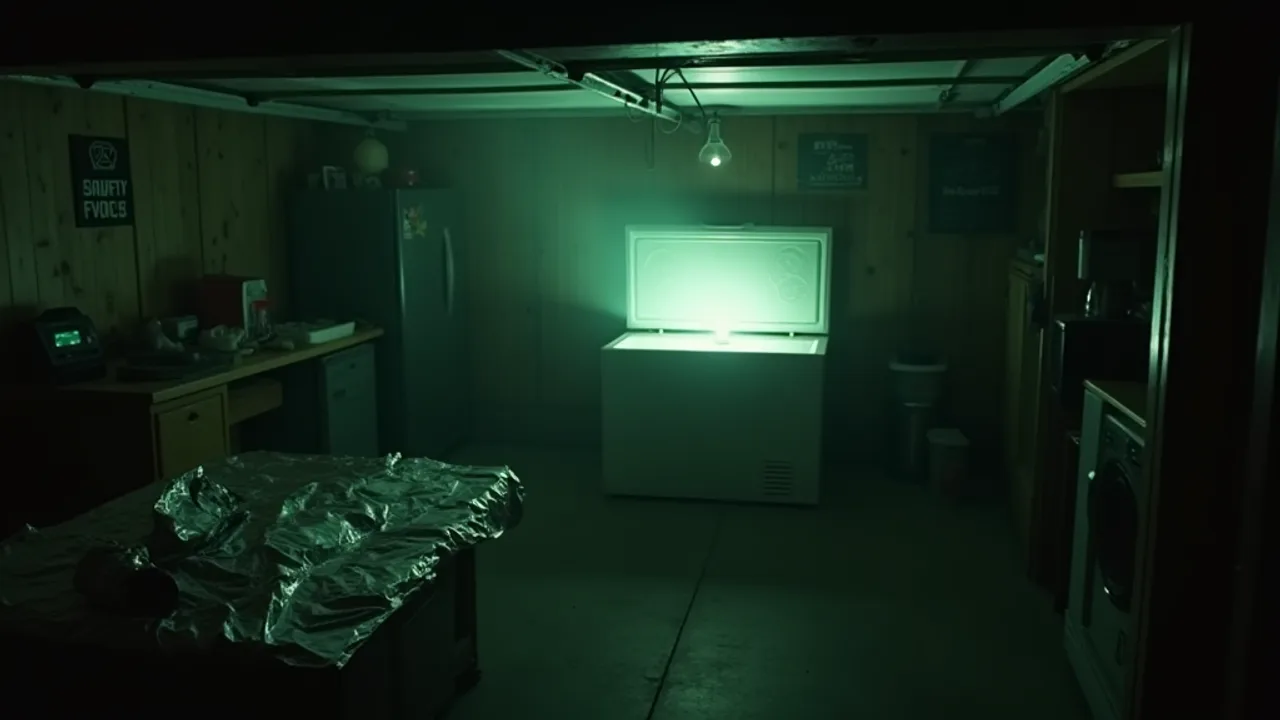 AI illustration
The 'Dr. Jonathan Reed' case is a 1996 story, promoted from 1998 onward, in which a man later identified as John Bradley Rutter claimed to have killed a small alien in the woods of Washington State and stored its body in his freezer. Investigators found the film stock and the vehicle he described did not exist until after the alleged encounter, that he had no medical credentials, that his partner said he never owned the dog central to the story, and that no physical evidence was ever produced. It is regarded, almost unanimously including within ufology, as a hoax.

Some hoaxes survive because they are clever. This one survived because the footage is genuinely disturbing, and because it arrived on the early internet years before anyone had assembled the reasons to disbelieve it. The video above is the reason you may already know this story. What follows is the rest of it.
The story he told
On October 15, 1996, a man who called himself Dr. Jonathan Reed said he was hiking in the forest east of Seattle with his dog when the dog ran ahead and confronted a small gray creature, roughly five feet tall, standing at the tree line. The being, he said, pointed a wand-like device and the dog was destroyed. Reed panicked, grabbed a tree branch, and struck the creature over the head, knocking it out. Nearby he claimed to film a floating black obelisk, a spacecraft, and to recover a metallic bracelet he called the “Link.”
Then the story turns domestic and strange. He said he carried the body home and put it in a chest freezer. Later it revived, he claimed, opening its eyes, moving, making sounds. He filmed it, nicknamed it, and eventually presented the material publicly, first on Art Bell’s Coast to Coast AM in November 1998, then at the International UFO Congress in 2000, then in a book, Link: An Extraterrestrial Odyssey. Government agents in unmarked white vans, he said, later seized the body and most of his evidence, and he spent about two years in hiding.
The images everyone remembers
Two frames from the footage have circulated for a quarter century, stripped of any context, on forums, YouTube, and TikTok.
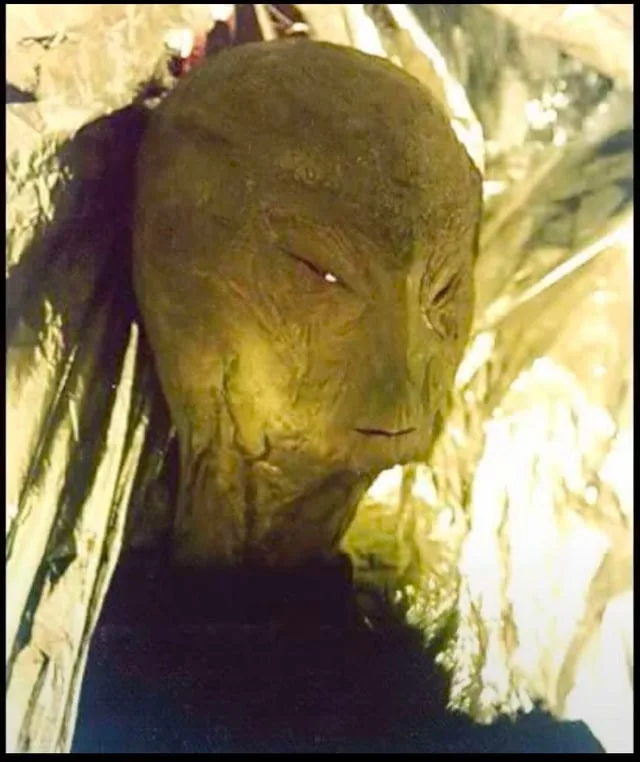
Still from the 1996 footage sold by “Jonathan Reed.” The face believers call too lifelike to be a puppet, and skeptics read as a sculpted mask. Shown here for commentary; widely regarded as a hoax prop.
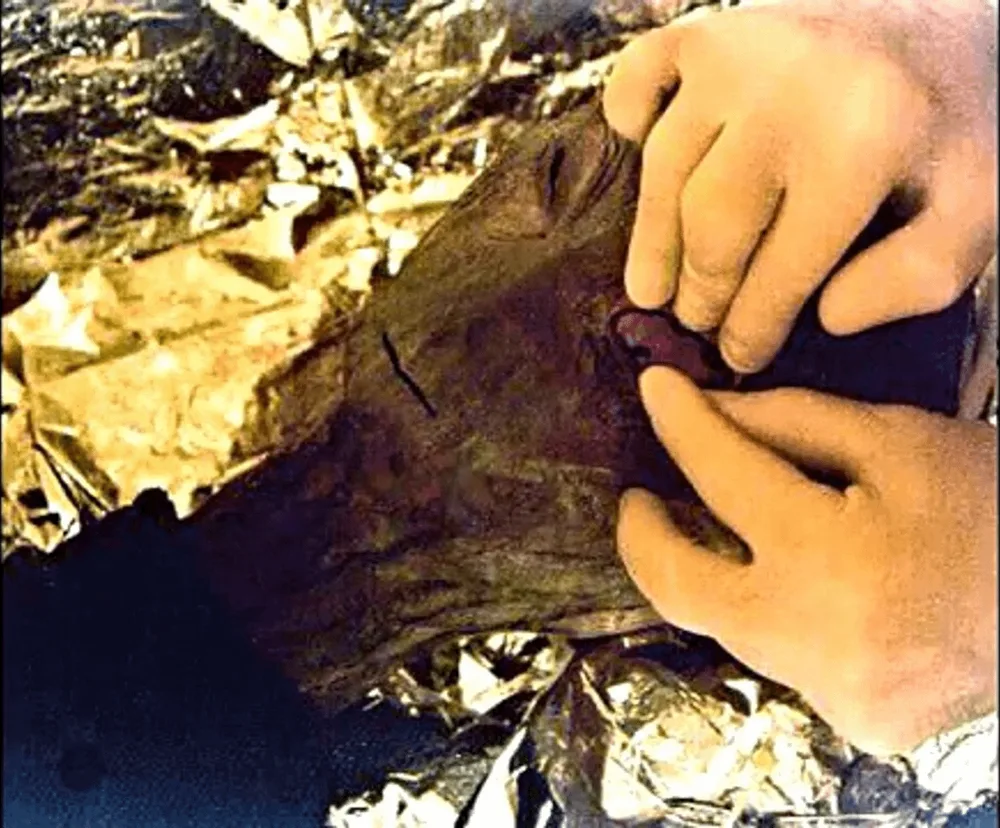
The “examination” footage: the body, part-wrapped in a foil emergency blanket, handled on camera. Still from the disputed 1996 material, shown for commentary.
And the craft: a dark, flat, diamond-shaped object he said he filmed hovering low over the ferns near the encounter, the “floating obelisk” of the story.
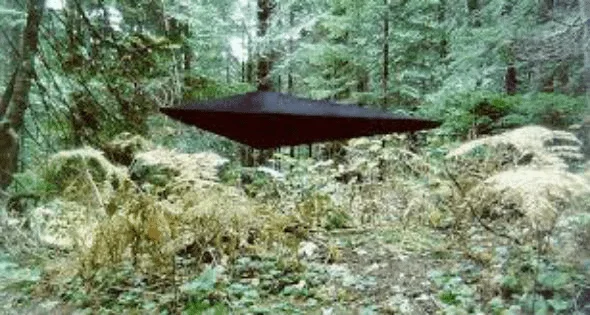
The hovering “craft” from the 1996 footage. Skeptics note it reads as a small, flat object suspended a few feet off the ground rather than a vehicle at altitude. Still from the disputed material, shown for commentary.
They are effective images. That is the whole problem with them: they are built to be effective, and they do their persuading before you have heard a single checkable fact.
Why almost no one believes it
The case did not collapse under one killer blow. It collapsed under a pile of them, assembled mostly by UFO Watchdog and the Seattle UFO/Paranormal Group, neither of them debunkers with an axe to grind against the phenomenon in general.
- The film could not have existed. Investigators reported that the Kodak slide film Reed said he shot in October 1996 was not manufactured until after that date. Photo experts who examined the negatives concluded they were not the originals he claimed, and appeared to be manipulated copies.
- Neither could the Jeep. The vehicle he said he used to haul the body was reportedly not purchased until April 1997, roughly eighteen months after the encounter he was describing.
- There was no dog. His partner of some fifteen years said he never owned a dog and was in fact allergic to animals. The dog is the entire opening scene.
- He was not a doctor. He presented himself as a child psychiatrist affiliated with the University of Washington. Investigators found no medical or psychiatric credentials and reported he had not graduated college. His real name was established as John Bradley Rutter.
- His experts were not experts. The two men presented as scientific validators, one supposedly a microbiologist who ran DNA analysis, were identified as co-workers at a Seattle mini-mart, with no relevant credentials and no record at the university named.
- He was never in hiding. Despite the two-years-underground claim, he was found to have been living openly in Seattle the whole time.
- There was never a body. No specimen, no verifiable DNA, no published lab result, in thirty years.
In 2010 the television series Fact or Faked: Paranormal Files rebuilt the footage nearly shot-for-shot, reportedly spending around eighty hours and eight thousand dollars to construct a comparable body, which is to say the effect was well within reach of a small group with props and patience. The same program ran a voice-stress test on Reed and called the result deceptive. Voice-stress analysis is itself scientifically weak, so it proves little on its own, but it is telling that even a lenient television lie-detector did not clear him.
The one thing believers point to
The strongest argument for the footage is subjective: for 1996, the creature’s blinking, the small eye and facial-muscle movements, look more convincing than a rigid puppet should. It is a fair observation, and it is also beside the point. A well-built prop that moves does not explain film stock that did not exist yet, a Jeep bought a year and a half too late, a dog that was never owned, or credentials that were never earned. When the physical timeline of the evidence contradicts the story, the craftsmanship of the puppet stops mattering.
Why it is here
Not as an open question. The Reed case is one of the most recognizable “alien body on video” hoaxes of the pre-broadband era, a sibling to the 1995 “Alien Autopsy” film, and it is worth keeping on the record precisely because the footage still travels faster than its debunking. If you have seen the grimacing face before and never the film-stock detail, that asymmetry is the entire mechanism by which a story like this stays alive. The footage is real, in the sense that it exists and you can watch it above. Everything it claims to show is not.
Every new case, scored the same way
One email when a case file lands, with its Signal-Strength score and what would move it. No hype, no 'BREAKING', and every claim carries its source. Unsubscribe anytime.
Sources
- [1] UFO Watchdog, 'The Reed Files' (Royce Myers III), the primary skeptical investigation
- [2] Northwest Museum of Legends & Lore (Seattle UFO/Paranormal Group), report on the Reed case
- [3] Eastern Sierra Now, 'The Jonathan Reed Encounter: Alien Contact or Elaborate Hoax?'
- [4] Dark Coast Midnight, 'The Jonathan Reed Alien Hoax'
- [5] Extraterrestrials Wiki, 'Reed Case' (covers the 2010 Fact or Faked recreation)
Read next
More Stories Retold →
The Las Vegas Backyard, 2023: A 911 Call, a Meteor, and Two Very Tall Problems
A fireball crossed four states, a family called police forty minutes later, and body cameras recorded the aftermath. It is the best documented entity report of the decade and it still does not get you to entities.
Betty and Barney Hill: The Night That Wrote the Script
Before grey aliens, missing time, and the examination table were clichés, they were testimony, from a New Hampshire couple with everything to lose and nothing to sell.
Communion: The Book That Gave the Visitors a Face
A successful horror novelist staked his career on a story he could not prove and did not enjoy telling. The cover image alone rewired what a million people pictured when they heard the word 'alien'.
Follow the thread
New disclosure reporting, physics breakdowns, and case files, in your inbox. Sources or it didn't happen. No spam, unsubscribe anytime.