Betty and Barney Hill: The Night That Wrote the Script
Before grey aliens, missing time, and the examination table were clichés, they were testimony, from a New Hampshire couple with everything to lose and nothing to sell.
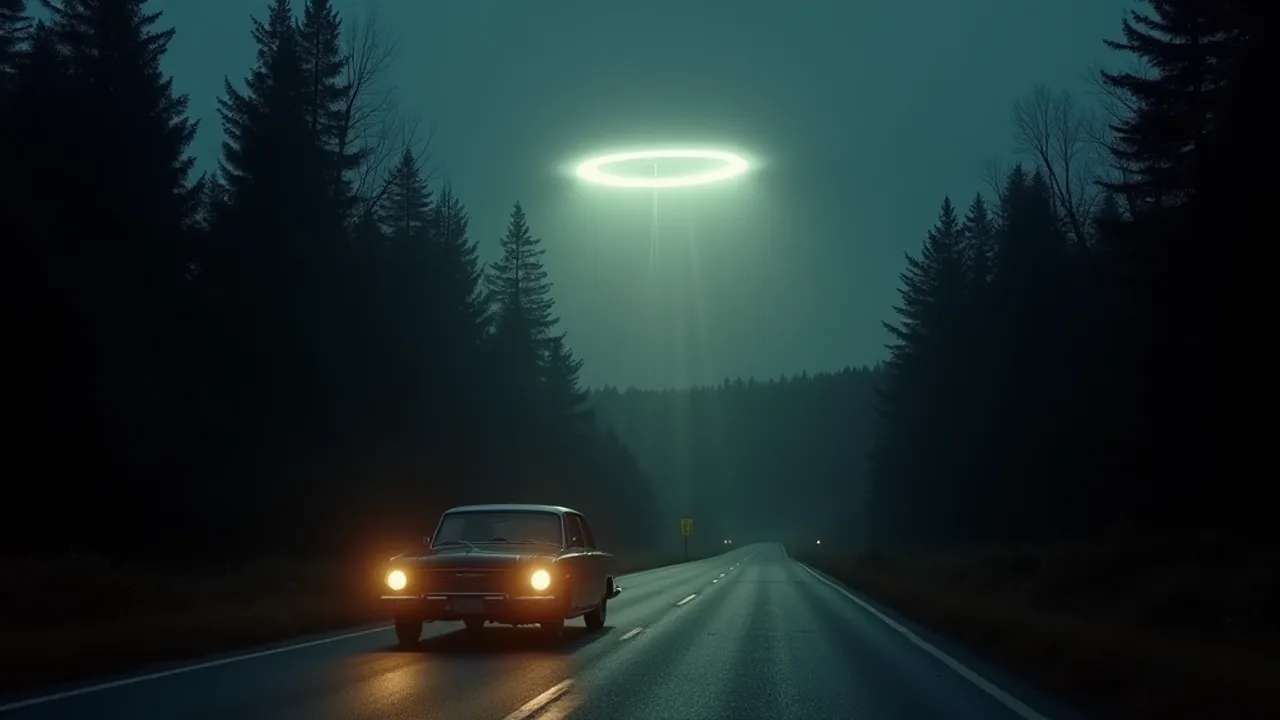 AI illustration
Betty and Barney Hill were a New Hampshire couple who reported an object following their car in September 1961 and later, under hypnosis, recalled being taken aboard and examined. Their case predates the pop-culture 'grey alien' imagery and is considered the origin of the modern abduction narrative, but the account rests on hypnotically-recovered memory with no physical evidence, corroborating witnesses, or official investigation, so our own evidence rubric rates it weak on all four measures.

Almost every detail you think you know about alien abduction, the small grey figures, the large dark eyes, the medical examination, the hours of “missing time” recovered later under hypnosis, entered the culture through one couple driving home through the White Mountains on a September night in 1961. Betty and Barney Hill did not draw from a template. They were the template. Everything after them is, in some sense, a copy.
That ordering matters. When a story arrives before its own clichés exist, the easy dismissal, “they just absorbed it from the movies”, runs backwards. There were no movies yet.
The drive
Betty, a social worker, and Barney, a postal worker and NAACP member, were returning to Portsmouth from a holiday in Canada. South of Lancaster, New Hampshire, they noticed a light that paced their car. Barney stopped, stepped out with binoculars near Indian Head, and saw, he said, a structured craft with figures visible through a window. He returned to the car badly frightened, convinced they were “going to be captured,” and drove off.
The next coherent memory was thirty-five miles further south. Two hours were gone. Neither could account for them. They arrived home at dawn with their watches stopped, Betty’s dress torn, Barney’s shoes scuffed, and a strip of concentric shiny circles on the trunk of the car that made a compass needle jump.
What surfaced later
Betty began having vivid nightmares. Both suffered anxiety severe enough that, in 1964, they sought help from Dr. Benjamin Simon, a respected Boston psychiatrist, who used hypnosis, not to investigate a UFO, but to treat the trauma.
Under separate sessions, recorded on tape, the two described being taken aboard, examined by short humanoid figures, and released. The accounts matched in structure while diverging in the idiosyncratic ways two genuinely separate memories do. Simon’s own conclusion was cautious: he thought the experience was real to them, and suspected the abduction narrative might be a shared fantasy built on a real frightening event. That is a defensible position. It is also not the same as a hoax, and Simon never accused them of one.
The star map
The single strangest artifact is Betty’s. Under hypnosis she recalled a “map” of stars with lines between some of them, shown to her aboard the craft, and she later drew it from memory. Years on, an Ohio schoolteacher named Marjorie Fish built a three-dimensional model of nearby sun-like stars and reported that Betty’s pattern matched a view centered on the Zeta Reticuli system.
The match has been argued about ever since, and the criticisms are fair: the data Fish used shifted as stellar distances were re-measured, and pattern-matching across thousands of stars invites coincidence. But the fact that an untrained witness produced a sketch that anyone could argue corresponds to real stellar geometry, that is more than most hoaxes ever manage to put on the table.
What it costs to dismiss it
You can attribute the lights to a planet or a misidentified aircraft. You can call the missing time a stress reaction and the hypnosis recall a confabulation, hypnosis is genuinely unreliable as a memory tool, and any honest account has to say so.
What the tidy explanations do not dispose of is the physical residue, the stopped watches, the torn dress, the magnetized circles on the trunk, and the timing. An interracial couple in 1961 had every social incentive to stay quiet and none to invent a story that would invite ridicule and scrutiny. They did not seek publicity; the case leaked, then a journalist, John Fuller, built a book around it.
They told it once, told it consistently, and went back to ordinary lives. The script they accidentally wrote has been running for sixty years. No one has shown where they could have read it first.
Every new case, scored the same way
One email when a case file lands, with its Signal-Strength score and what would move it. No hype, no 'BREAKING', and every claim carries its source. Unsubscribe anytime.
Sources
Read next
More Stories Retold →
Is 'Disclosure Day' Based on a True Story? Every Real UFO Claim in Spielberg's Movie, Graded
Spielberg's 'Disclosure Day' opens June 12 at 86% on Rotten Tomatoes, and almost every beat in it, the insider who steals the files, the psychic contactee, the aliens disguised as animals, the broadcast that tells the world, is borrowed from a real claim someone has actually made. None of those claims is proven. Here is the full plot, element by element, matched against the actual record: what's documented, what's only alleged, and what the movie invented outright. Spoilers throughout.
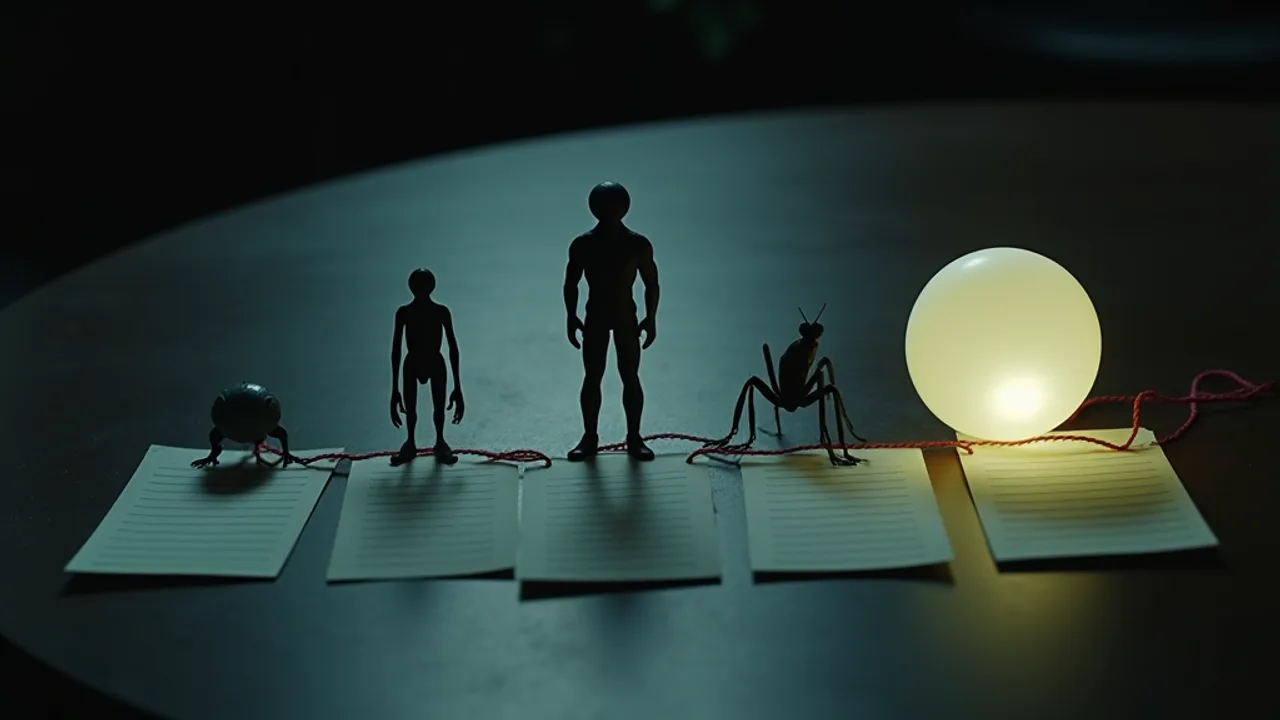
The Reported-NHI Field Guide: Every Claimed Non-Human Type, Graded by Provenance
Greys, Nordics, Reptilians, Insectoids, Tridactyls, and, as of June 2026, 'sentient plasmoid life.' Pop catalogs list a dozen alien races as if they were equally real. They are not equally evidenced. This is a field guide that logs each reported non-human type, ties it to the specific cases it actually comes from, and sorts the whole gallery into three honest tiers of provenance, from investigated physical encounters down to channeled starseed lore.
'Taken' at 24: The 2002 Spielberg Abduction Series That Now Reads Like a 2026 Briefing
Steven Spielberg Presents Taken, a 20-hour, Emmy-winning miniseries from 2002 about Roswell, a hidden government program, and a multi-generational hybrid breeding project, now lines up unnervingly well with what whistleblowers are telling Congress in 2026. We score it element by element: where the fiction matches the current claims, where it's still pure TV, and the uncomfortable possibility nobody raises, that the resemblance runs backwards.
Follow the thread
New disclosure reporting, physics breakdowns, and case files, in your inbox. Sources or it didn't happen. No spam, unsubscribe anytime.