The Varginha Incident, Explained: Brazil's 'Roswell' and What the Evidence Actually Shows
In January 1996, three young women in Varginha, Brazil said they saw a hunched, red-eyed creature crouched by a wall. Thirty years later it's the most famous UFO case in the Southern Hemisphere, wrapped in claims of a military capture, a dead soldier, and a body flown to a university. Here's what was actually witnessed, what only got attached later, what the Brazilian Army's own inquiry concluded, and how the case scores once you separate the sighting from the legend.
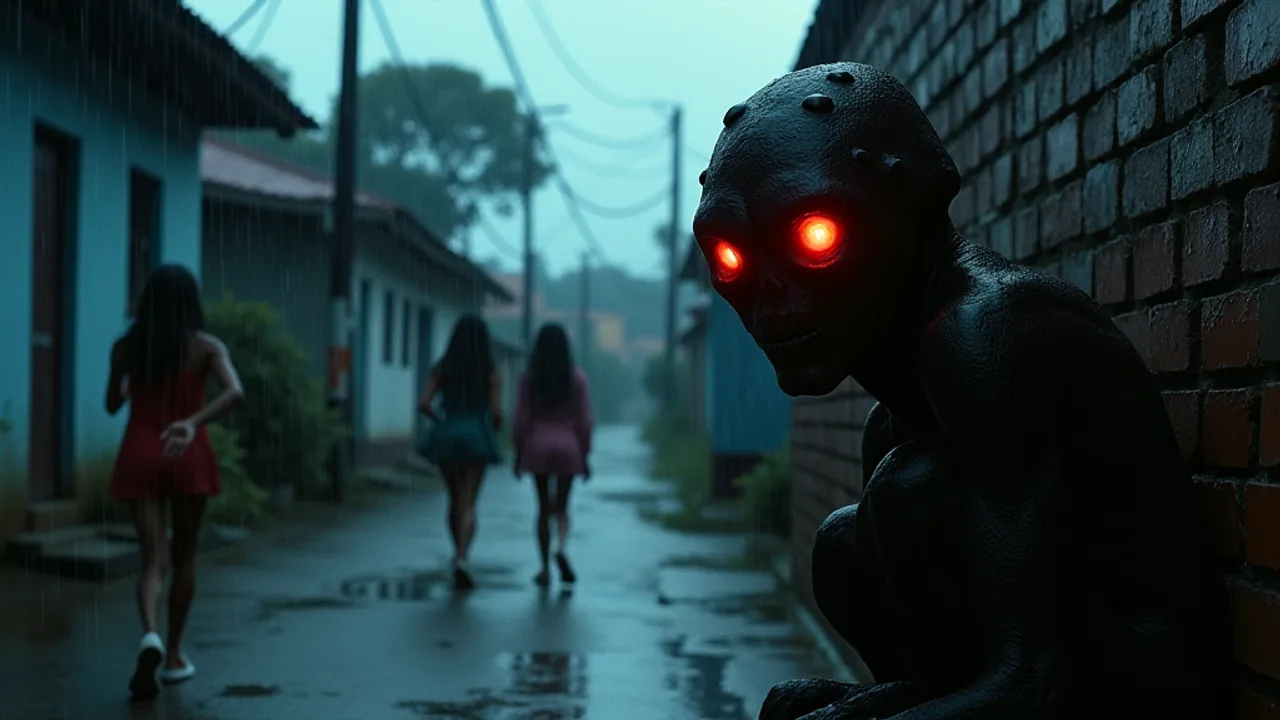 AI illustration
On 20 January 1996 in Varginha, Brazil, three young women reported seeing a hunched creature with dark oily skin, three bumps on its head, and large red eyes, crouched by a wall. The dramatic claims attached to the case afterward, a military capture, a body flown to a university, and a dead soldier, have never been substantiated with any document, photograph, or physical material, and a Brazilian Army inquiry concluded the women most likely encountered a disoriented local man after heavy rain. The sighting is genuine as a report. The recovery story is unverified.
Every country with a UFO culture has its founding case, the one that gets a museum, a tourist trade, and an argument that never ends. In the United States it’s Roswell. In Brazil it’s Varginha: a small city in Minas Gerais where, in January 1996, three young women said they saw a creature crouched by a wall, and a nation spent the next thirty years deciding whether the army had just bagged an alien.
It is genuinely one of the most interesting cases in the world, not because the evidence is strong (it isn’t), but because of how a modest sighting became an epic. This is the explainer: what was actually witnessed, what got bolted on afterward, what the Brazilian Army’s own inquiry said, and where the case lands once you score it like every other.
What the three women actually saw
Strip everything else away and the core of Varginha is a single encounter. Around 3:30 PM on 20 January 1996, on Dr. Benevenuto Braz Vieira street in the Jardim Andere neighborhood, three young women, sisters Liliane and Valquíria Silva and their friend Kátia Xavier, aged roughly 14 to 22, said they came upon a creature crouched against a wall.
Their description, consistent across early retellings: roughly human-sized but hunched; dark, oily skin with vein-like marks; three bumps or small horns on the head; and two large red eyes. It seemed unsteady, as if hurt or sick. They were terrified, they ran home and told their mother they’d seen the devil. (A 1996 Wall Street Journal piece memorably ran under the headline “Tale of Stinky Extraterrestrials,” capturing the ammonia-smell detail that became part of the lore.)
That’s it. That’s the eyewitness core: three frightened young people, one creature, no photograph, no physical trace. Everything that makes Varginha Varginha was added to this seed afterward.
The story that grew around it
In the days and weeks that followed, a much larger narrative assembled itself from rumor, second-hand accounts, and ufologist investigation. None of the following has ever been confirmed with a document, a body, or an image, so we mark it plainly as claimed:
- A military capture. That the Army and Fire Department captured one or two creatures and moved them under guard.
- A hospital and a university. That a creature was taken to a local hospital, then a body flown to a university (Campinas/São Paulo) for examination.
- A dead soldier. That a military policeman, Marco Eli Chereze, who allegedly handled a creature, died weeks later, attributed by believers to contact, and by records to an infection.
- Supporting omens. UFOs seen over the city in the preceding days; an animal “prowling” a nearby forest; and unexplained deaths of zoo animals (a tapir, an ocelot, two gray brockets).
Notice the shape: a real, sincere sighting at the center, and a ring of dramatic, unverifiable claims orbiting it, each one repeated until the repetition started to feel like corroboration. That is the exact mechanism this site exists to watch for.
The official explanation
In an inquiry led by the Brazilian military, the conclusion was deflating. The commander of the 24th Police Battalion presented photographs of a local man, nicknamed “Mudinho” (Luiz Antônio de Paula), described as having a probable mental disability and physical characteristics that matched the creature’s description. The inquiry’s reading: after heavy rains, a dirty, disoriented man crouched by a wall was mistaken by three terrified young women for “a space creature.”
It addressed the military-movement claims too: the firefighters in Jardim Andere, the Army trucks parked near a dealership for routine maintenance, and departing military school (EsSA) vehicles were real events, incorrectly stitched together into a story about capturing and transporting a creature to Campinas.
You don’t have to take the inquiry as gospel, official conclusions in UFO cases are themselves often contested, and proponents argue it doesn’t explain every thread. But it is the closest thing to an official record the case has, and it points away from extraterrestrials, not toward them.
The skeptic’s verdict
Skeptic Brian Dunning put it more bluntly. To him, Varginha is “the most compelling example of a case where literally nothing at all happened that was remotely unusual, and was magnified into a case considered unassailable proof of alien visitation by many.” His challenge to believers: “recalibrate where you set the bar for quality of evidence.”
That’s harsh, and it arguably under-weights how many independent threads the case has. But on the central question, is there anything here you can physically check?, he’s right. There isn’t.
Why it refuses to die
If the evidence is this thin, why is Varginha still a household name in Brazil and a recurring subject of international documentaries? Three reasons, none of them “because it was proven”:
- Dedicated investigators. Ufologists like Vitório Pacaccini (Incidente em Varginha, 1996), lawyer Ubirajara Rodrigues (O Caso Varginha, 2001), and Revista UFO’s Ademar José Gevaerd built and sustained the case for decades, gathering witnesses the official inquiry didn’t.
- A tourism economy. Varginha leaned in: a 20-meter spaceship-shaped water tower, UFO-shaped bus stops, alien dolls in football kits. A town with a merchandising stake in the legend is a town that keeps the legend alive.
- A steady media drip. James Fox’s 2022 documentary Moment of Contact brought it to English-speaking audiences (we fact-checked what the film actually adds: a great deal of testimony, and nothing on the other three axes); a new Brazilian documentary series, O Mistério de Varginha, arrived for the 30th anniversary (2025-26). And in 2026 the case re-entered geopolitics: former defense minister Aldo Rebelo, now a presidential candidate, teased that he “knows what’s in the archives,” a line a US congressman then overstated at a Capitol press conference as Rebelo “confirming” Varginha. He did no such thing.
How it scores
We run every case through the same four-axis Signal-Strength rubric (see the badge above). Varginha lands at Contested, and revealingly so. It has real witnesses (the original three, plus a long tail of others), but no instrumentation (not one photograph of the creature, no radar, no recovered material), only a weak official record (an inquiry that debunks it), and weak debunk-resistance (a specific, mundane explanation exists). The result is a case that is famous far out of proportion to what can be verified.
That places it near the bottom of our ranked case files, below cases you’ve never heard of, like Trindade or Shag Harbour, that scored higher purely because their evidence survives outside a witness’s memory. Varginha is the perfect illustration of the site’s core finding: fame and evidence are not the same axis.
Its own country makes the point sharpest. Rank every major Brazilian case by evidence and Varginha comes fourth of five, beneath the Trindade Navy photographs, the Colares Air Force investigation, and, at the top, the 1986 Night of the UFOs: 21 radar plots, five fighters scrambled, and a sitting Minister of Aeronautics confirming it at a press conference four days later. That case scores 10 of 12 and has no water tower.
What to actually make of it
Hold two things at once. Three young women in 1996 almost certainly saw something that frightened them, and “a disoriented man in the rain” is a perfectly human, non-derisive explanation that takes their fear seriously without requiring a spaceship. Around that small, real moment, a culture built a cathedral: a capture, a cover-up, a martyr, a museum.
That cathedral is fascinating. It is also, on the evidence, a cathedral built on a crouching shadow and a town’s willingness to believe. When a document, a body, or an authenticated image finally enters the record, we’ll move Varginha up the table and say so. Until then, it is Brazil’s Roswell in the fullest sense, enormous, beloved, and unproven.
Compare: the Pascagoula creature encounter, another famous “occupant” case, and where every reported being-type sits on the evidence.
Every new case, scored the same way
One email when a case file lands, with its Signal-Strength score and what would move it. No hype, no 'BREAKING', and every claim carries its source. Unsubscribe anytime.
Frequently asked
What was the ET de Varginha? +
On 20 January 1996, three young women in Varginha, Brazil reported seeing a roughly human-sized hunched creature crouched by a wall, dark, oily, vein-like skin, three bumps on its head, and two large red eyes. It seemed weak or injured. The case became known as the 'ET de Varginha' and grew into Brazil's most famous UFO story, later attached to claims of a military capture.
Did the Brazilian military capture an alien in Varginha? +
There is no verified evidence that they did. Claims of a capture, a creature taken to a hospital, and a body flown to a university all come from witness testimony and ufologist investigation, not from any released document, photograph, or body. A Brazilian Army inquiry concluded the military and fire-department vehicle movements seen that day were routine and were misinterpreted as a capture operation.
What is the official explanation for Varginha? +
An official inquiry led by the Brazilian military concluded the three women most likely encountered a mentally unstable local man nicknamed 'Mudinho', dirty from heavy rain and crouched by a wall, whose appearance matched their description. It also found the army and fire trucks in the area were performing routine duties (maintenance and transport), not capturing or moving a creature.
Is the Varginha incident real? +
Something was witnessed, the three women's sighting is genuine in the sense that they reported it sincerely and consistently at the time. But the dramatic parts (a captured extraterrestrial, a dead soldier, a body at a university) have never been substantiated with physical evidence, and the official inquiry offers a mundane explanation. By a transparent evidence rubric, Varginha scores 'Contested', famous far out of proportion to what can be verified.
What did Aldo Rebelo say about Varginha in 2026? +
Aldo Rebelo, a former Brazilian Minister of Defense and 2026 presidential candidate, posted that he 'knows what the Armed Forces have in the archives' and would release it if elected. At a June 2026 US Capitol press conference, a lawmaker characterized this as Rebelo 'confirming' Varginha, but Rebelo did not confirm the incident or mention extraterrestrials. It was a conditional, political statement, not a disclosure.
Sources
- [1] Wikipedia, Varginha UFO incident (overview + 2010 Brazilian Army inquiry)
- [2] The Wall Street Journal, 'Tale of Stinky Extraterrestrials Stirs Up UFO Crowd in Brazil' (Moffett, June 28 1996)
- [3] Skeptoid (Brian Dunning), 'Brazil's Roswell: The Varginha UFO'
- [4] G1 / Globo, 'ET de Varginha: caso completa 20 anos com mistérios e incertezas' (20 January 2016)
- [5] CNN Brasil, Aldo Rebelo sobre OVNIs: 'Sei o que as Forças Armadas têm nos arquivos' (Feb 2026)
Read next
More History & Lore →
Brazil's UFO Cases, Ranked by Evidence: Why the Most Famous One Comes Last
Brazil has the deepest UFO archive in the Southern Hemisphere: a Navy photo sequence, a four-month Air Force field investigation, a night of radar intercepts confirmed by a cabinet minister, a metal sample analysed for sixty years, and a creature story that became a tourist industry. Scored on the same four axes, they line up in almost exactly the reverse order of their fame.
Moment of Contact, Fact-Checked: What James Fox's Varginha Documentary Adds to the Evidence File
The 2022 documentary is the reason most English speakers have heard of Varginha at all. It found witnesses nobody else had reached and put them back in the streets where they say it happened. It also, by the admission of its friendliest reviewers, has no photograph, no debris, and no document. Here is exactly which parts of the case it moves, and which parts it leaves exactly where they were.
The Night of the UFOs: Brazil Scrambled Its Air Force in 1986, and the Minister Said He Had No Explanation
On 19 May 1986, radar across four Brazilian states tracked objects nobody could identify, five fighters went up after them, and four days later the sitting Minister of Aeronautics stood in front of the press with his pilots and said, on the record, that the Air Force had no explanation. It is almost unknown outside Brazil, and by a transparent evidence rubric it is the best-documented case the country has, far above the one everybody has heard of.
Follow the thread
New disclosure reporting, physics breakdowns, and case files, in your inbox. Sources or it didn't happen. No spam, unsubscribe anytime.