The USS Nimitz Tic Tac, 2004: The Best-Documented UAP Case on Record
Two weeks of radar tracks, four aviators' eyes, an infrared video the Pentagon itself released, and sworn congressional testimony. The Tic Tac is the case that moved UFOs from tabloids to oversight hearings, and the gap between what's confirmed and what's claimed still matters.
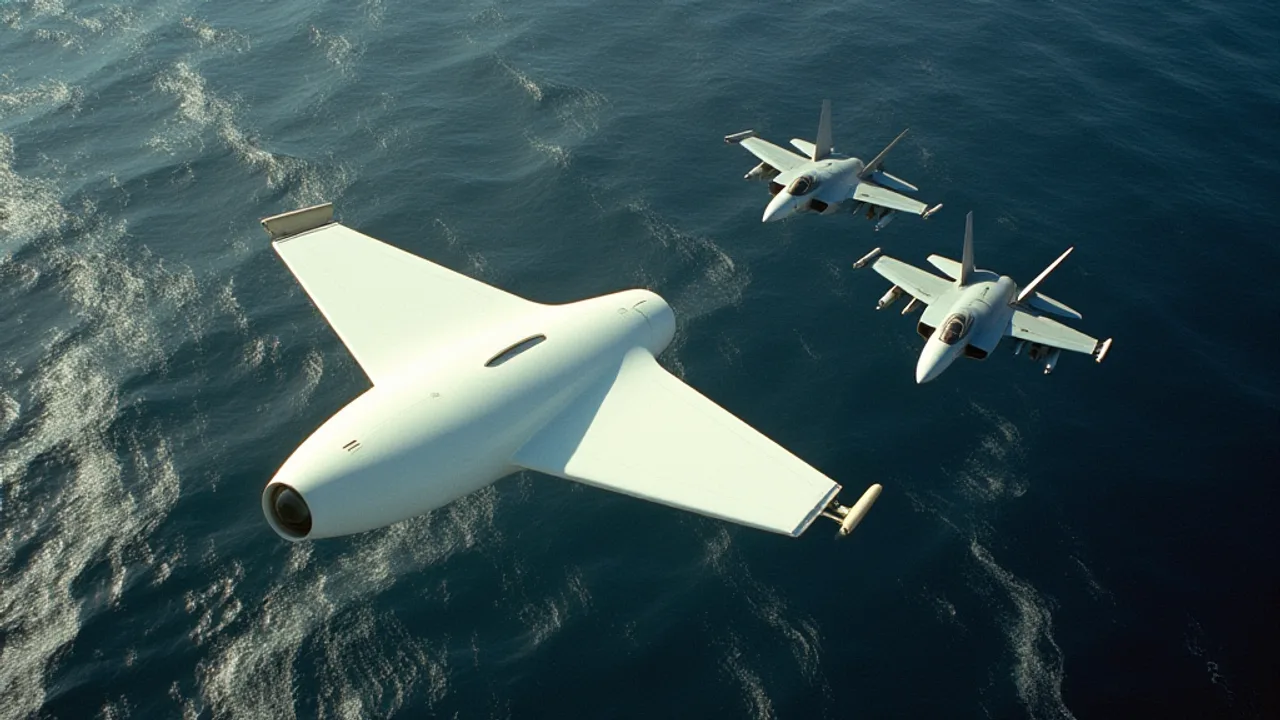
The 'Tic Tac' was a smooth, wingless, roughly 40-foot-long white object that Navy pilots including Cmdr. David Fravor encountered near the USS Nimitz on November 14, 2004, after the USS Princeton had tracked anomalous radar returns for about two weeks. The Department of Defense officially confirmed the released FLIR1 infrared video is genuine Navy footage, and Fravor repeated his account under oath to Congress in 2023, but no complete non-exotic explanation covering the radar, visual, and video evidence together has ever been published, nor has the object's origin been identified.
If you had to defend a single modern UFO case in front of a hostile audience, this is the one you would bring. Not because it has the most spectacular claims, it doesn’t, but because it has the most layers: military radar, trained observers, recorded sensor video, an on-the-record government release, and sworn testimony, all describing the same week off the California coast.
In November 2004, the USS Nimitz carrier strike group was training about a hundred miles southwest of San Diego. For roughly two weeks, operators on the guided-missile cruiser USS Princeton, running one of the most capable radar systems afloat, tracked intermittent returns they couldn’t classify: objects appearing at around 80,000 feet, descending toward the sea, and behaving like nothing in the threat library. The crews ran system resets, assuming the hardware was at fault. The tracks stayed.
November 14: the intercept
On the 14th, the Princeton vectored two F/A-18F Super Hornets, flown by Commander David Fravor, commanding officer of the VFA-41 Black Aces, and Lieutenant Commander Alex Dietrich, each with a weapons systems officer in the back seat, away from their training mission to investigate a live track.
What all four aviators reported seeing, in daylight and clear weather, was a disturbance in the ocean below, and above it a smooth, white, wingless oval, about the size of their own jets, roughly forty feet, moving erratically like “a ping-pong ball,” with no rotors, no exhaust, no visible means of lift. Fravor descended toward it; the object, he says, mirrored him, rising to meet his aircraft, then accelerated away and was gone in about a second. Minutes later, the Princeton called out the same object, or something, re-acquired at the pilots’ pre-briefed training point, sixty miles away.
A second flight launched the same day. Lieutenant Commander Chad Underwood locked his targeting pod on a target and recorded the FLIR1 video, the seventy-six seconds of infrared footage that, thirteen years later, would run on the front page of the New York Times.
What is officially on the record
This is the part that separates the Tic Tac from nearly every case that came before it. In April 2020 the Department of Defense formally released FLIR1 (with the two 2015 “Gimbal” and “GoFast” videos), confirming the footage is genuine and that the phenomena shown remain “unidentified.” The Navy’s own spokespeople had already used the term unidentified aerial phenomena. In July 2023, Fravor testified under oath before the House Oversight Committee and repeated the account in detail. No government body has ever offered an explanation for the encounter.
On our rubric, that makes the official record strong, not because anyone in government said “alien,” but because the chain of custody is intact and acknowledged: the video is real, the encounter happened, and the identification is officially open. Compare that with cases like the Belgian wave, where the most famous evidence turned out to be fake, and you can see why this one rearranged the serious conversation.
What is claimed but not shown
Now the discipline. The most dramatic elements of the Tic Tac story, the drop from 80,000 feet in seconds, the instant reacquisition sixty miles away, the “faster than a bullet” departure, live in testimony about radar, not in released radar data. The Princeton’s tapes have never been made public, and crew members have described data being collected afterward. The FLIR1 video itself, watched cold, shows a small infrared blob that jumps out of frame when the pod loses lock; skeptics, most prominently Mick West, argue everything in the video is consistent with a distant aircraft and camera artifacts.
That critique is narrower than it sounds, it addresses seventy-six seconds of footage, not the radar weeks or the four sets of eyes, but it is honest to say the strongest recorded evidence is the weakest spectacular evidence. The case’s “impossible” physics rests on people; its instruments confirm only that something unidentified was there. That is why the Tic Tac exhibits three of the Five Observables, sudden acceleration, positive lift with no visible surfaces, low observability, as reported, with the instrumented portion more modest.
Where it lands
Scored on the same four axes as every other case in our ranked evidence index: witnesses strong (four aviators plus radar crews, on the record, consistent for two decades), instrumentation moderate (real sensor video officially released, but the radar data unreleased), official record strong (DoD authentication, Navy UAP confirmation, sworn testimony), debunk-resistance moderate (the video has a serious prosaic critique; the full three-legged event does not). That total puts it at the top of the modern era, alongside Rendlesham and Tehran 1976, and, like both, it is a case where what’s confirmed is strange enough that nobody needs to exaggerate it. You can watch the released footage itself on our video page.
Every new case, scored the same way
One email when a case file lands, with its Signal-Strength score and what would move it. No hype, no 'BREAKING', and every claim carries its source. Unsubscribe anytime.
Frequently asked
What was the Tic Tac UFO? +
An object described by US Navy pilots as a smooth, white, wingless oval roughly 40 feet long, like a Tic Tac mint, encountered on November 14, 2004 near the USS Nimitz carrier strike group off San Diego, after the cruiser USS Princeton had tracked anomalous radar returns for about two weeks.
Is the Tic Tac video real? +
Yes, in the narrow sense: the Department of Defense officially released the FLIR1 infrared video in April 2020 and confirmed it is genuine Navy footage of an unidentified aerial phenomenon. What the video shows, and whether the dramatic flight behavior pilots described is captured in it, remains contested.
What did Commander David Fravor see? +
Fravor described a white, featureless, 40-foot oval maneuvering erratically above a disturbance in the ocean, which mirrored his approach and then accelerated out of sight in roughly a second. He repeated the account under oath before the House Oversight Committee in July 2023.
Has the Tic Tac been debunked? +
No, though parts are contested. Skeptics argue the FLIR video itself is consistent with a distant jet and camera artifacts. That critique does not address the two weeks of Princeton radar tracks or the four aviators' visual reports, and no complete prosaic account covering all three legs has been published.
Was the radar data from the Princeton ever released? +
No. The radar tapes have never been made public, and crew members have said data was collected after the events. The radar leg of the case rests on operator testimony, which is why our instrumentation score is moderate rather than strong.
Sources
- [1] Pentagon UFO videos, Wikipedia
- [2] Statement by the Department of Defense on the Release of Historical Navy Videos (April 27, 2020)
- [3] David Fravor, written statement to the House Oversight Committee (July 2023, PDF)
- [4] CBS News, The story behind the 'Tic Tac' UFO sighting by Navy pilots in 2004
Read next
More History & Lore →
Rendlesham Forest: The Night the Cold War Brushed Up Against Something Else
Three nights in December 1980, a USAF nuclear base in Suffolk, and a memo so calm it became the loudest thing in the archive.

The Belgian UFO Wave, 1989-1990: F-16s, a Hoaxed Photo, and What's Left
The Belgian UFO wave: thousands of witnesses, many of them police, reported silent black triangles, F-16s scrambled, and the Air Force published its radar. The famous photo was a hoax; the radar was weather. What's left is still strange.
Tehran, 1976: The Night Two Fighter Jets Lost Their Weapons to a Light
An Imperial Iranian Air Force F-4 locked onto a brilliant object over Tehran and, by the pilot's account, watched its weapons-control panel die as it closed. The reason the case survives isn't the dogfight, it's a U.S. Defense Intelligence Agency report so favorable it called the encounter 'a classic.'
Follow the thread
New disclosure reporting, physics breakdowns, and case files, in your inbox. Sources or it didn't happen. No spam, unsubscribe anytime.