The Belgian UFO Wave, 1989-1990: F-16s, a Hoaxed Photo, and What's Left
The Belgian UFO wave: thousands of witnesses, many of them police, reported silent black triangles, F-16s scrambled, and the Air Force published its radar. The famous photo was a hoax; the radar was weather. What's left is still strange.
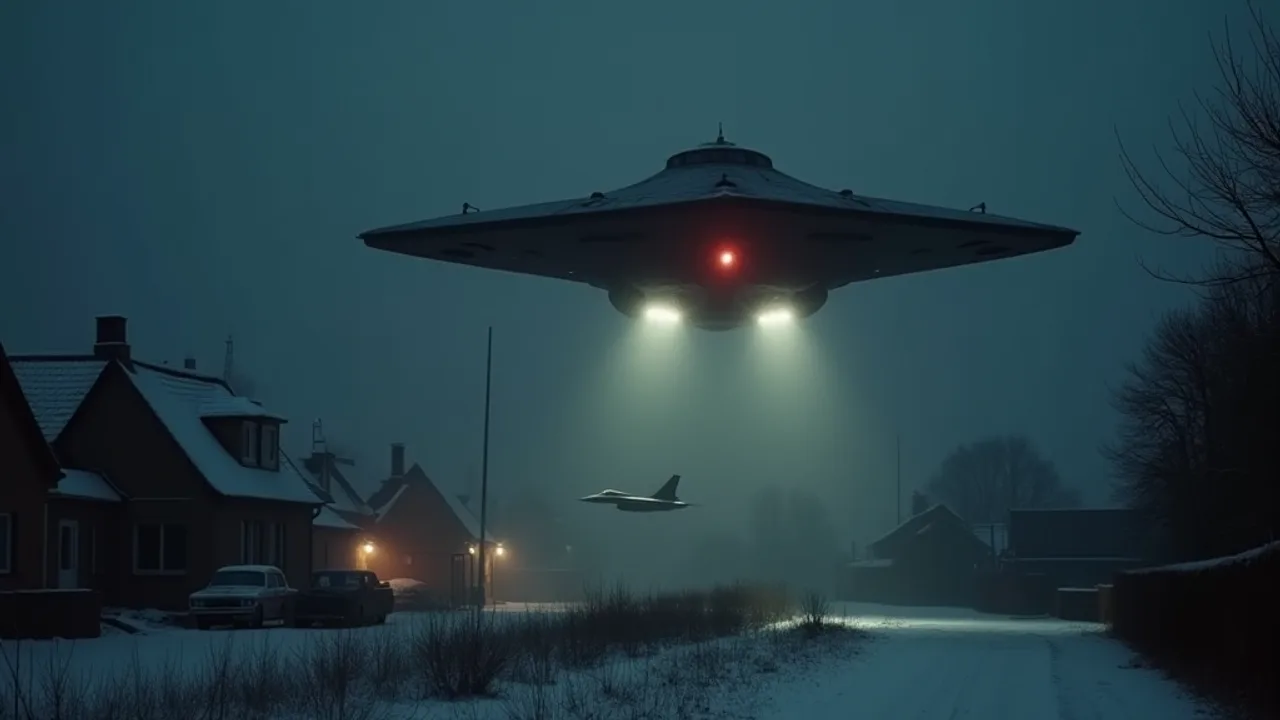 AI illustration

The Belgian Wave is the case we point skeptics and believers at for the same reason: it is a lesson in what survives scrutiny and what doesn’t. It has the strongest official engagement of almost any UFO event in Europe, and its two most iconic pieces of evidence have both fallen apart. Holding those two facts at once is the whole exercise.
Starting in late November 1989, around the eastern town of Eupen, Belgians began reporting a recurring object: a large, silent, low-flying triangle with lights at its corners, drifting slowly enough that it seemed to defy how it stayed airborne. Over the following months the civilian research group SOBEPS logged on the order of two thousand reports. Crucially, many witnesses were gendarmes, police officers filing official descriptions.
The part that’s genuinely remarkable
What sets the Belgian Wave apart is not the triangles. It’s the response. Instead of stonewalling, the Belgian Air Force cooperated openly. Then-Colonel (later Major-General) Wilfried De Brouwer ran the official side, held press briefings, and decades later wrote a first-person chapter in Leslie Kean’s book UFOs: Generals, Pilots, and Government Officials Go on the Record. On the night of March 30-31, 1990, after coordinated reports from police and radar stations, two F-16s scrambled from Beauvechain. Over about an hour they attempted multiple radar locks on a target that, on the tapes, made sharp jumps and extreme apparent accelerations.
That sentence, F-16s got radar locks on a UFO that pulled impossible G, is the one that made the case legendary. It is also the one that didn’t hold.
Both pillars collapsed
The photograph. The single most reproduced image of the wave, a black triangle with three corner lights and a central glow, taken near Petit-Rechain in April 1990, was confessed to be a hoax in 2011. A man named Patrick Maréchal told Belgian television he had made it by cutting a triangle of polystyrene, painting it black, fixing a small light at each corner, and photographing it with a long exposure to produce the glow. The picture that launched a thousand documentaries was a piece of painted foam.
The radar. The F-16 tapes were analyzed by the Air Force’s own Electronic War Center (Col. Salmon and physicist M. Gilmard) and later reviewed by physicist Auguste Meessen. Their conclusion: much of the dramatic radar behavior was caused by “angels”, false echoes from atmospheric conditions, cells of warm, humid air producing Bragg scattering, with some “accelerations” being artifacts of radar mode changes and geometry. Meessen and SOBEPS broadly accepted the radar reassessment. The “impossible maneuvers” were, in large part, the weather fooling a sensor.
So the photo is fake and the radar is explained. A lesser case would be over.
What’s actually left
Strip away the hoax and the angels and you do not get nothing. You get the part that no one has cleanly dissolved: thousands of ground witnesses, including police, over five months, plus a national air force that took it seriously enough to publish its data. The F-16 pilots, notably, never visually acquired anything, which cuts both ways: it weakens the “craft” story, but it also means the radar returns and the eyewitness triangles were never actually reconciled with each other. The visual wave remains unexplained at the level of the witnesses, even after the famous props were knocked down.
Why it scores low on physical evidence, and that’s the honest result
On our rubric the Belgian Wave lands in Credible territory, but look at why, because it’s instructive. The official record is strong, arguably the most transparent military handling of a UFO event anywhere. The witnesses are strong by sheer independent volume. But the instrumentation is weak (the radar was reattributed to atmospheric artifacts) and the debunk-resistance is weak (the headline photo is a confessed fake). The score rides almost entirely on people and official candor, and barely at all on physical evidence, which is the opposite of how the case is usually sold.
That is exactly the value of scoring out loud. The Belgian Wave is not strong because of the triangle photo or the radar lock; it is strong despite both of them having failed, on the strength of how many credible people saw something and how openly a government chased it. Take away the myth and the case is smaller, stranger, and more honest, which is the only kind worth keeping.
For the same tension between mass witnesses and collapsing physical evidence, read the Phoenix Lights, another huge, slow, silent shape over a city, with its own military counter-explanation. For a jet intercept where the instrumentation held up far better, see Tehran 1976. And to see where the Belgian Wave lands against every case we’ve scored on the same rubric, browse the ranked evidence index.
Every new case, scored the same way
One email when a case file lands, with its Signal-Strength score and what would move it. No hype, no 'BREAKING', and every claim carries its source. Unsubscribe anytime.
Frequently asked
Was the Belgian UFO wave ever explained? +
Not fully. Its two most famous pieces of evidence collapsed, the Petit-Rechain triangle photograph was a confessed hoax, and the F-16 radar returns were attributed to atmospheric effects, but the thousands of ground sightings, including many by police officers, have never been cleanly explained.
Was the famous Belgian triangle photo real? +
No. In 2011, Patrick Maréchal confessed on Belgian television that he had created the Petit-Rechain photograph using a triangle of painted polystyrene with a small light at each corner, photographed in long exposure.
Did Belgian F-16s really chase a UFO? +
Two F-16s scrambled from Beauvechain on the night of March 30-31, 1990 and recorded brief radar locks on a target showing extreme apparent accelerations. The Air Force's own later analysis attributed most of the dramatic returns to false echoes from atmospheric conditions, and the pilots never visually acquired anything.
What did the Belgian Air Force conclude? +
Under then-Colonel Wilfried De Brouwer, the Air Force cooperated openly, held press briefings, and published its radar data, and still identified no responsible aircraft and offered no definitive explanation for the visual sightings.
What were the black triangles people saw over Belgium? +
No single explanation has accounted for the full pattern. Proposed candidates include helicopters, early stealth aircraft, and media-amplified misidentification, but none cleanly fits the reported silence, slow drift, and low altitude across roughly 2,000 sightings.
Sources
Read next
More History & Lore →
The Phoenix Lights: When a Whole City Was the Witness
Thousands of people across Arizona watched something cross the sky on one March night in 1997. The governor mocked it on camera, then admitted, a decade later, that he had seen it too.
The USS Nimitz Tic Tac, 2004: The Best-Documented UAP Case on Record
Two weeks of radar tracks, four aviators' eyes, an infrared video the Pentagon itself released, and sworn congressional testimony. The Tic Tac is the case that moved UFOs from tabloids to oversight hearings, and the gap between what's confirmed and what's claimed still matters.
The Westall UFO, 1966: Two Hundred Witnesses and a Balloon That Might Explain It
Australia's biggest mass UFO sighting happened in a schoolyard in broad daylight: students and teachers watched a silvery disc descend behind the trees, then climb away. Sixty years on there is still no official file, and one prosaic theory that almost fits.
Follow the thread
New disclosure reporting, physics breakdowns, and case files, in your inbox. Sources or it didn't happen. No spam, unsubscribe anytime.