Tehran, 1976: The Night Two Fighter Jets Lost Their Weapons to a Light
An Imperial Iranian Air Force F-4 locked onto a brilliant object over Tehran and, by the pilot's account, watched its weapons-control panel die as it closed. The reason the case survives isn't the dogfight, it's a U.S. Defense Intelligence Agency report so favorable it called the encounter 'a classic.'
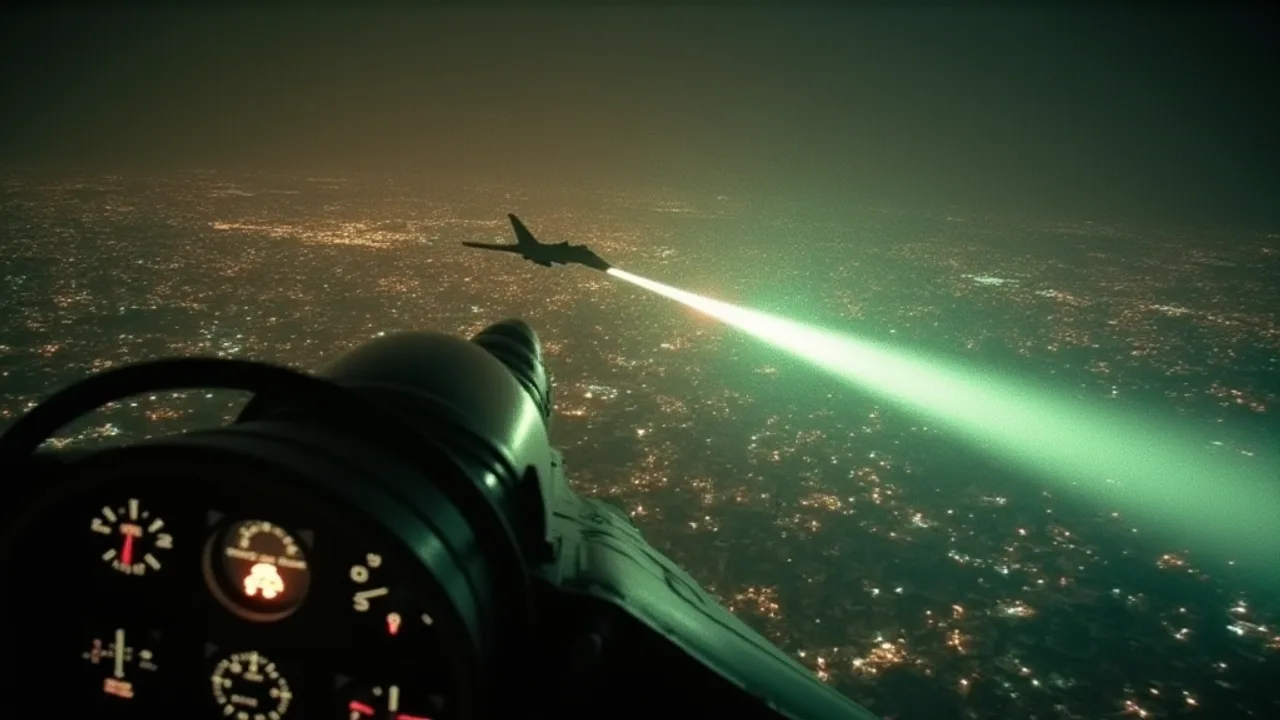
On September 19, 1976, Imperial Iranian Air Force pilots including Gen. Parviz Jafari reported that an F-4 Phantom's weapons and communications systems malfunctioned as it closed on a brilliant, maneuvering light over Tehran. A declassified US Defense Intelligence Agency report on the incident calls it 'a classic' UFO encounter, an unusually favorable official assessment, but the DIA report itself only documents that the incident was reported and investigated, not what the object actually was.

Most UFO cases live or die on witnesses. This one is unusual because its best evidence is a piece of paper from the United States government, and the government, for once, was impressed.
In the early hours of September 19, 1976, Mehrabad air traffic control in Tehran started taking calls about a brilliant light over the city. A supervisor looked himself, saw something star-like but far too bright and low, and an F-4 Phantom was scrambled from Shahrokhi Air Base. According to the report that followed, as the jet closed to about 25 nautical miles, its instrumentation and radio abruptly failed, and recovered the moment it turned away. A second F-4, flown by then-Major Parviz Jafari, was sent up behind it.
What Jafari reported
Jafari said he got a radar lock at roughly 27 miles. As he closed, he described the object as enormous and strobing, and then, the detail that made the case famous, a smaller, bright object separated from the primary and came straight at him. When he reached to fire, he reported that his weapons-control panel and communications went dead. He broke away; the smaller object, he said, returned to the larger one. A third object was reported to descend and land, with a glow bright enough that a civilian airliner overhead also reported it.
Jafari was not an anonymous witness. He retired a general and repeated the account in public, on the record, at the National Press Club in Washington in 2007. People can lie on the record too, but he put his name and rank behind it for thirty years.
Why the case has weight: the DIA report
What separates Tehran from a hundred dramatic intercept stories is what happened on the American side. A U.S. Defense Intelligence Agency “Defense Information Report” on the incident was distributed unusually widely, to the White House, the Secretary of State, the CIA, the NSA, and the Joint Chiefs. An evaluation attached to it rated the report “High” and described it as “an outstanding report” and “a classic which meets all the criteria necessary for a valid study of the UFO phenomenon.” It was later released under the Freedom of Information Act, and you can read the teletype yourself.
That is the load-bearing fact. Not that the object was alien, the DIA never said that, but that a sober intelligence agency looked at a UFO intercept and, rather than filing it under hysteria, called it a textbook case worth studying.
The deflationary reading
The skeptics have a real argument, and it deserves to be stated plainly. NASA engineer James Oberg and journalist Philip Klass pointed out that the initial brilliant object was low on the horizon and almost certainly the planet Jupiter, which was prominent that night, bright, star-like, and a perennial source of “it followed my car” reports. Brian Dunning adds that the date falls during minor meteor activity (good for “falling object” reports), and that Jafari’s specific F-4 had a documented history of intermittent electrical faults, which makes the “weapons mysteriously disabled” climax a lot less mysterious.
It’s a coherent skeptical case. What it doesn’t cleanly absorb is the correlation, two aircraft, on two passes, reporting electronic failure at the moment of approach and recovery on withdrawal, plus a ground component. Jupiter explains a light. It explains an avionics glitch on one jet less comfortably, and the convergence of all of it least of all.
Why it belongs in the file
We are not scoring Tehran as proof of a craft. We are scoring it on what can be checked, and on that axis it is one of the strongest military cases on record, not because the story is the wildest, but because the official paper trail is real, favorable, and declassified. The phenomenon rarely leaves a document that the Joint Chiefs were asked to read. Here it did, and the document called the encounter a classic. You can take the radar and the dead weapons panel as testimony, which is all they are, and still be left with the one fact nobody has to take on faith: the people whose job is to dismiss this kind of thing read the file and decided it was worth keeping.
Every new case, scored the same way
One email when a case file lands, with its Signal-Strength score and what would move it. No hype, no 'BREAKING', and every claim carries its source. Unsubscribe anytime.
Sources
Read next
More History & Lore →
The USS Nimitz Tic Tac, 2004: The Best-Documented UAP Case on Record
Two weeks of radar tracks, four aviators' eyes, an infrared video the Pentagon itself released, and sworn congressional testimony. The Tic Tac is the case that moved UFOs from tabloids to oversight hearings, and the gap between what's confirmed and what's claimed still matters.
The Belgian UFO Wave, 1989-1990: F-16s, a Hoaxed Photo, and What's Left
The Belgian UFO wave: thousands of witnesses, many of them police, reported silent black triangles, F-16s scrambled, and the Air Force published its radar. The famous photo was a hoax; the radar was weather. What's left is still strange.
The Westall UFO, 1966: Two Hundred Witnesses and a Balloon That Might Explain It
Australia's biggest mass UFO sighting happened in a schoolyard in broad daylight: students and teachers watched a silvery disc descend behind the trees, then climb away. Sixty years on there is still no official file, and one prosaic theory that almost fits.
Follow the thread
New disclosure reporting, physics breakdowns, and case files, in your inbox. Sources or it didn't happen. No spam, unsubscribe anytime.