The Phoenix Lights: When a Whole City Was the Witness
Thousands of people across Arizona watched something cross the sky on one March night in 1997. The governor mocked it on camera, then admitted, a decade later, that he had seen it too.
 AI illustration
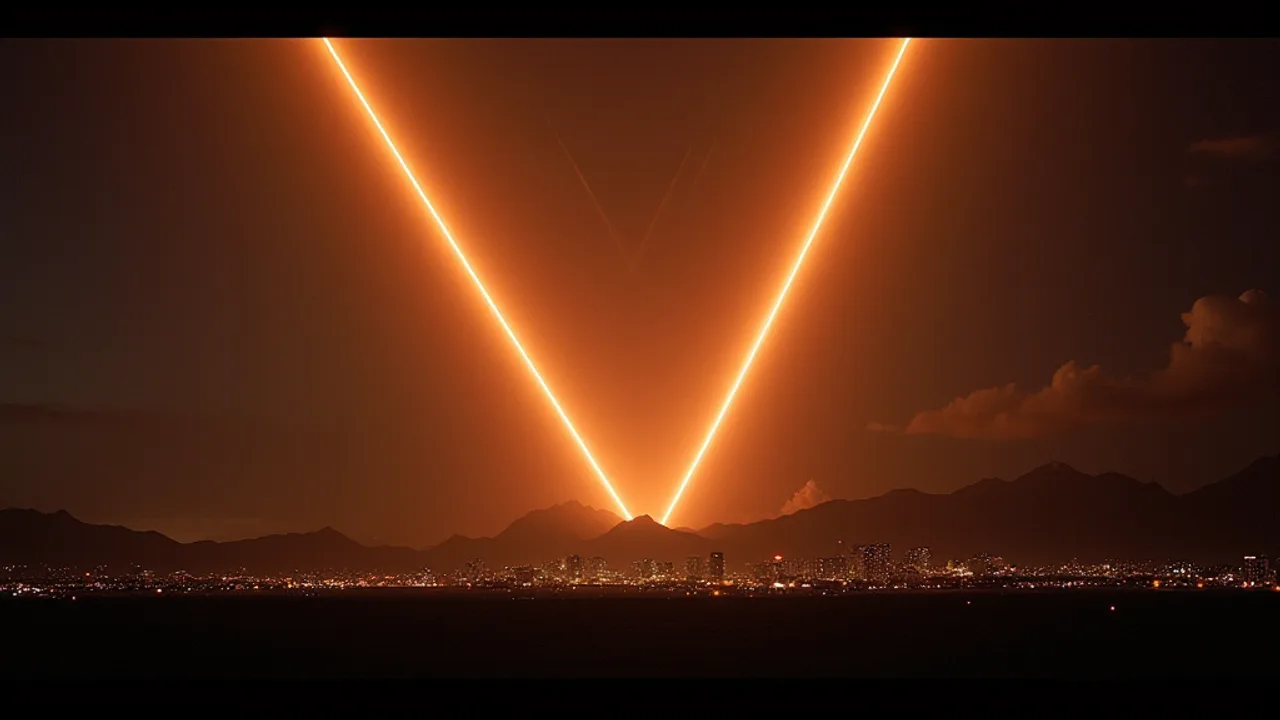
The Phoenix Lights refers to two separate events on the night of March 13, 1997: a silent V-shaped formation of lights witnessed by thousands across a roughly 300-mile stretch of Arizona, and a later set of stationary flares that the Air Force confirmed were dropped during a National Guard training exercise. The military's flare explanation is well-documented and accounts for the second event, but it does not explain the earlier mass-witnessed formation, which remains officially unexplained; then-Governor Fife Symington, who initially mocked the reports, later said in 2007 that he too had seen something he could not identify.

Most famous UFO cases come down to a handful of witnesses and a credibility argument. The Phoenix Lights are the opposite problem: too many witnesses, across too many miles, for the usual machinery of doubt to grip. On the night of March 13, 1997, people reported it from Henderson, Nevada, down through Phoenix, all the way to Tucson, a corridor roughly 300 miles long.
That scale is the case’s signature and its complication. When thousands of people in different cities describe the same hour of sky, you are no longer arguing about one person’s reliability. You are arguing about a crowd.
Two events, often conflated
Careful accounts separate the night into two distinct things, and the conflation of them is where most of the confusion lives.
The first, earlier event was a silent, V-shaped formation of lights, described by many witnesses as a single solid object occluding the stars as it passed slowly overhead, not a cluster of separate aircraft. This is the one that has never been satisfactorily explained.
The second, later event, the one most photographed and televised, was a series of bright lights hanging over the city. The military eventually attributed these to illumination flares dropped by A-10 aircraft on a training exercise at the Barry Goldwater Range. That explanation is plausible for the second event and is widely accepted for it.
The trouble is that it was then stretched to cover the first event too, which it fits poorly. Flares do not fly in a rigid V, do not move against the wind in formation, and do not blot out stars in the shape of a craft.
The governor’s reversal
The most quoted moment of the aftermath was political theater. Then- Governor Fife Symington held a press conference, announced he had found the culprit, and brought out an aide in an alien costume. The room laughed. The story died down.
Ten years later, Symington said the stunt had been a deliberate attempt to calm a panicking public, and that he himself had been among the witnesses. He described seeing a large, distinct, craft-like object that night, and called it “otherworldly.” A sitting governor had watched it, mocked it for the cameras to keep the peace, and waited a decade to say so.
What it costs to dismiss it
The flare explanation is real, and honest accounts grant it the second event. What it does not dispose of is the first: the silent V, the star-occlusion, the consistency of the shape across witnesses who could not coordinate in 1997’s pre-smartphone world.
You can argue misperception, that a formation of high-altitude aircraft in tight echelon, seen at night, can read as a single object. It is the strongest prosaic case, and it deserves to be sat with. What it strains against is the number of independent observers, spread over hundreds of miles, describing the same geometry within the same window.
The Phoenix Lights endure not because they are unexplained in full, half the night is explained, but because the explained half keeps getting quietly extended over the half that isn’t, and a governor who was there spent ten years telling us not to let it.
The closest analogue in the historical record is the Belgian UFO wave of 1989-1990, another slow, silent triangle seen by thousands, where the famous physical evidence collapsed and the mass-witness core refused to.
Every new case, scored the same way
One email when a case file lands, with its Signal-Strength score and what would move it. No hype, no 'BREAKING', and every claim carries its source. Unsubscribe anytime.
Sources
Read next
More History & Lore →
The Belgian UFO Wave, 1989-1990: F-16s, a Hoaxed Photo, and What's Left
The Belgian UFO wave: thousands of witnesses, many of them police, reported silent black triangles, F-16s scrambled, and the Air Force published its radar. The famous photo was a hoax; the radar was weather. What's left is still strange.
The Westall UFO, 1966: Two Hundred Witnesses and a Balloon That Might Explain It
Australia's biggest mass UFO sighting happened in a schoolyard in broad daylight: students and teachers watched a silvery disc descend behind the trees, then climb away. Sixty years on there is still no official file, and one prosaic theory that almost fits.
The Lubbock Lights, 1951: When the Witnesses Were the Professors
Several Texas Tech professors, men who knew the night sky and how to measure things, watched formations of lights cross over Lubbock for weeks in 1951. A college freshman got photographs. The Air Force eventually offered a tidy explanation involving birds and new streetlights, and the lead investigator who signed off on it never quite believed his own answer.
Follow the thread
New disclosure reporting, physics breakdowns, and case files, in your inbox. Sources or it didn't happen. No spam, unsubscribe anytime.