The Lubbock Lights, 1951: When the Witnesses Were the Professors
Several Texas Tech professors, men who knew the night sky and how to measure things, watched formations of lights cross over Lubbock for weeks in 1951. A college freshman got photographs. The Air Force eventually offered a tidy explanation involving birds and new streetlights, and the lead investigator who signed off on it never quite believed his own answer.
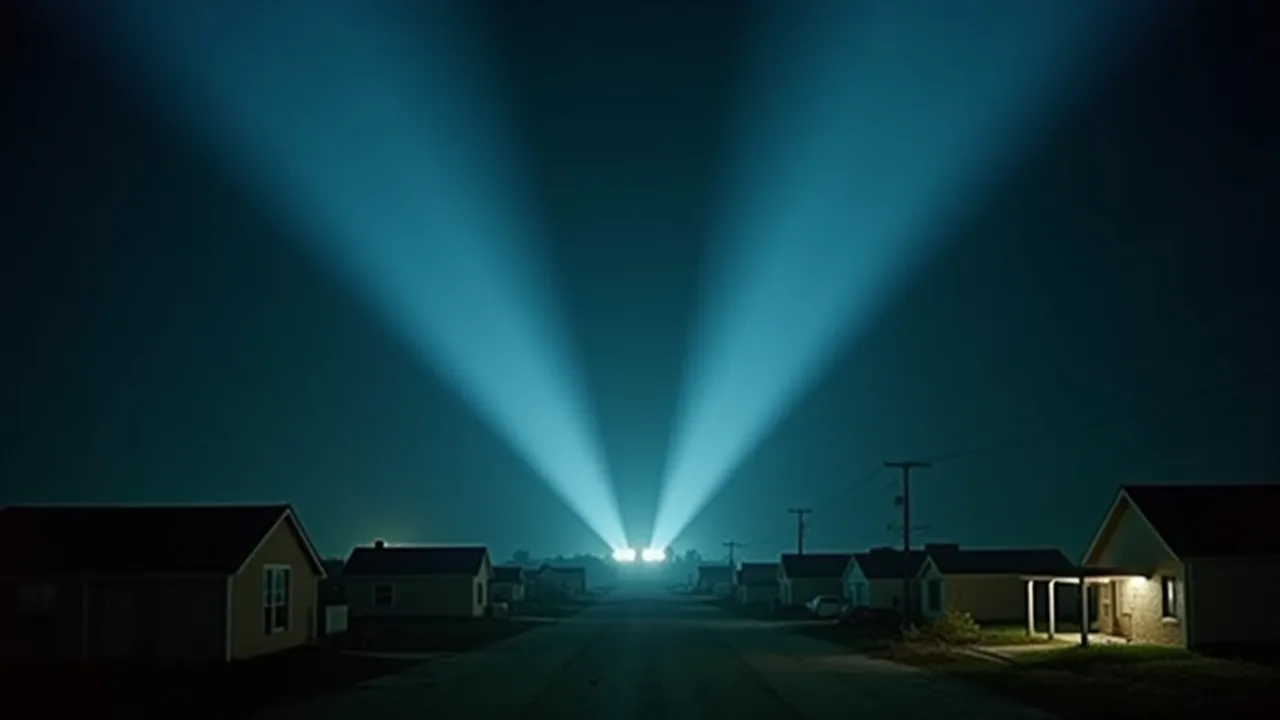 AI illustration
In August-September 1951, several Texas Technological College professors and a student photographer independently observed and photographed V-formations of lights over Lubbock, Texas. The US Air Force's Project Blue Book later attributed the sightings to birds reflecting new mercury-vapor streetlights, an explanation the lead Air Force investigator on the case reportedly never fully accepted himself, so the official resolution is disputed rather than unanimous.
The Lubbock Lights endure for one reason above all others: the witnesses were the wrong people to be wrong. On the night of August 25, 1951, a group of professors from Texas Technological College, across the sciences, geology and physics and engineering among them, were sitting in a backyard when a formation of bluish lights swept silently overhead. Then another. And over the following weeks, again and again, in arcs and crescents and rough V-shapes, sometimes a dozen lights, sometimes two or three dozen, moving fast and without sound.
These were not panicky teenagers. They were men trained to observe carefully and to distrust their own first impressions, and they took the sightings seriously enough to try to measure them, to time the passages, estimate angular speed, and rule out the obvious. They could not explain what they were seeing, and they were sober and credentialed enough that their inability to explain it carried weight.
The photographs
Then a 19-year-old Texas Tech freshman named Carl Hart Jr. pointed a camera out his bedroom window on a night the lights returned and captured several frames showing a V-formation of luminous dots against the dark sky. The photographs were published widely, analyzed, and, unusually for the era, never conclusively shown to be faked. They remain among the more durable UFO images of the 1950s precisely because the debunking never closed: skeptics have argued for a hoax, but no one produced the rig that would have made one.
The combination is what gives the case its staying power: credentialed multiple witnesses and surviving photographs, a pairing most famous cases never manage.
The Air Force’s tidy answer
The case landed on the desk of Project Blue Book, and specifically on Edward Ruppelt, the level-headed officer who ran it. The eventual official posture leaned mundane: the professors’ lights, the argument went, were most likely city lights, including a new installation of bright mercury-vapor streetlights in Lubbock, reflecting off the pale breasts of birds (plovers were the usual nominee) flying over in formation at night. The Hart photographs were treated as a separate, unresolved item.
It is not a crazy explanation. Birds catching artificial light and crossing overhead in loose formation can absolutely produce moving “lights” that fool a ground observer, and the timing, new bright streetlights, migrating birds, fits.
The bird-and-streetlight theory has one job: explain how trained scientific observers, watching repeatedly over weeks and actively trying to rule out the ordinary, all failed to notice they were looking at illuminated ducks. It is plausible. It is also exactly the kind of answer that is easier to write down than to believe.
The investigator’s own doubt
Here is the wrinkle the tidy version skips. Ruppelt himself, in his later writing, was famously uneasy about the resolution. He indicated the professors’ sightings had been “solved” by a natural cause, and also that he was not free to fully detail it, and that the explanation never sat right with him. That ambivalence from the man who closed the file is why the Lubbock Lights never fully closed in the public record: the official answer exists, and the official who gave it didn’t quite trust it.
What survives
The Lubbock Lights are not a smoking gun. The birds-and-lights hypothesis is genuinely viable, and a responsible reading has to grant that a flock under new streetlights can do a lot of what the professors described. But the case keeps its place in the canon for a reason that has nothing to do with proof: it is one of the cleanest examples of good witnesses, careful, trained, repeat observers, running into something they could not resolve, backed by photographs no one could break, and handed an explanation that even the investigator delivering it seemed to doubt.
It may well have been ducks. The honest history is that some very competent people watched the sky for a month and a half and never became convinced it was.
Every new case, scored the same way
One email when a case file lands, with its Signal-Strength score and what would move it. No hype, no 'BREAKING', and every claim carries its source. Unsubscribe anytime.
Sources
Read next
More History & Lore →
The Phoenix Lights: When a Whole City Was the Witness
Thousands of people across Arizona watched something cross the sky on one March night in 1997. The governor mocked it on camera, then admitted, a decade later, that he had seen it too.
The Westall UFO, 1966: Two Hundred Witnesses and a Balloon That Might Explain It
Australia's biggest mass UFO sighting happened in a schoolyard in broad daylight: students and teachers watched a silvery disc descend behind the trees, then climb away. Sixty years on there is still no official file, and one prosaic theory that almost fits.
What the Evidence Actually Says: We Scored Every Case on the Same Four Axes
Most UFO writing argues case by case, which makes every story sound equally strong. We did the opposite: scored every case file on the same four-part rubric and lined the numbers up. The pattern that falls out is not the one either side wants.
Follow the thread
New disclosure reporting, physics breakdowns, and case files, in your inbox. Sources or it didn't happen. No spam, unsubscribe anytime.