What's Down There: USOs, the Catalina Window, and the Bases No One Will Confirm
Long before the Navy admitted the Tic Tac was real, sailors and fishermen off Southern California were watching objects rise out of the water and disappear back into it. The stretch of ocean between Los Angeles and Catalina Island has produced so many of these reports that researchers gave it a name. Here is the case for taking USOs seriously, and the reason 'underwater base' remains a claim, not a fact.
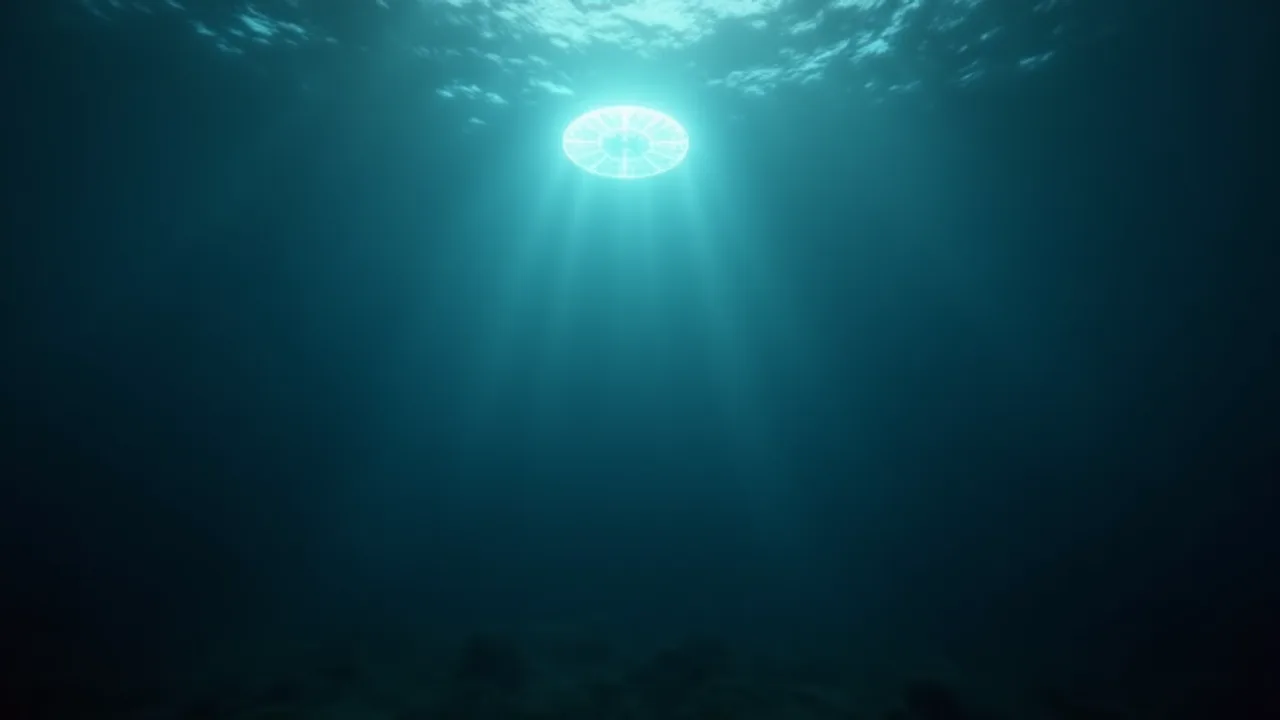 AI illustration
The Tic Tac gets all the attention, and it should, gun-camera footage, named pilots, a Navy that eventually stopped denying. But the encounter that made Commander David Fravor famous in 2004 happened over a particular patch of ocean, and that patch has a longer memory than the Nimitz incident alone. The water between Los Angeles and Santa Catalina Island, the San Pedro Channel, has been generating reports of objects entering and leaving the sea for decades. Researchers who track them call it a window: a place the phenomenon seems to favor.
The objects have their own name. Not UFOs but USOs, Unidentified Submerged Objects. Things that fly, then dive, then are gone.
The category that aviation taught us to ignore
A UFO is a hard enough sell. A USO asks more. It asks you to believe that an object can transit between two mediums, air and water, that punish the crossing brutally. A jet that hits the ocean at speed disintegrates. A submarine that breaches and accelerates does no such thing as flying. The trans-medium claim is, on its face, the most physically demanding thing in the entire catalog of anomalous reports.
Which is exactly why the Nimitz case matters so much to the USO story. The 2004 object was tracked, by the cruiser USS Princeton’s radar, descending from above 60,000 feet to near sea level in seconds, and the pilots reported a disturbance in the water beneath it, a roiling, churned patch the size of a Boeing, as if something had just come up, or was about to go down. The single most credible UAP encounter in the U.S. record is also, read honestly, a trans-medium encounter. It happened over the same channel.
The witnesses nobody filmed in time
Most USO reports do not come with radar tapes. They come with people who were on boats.
A recurring one, surfaced in recent reporting, describes a captain watching an object beneath the surface light the surrounding water “like a baseball stadium” before moving off, a glow with no engine, no wake-grade turbulence, no running lights. Divers off Catalina have reported encounters with fast, silent shapes underwater that behaved like nothing in the navy’s or the marine-biology textbook’s inventory. Recreational sailors describe orbs skimming low and slow against the wind, then dropping into the sea.
None of this is proof. Eyewitness testimony over open water at night is the softest evidence there is, distances are impossible to judge, lights play tricks, and the human appetite for a good story is bottomless. A single “baseball stadium” account is an anecdote. What changes the weight slightly is the clustering: the same behavior, in the same few square miles of ocean, reported by people who mostly do not know each other and have no shared incentive to invent it.
A hotspot is not evidence of a base. It is evidence of a pattern. The leap from “objects keep appearing here” to “something is parked down there” is the exact place where the subject stops being observation and starts being belief.
The word “base” is doing a lot of work
Here is where honesty earns its keep. The phrase that draws the clicks, underwater alien base, is not something any witness has seen. Nobody has filmed a structure. Nobody has retrieved a hatch. The “base” is an inference, and a very old one: if objects repeatedly enter and exit the sea at one location, the human mind supplies a garage to keep them in.
That inference could be right. The deep ocean is the least-surveyed environment on the planet, we have better maps of the Moon’s surface than of the San Pedro Channel’s floor, and a sustained presence in deep water would be, almost by definition, the hardest thing on Earth to detect or disprove. The absence of a found base is not the absence of a base. But it is also not a base. The discipline the subject demands is to hold those two facts at once.
What would actually settle it
Not another night-time orb video. The USO question is, uniquely, the most testable corner of the entire phenomenon, because the ocean keeps records. Sustained sonar coverage of the San Pedro Channel floor. Hydrophone arrays logging the acoustic signature of an object breaching from below. A single ROV pass over a coordinate that a credible witness can actually point to. The Navy already operates exactly this kind of sensing in exactly this water.
The reason the underwater story stays stuck at “hotspot” rather than moving to “confirmed” is not that the ocean is unsearchable. It is that nobody with the sonar has shown their tapes. Until they do, what we have off Catalina is a genuine pattern wearing a speculative noun, objects that keep choosing the same door in the sea, and a word, base, that we keep painting on the far side of it.
Every new case, scored the same way
One email when a case file lands, with its Signal-Strength score and what would move it. No hype, no 'BREAKING', and every claim carries its source. Unsubscribe anytime.
Sources
From the Canon
The reading list →Read next
More History & Lore →
Shag Harbour, 1967: The UFO Canada Filed Under 'Unsolved'
Eleven people watched a lit object descend into the water off Nova Scotia. The RCMP responded, the Royal Canadian Navy sent divers, and they found nothing, which is exactly why it became one of the few UFO events a government has officially logged as unsolved.

The USS Nimitz Tic Tac, 2004: The Best-Documented UAP Case on Record
Two weeks of radar tracks, four aviators' eyes, an infrared video the Pentagon itself released, and sworn congressional testimony. The Tic Tac is the case that moved UFOs from tabloids to oversight hearings, and the gap between what's confirmed and what's claimed still matters.
What the Evidence Actually Says: We Scored Every Case on the Same Four Axes
Most UFO writing argues case by case, which makes every story sound equally strong. We did the opposite: scored every case file on the same four-part rubric and lined the numbers up. The pattern that falls out is not the one either side wants.
Follow the thread
New disclosure reporting, physics breakdowns, and case files, in your inbox. Sources or it didn't happen. No spam, unsubscribe anytime.