Trindade Island, 1958: The Photographs the Brazilian Navy Couldn't Explain Away
A Saturn-shaped object crossed the sky over a Brazilian naval island while a photographer happened to have a camera in his hands. He got four frames. The Navy developed them on the ship, the President of Brazil released them, and seventy years of debunking has never quite landed the knockout blow.
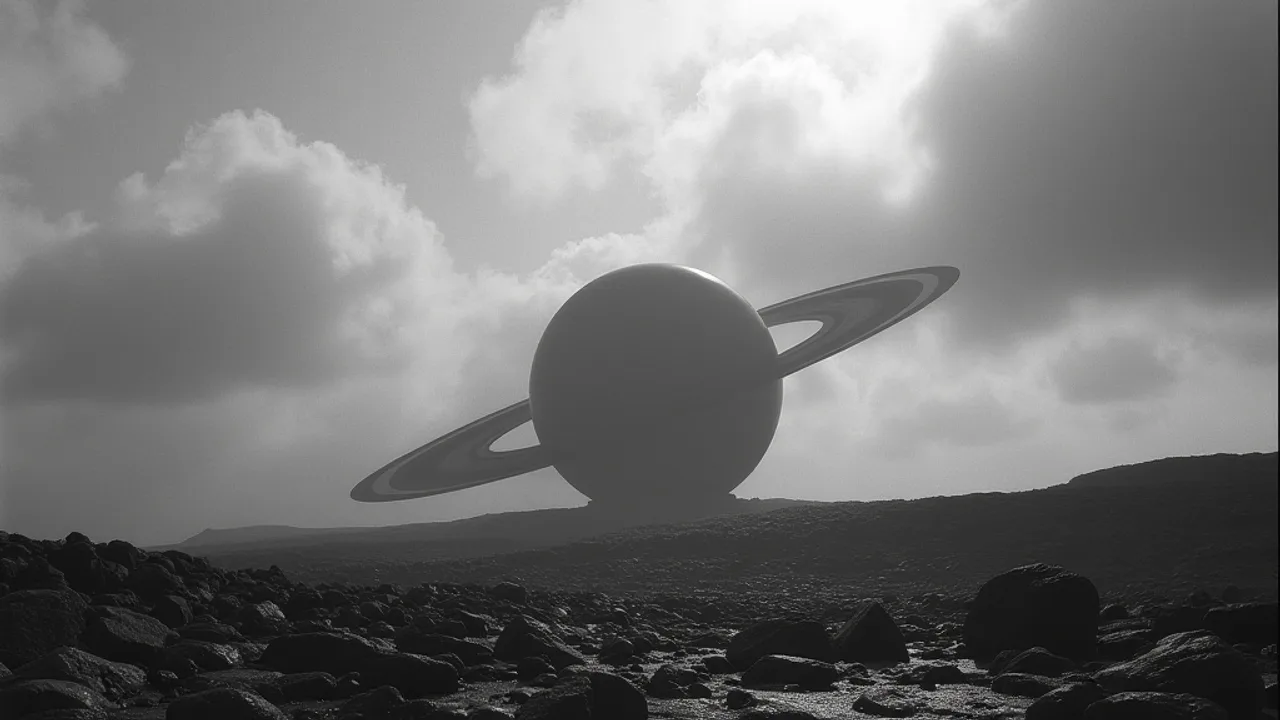 AI illustration
In January 1958, photographer Almiro Baraúna captured four frames of a Saturn-shaped object over Ilha da Trindade while aboard a Brazilian Navy training ship; the Navy itself developed the film and Brazil's president released the images publicly. Decades of skeptical analysis have proposed hoax and optical-artifact explanations, but no analysis has definitively proven fabrication, leaving the case officially unresolved rather than debunked.
Trindade is not a place you wander into. It is a volcanic spike in the South Atlantic, more than a thousand kilometers from the Brazilian mainland, and in January 1958 it held a small naval garrison and a passing training ship, the Almirante Saldanha, on oceanographic duty. There were no tourists to mistake a weather balloon for a spaceship, no traffic, no town lights. There was a Navy crew and a freelance photographer named Almiro Baraúna, aboard to shoot underwater work.
On the afternoon of January 16, something came over the island. Witnesses on deck described a grey, Saturn-shaped object, a disc with a raised band around its middle, moving toward the peak called Desejado, vanishing behind it, and reappearing on the far side before heading back out to sea. Baraúna, by his account, fought the jostling crowd on deck, got his Rolleiflex up, and fired off six exposures in the chaos. Four caught the object.
Why this one is hard to dismiss
Most famous UFO photographs share a fatal weakness: a single photographer, alone, with no corroborating eyes and no chain of custody. Trindade is the inverse on nearly every count.
The film was developed almost immediately, aboard the ship, in the presence of officers, in a darkroom Baraúna did not control and could not have pre-loaded with fakes. The negatives went up the Navy chain. And the sequence is internally consistent: the object’s apparent size and position change frame to frame in a way that matches the described flight path, the disc passing behind the island’s silhouette. This is not one lucky still. It is a short photographic story that agrees with itself and with the men who say they watched it happen.
It went high. The Brazilian Navy stood behind the authenticity of the images, and President Juscelino Kubitschek personally authorized their public release, a head of state putting his name to UFO photographs, which is not a thing governments do lightly, then or now.
A single photo can be a hoax. Four sequential frames, developed under Navy supervision, that agree with a deck full of independent witnesses, that is a different category of claim. It does not prove a spacecraft. It proves the easy explanations have to work harder than usual.
The case against
The skeptical literature has not been idle. The central attack targets Baraúna himself: he was a professional photographer with prior experience in trick photography, and he had reportedly published a tongue-in-cheek article demonstrating how to fake “flying saucer” images using double exposure. If anyone aboard had the skill to manufacture the frames, it was him.
Investigators have also questioned the witness count, how many people on deck actually saw the object versus saw the commotion, and noted that the official Navy report has never been released in full, leaving the provenance more rumored than documented. Image analysts on both sides have spent decades arguing over the disc’s blur, its lighting relative to the sky, and whether the band around its middle is a structural feature or a darkroom artifact.
None of it is conclusive. The double-exposure charge is the strongest card the skeptics hold, and it remains exactly that: a demonstration that Baraúna could have faked it, not evidence that he did, produced in a moving darkroom he did not own, against the testimony of naval officers with no stake in a hoax.
What survives
Seventy years on, Trindade sits in an uncomfortable middle. It is not proof. The photographer’s background guarantees it never will be, no matter how clean the frames look. But it has also never been cleanly debunked, and the weight of corroborating witnesses plus government-supervised development keeps it out of the LARP bin where most “famous UFO photos” belong.
That is the honest verdict the case has earned: not solved, not dismissed. A grey disc over a Navy island, four frames a head of state was willing to sign off on, and a single, stubborn fact that the debunkers have never gotten past, the man who took the pictures was not alone when he took them.
Trindade places second in Brazil’s UFO cases ranked by evidence, above the Colares investigation and far above Varginha, but below the 1986 Night of the UFOs, the radar-and-minister case almost nobody outside Brazil has heard of.
Every new case, scored the same way
One email when a case file lands, with its Signal-Strength score and what would move it. No hype, no 'BREAKING', and every claim carries its source. Unsubscribe anytime.
Sources
- [1] The Trindade island visual and photographic case of 1958, Patrick Gross / UFOlogie
- [2] Almiro Baraúna and crew aboard the Almirante Saldanha, r/UFOs archive thread
- [3] CIA Reading Room, CIA-RDP81R00560R000100040011-6: U.S. Naval Attache Rio report on the Barauna photographs, filed with a draft reply to Rep. Gordon H. Scherer (Wayback snapshot; cia.gov blocks some datacenter IPs)
Read next
More History & Lore →
Brazil's UFO Cases, Ranked by Evidence: Why the Most Famous One Comes Last
Brazil has the deepest UFO archive in the Southern Hemisphere: a Navy photo sequence, a four-month Air Force field investigation, a night of radar intercepts confirmed by a cabinet minister, a metal sample analysed for sixty years, and a creature story that became a tourist industry. Scored on the same four axes, they line up in almost exactly the reverse order of their fame.
The Night of the UFOs: Brazil Scrambled Its Air Force in 1986, and the Minister Said He Had No Explanation
On 19 May 1986, radar across four Brazilian states tracked objects nobody could identify, five fighters went up after them, and four days later the sitting Minister of Aeronautics stood in front of the press with his pilots and said, on the record, that the Air Force had no explanation. It is almost unknown outside Brazil, and by a transparent evidence rubric it is the best-documented case the country has, far above the one everybody has heard of.
The Varginha Incident, Explained: Brazil's 'Roswell' and What the Evidence Actually Shows
In January 1996, three young women in Varginha, Brazil said they saw a hunched, red-eyed creature crouched by a wall. Thirty years later it's the most famous UFO case in the Southern Hemisphere, wrapped in claims of a military capture, a dead soldier, and a body flown to a university. Here's what was actually witnessed, what only got attached later, what the Brazilian Army's own inquiry concluded, and how the case scores once you separate the sighting from the legend.
Follow the thread
New disclosure reporting, physics breakdowns, and case files, in your inbox. Sources or it didn't happen. No spam, unsubscribe anytime.