The Sun Dance
A speculative thriller, and a work of fiction. Every anchor is real: the six apparitions at the Cova da Iria in 1917, the three shepherd children, the anticlerical reporter who came to laugh and filed the strangest column of his career, the tens of thousands who stood in the rain on 13 October and watched the sun come loose, the secret written down in 1944 and kept sealed until 2000. The only invention is who was on the other end, and why it chose the shape it chose.
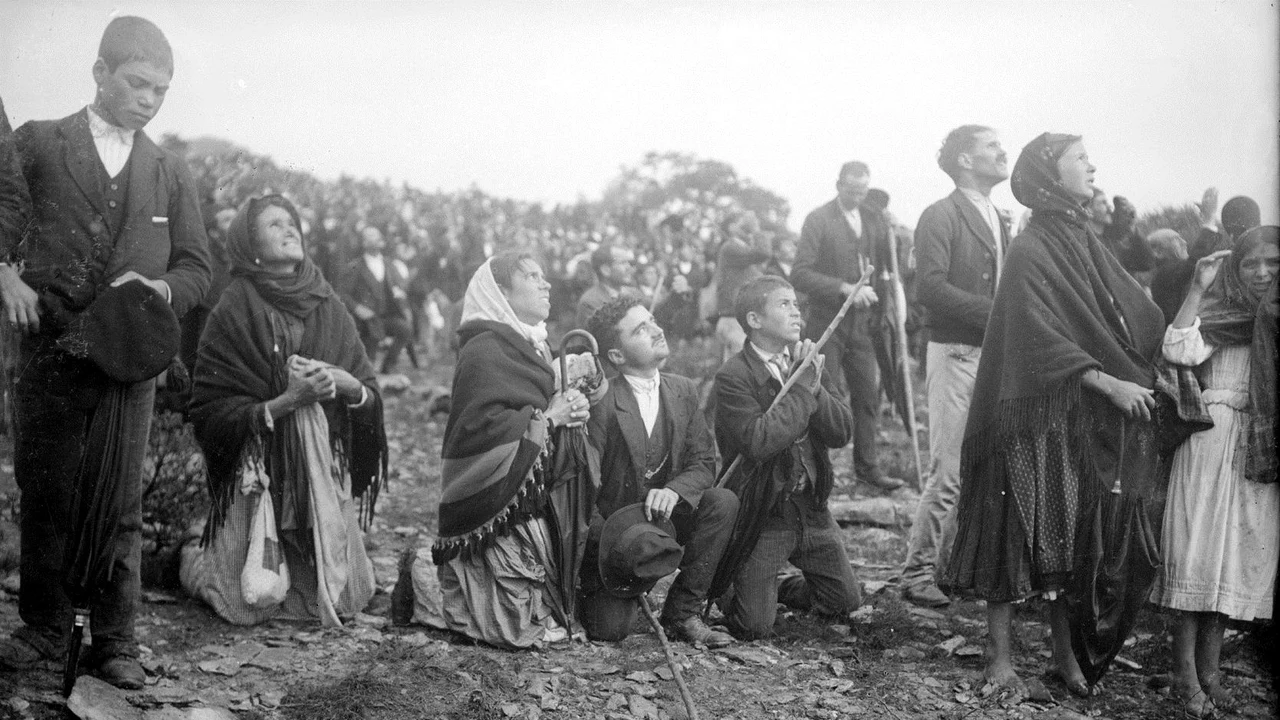
This is fiction standing on a devotion that a great many people hold sincerely, so the ground rules go first. The children, the apparitions, the crowd, the newspaper coverage and the sealed secret are all documented history. The entity’s motives, methods and intentions are invented by this story, and the coda says so line by line. If Fátima is your faith, read this as a story told beside it, not against it.
I. The Cova
The trouble with contacting a species is that you must use a channel it already has.
You cannot open a new one. There is no unused frequency in a human population, no clean input; everything arrives through some existing pipe and comes out wearing the shape of that pipe. So the first question is never what do we say. The first question is: what does this place already listen to.
In the parish of Fátima, in the Estremadura hills of Portugal, in the spring of 1917, the answer was not difficult.
It was a country in its third year of a war it did not want, under an anticlerical republic that had been busy for seven years stripping the Church out of public life. The villages were poor, mostly illiterate, and devout in the specific rural way where heaven is a real and populated place with a known chain of command. The available channels were: the priest, the newspaper, the rumour, and the Virgin.
Only one of those had reach.
So on 13 May 1917, in a hollow of grazing land called the Cova da Iria, three children minding sheep, Lúcia dos Santos, who was ten, and her cousins Francisco and Jacinta Marto, who were nine and seven, looked up at a flash they took for lightning in a clear sky, and saw a lady standing above a small holm oak.
Note the distribution of the encounter, because it is the detail that convinced the parish and that no fabricator would have thought to invent. Lúcia saw her and heard her and could speak to her. Jacinta saw her and heard her but could not speak. Francisco saw her and heard nothing at all, and spent the next two years asking his sister and his cousin what the lady had said.
Three receivers of the same signal, at three different bit rates. Any radio engineer would recognise the situation immediately.
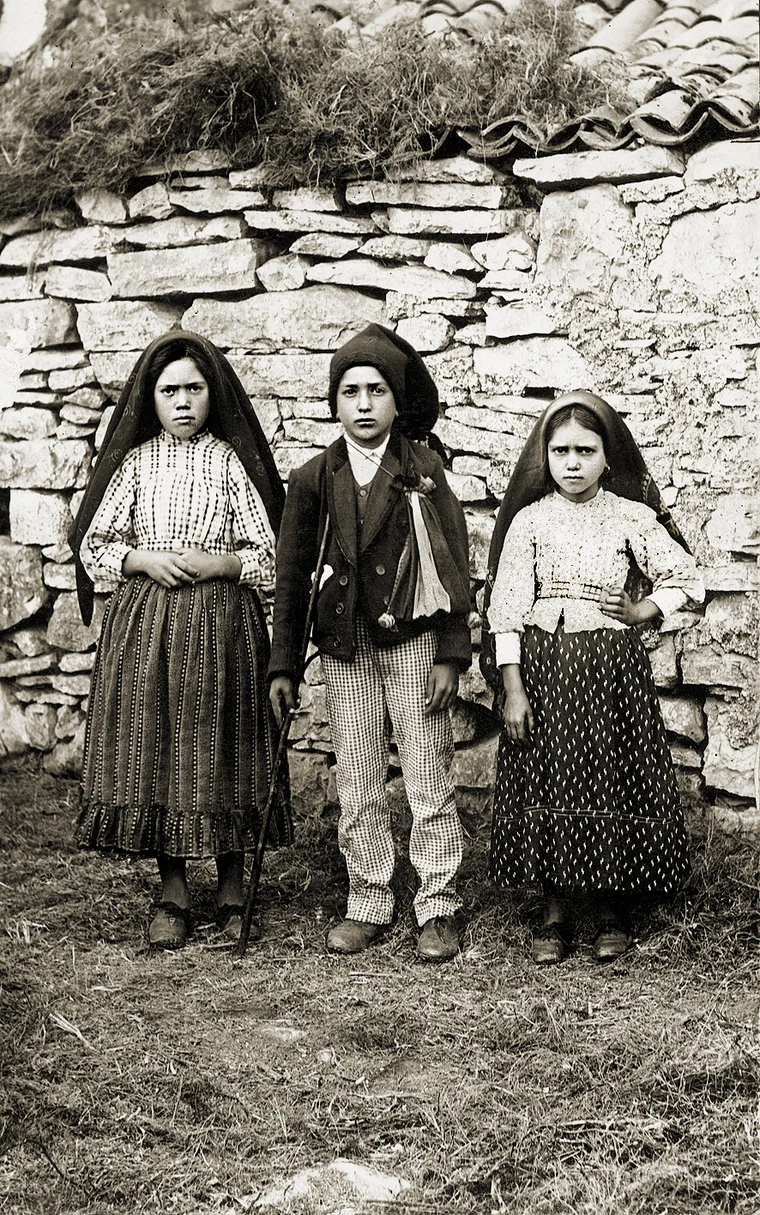
Real photograph, 1917: Lúcia dos Santos and her cousins Jacinta and Francisco Marto, aged ten, seven and nine. Attributed to Joshua Benoliel, published in Ilustração Portuguesa, 29 October 1917. Public domain. Everything this story says about what was talking to them is invented.
II. The Terms
The lady asked them to come back on the thirteenth of every month until October, when she would say who she was and do something that would make people believe.
Consider what an extraordinary structure that is. It is not a message. It is a schedule, with a stated delivery date and a promised proof of authenticity at the end, which is to say a demonstration. Six sessions, monthly, same time, same place, escalating audience. That is not how visions behave. That is how a broadcast test behaves.
The audiences did escalate: a few dozen in June, a few thousand in July, tens of thousands by autumn. In July the children were given three things to keep to themselves, the famous secrets, which will matter later. In August the local administrator, a man named Artur de Oliveira Santos, who thought the whole business was clerical superstition retarding the Republic, simply arrested the three of them, took them to Vila Nova de Ourém, separated them and told each in turn that the others had confessed and that they would be boiled in oil if they did not.
They were seven, nine and ten. They did not budge.
The kidnapping is real, it is documented, and it is one of the load-bearing facts of the case, because a hoax has a chain of custody and this one survived the single most effective interrogation technique known to man, applied to small children, by an adult with the power of the state and every motive to break it.
From the other end, the interrupt was recorded as a nine-day session loss and something else, filed under the heading the operators had been using for this species since the Bronze Age and had never yet had to revise: the carrier is more robust than the message.
Which was the whole problem, and had always been the whole problem.
III. 13 October, in the Rain
The sixth session was announced in the press, because Portugal’s newspapers had spent the summer covering the affair as a delicious embarrassment for the Church. O Século, the big anticlerical daily in Lisbon, sent its editor Avelino de Almeida, a professional sceptic who had already published a mocking piece and who arrived expecting to write the funniest column of the year.
It rained all morning, hard, the kind of October rain that soaks through wool. The crowd, by the estimates of the reporters standing in it, was somewhere in the high tens of thousands. Seventy thousand is the number usually given. They had walked, mostly, some of them for days, and they stood in a mudded field in the rain and waited for a lady to keep an appointment with three children.
At about midday the rain stopped. The cloud thinned. And a very large number of people, including Almeida, including hostile witnesses, including some who were miles away and had come for nothing, reported that the sun did something the sun does not do.
Accounts differ in the details in exactly the way real mass testimony always differs, which is one of the few good arguments that something happened. But the core is consistent: the disc could be looked at directly, without pain. It was silvered, dulled, like a plate rather than a fire. It spun, and threw colours across the field, faces and clothes and the rocks going violet, yellow, red. And then it came loose from where the sun is supposed to be and appeared to plunge toward the crowd in a zig-zag, close enough that many of the seventy thousand went to their knees in the mud and made their confessions out loud, believing that this was the end of the world and that they had about four seconds left of it.
Then it went back, and their clothes were dry.
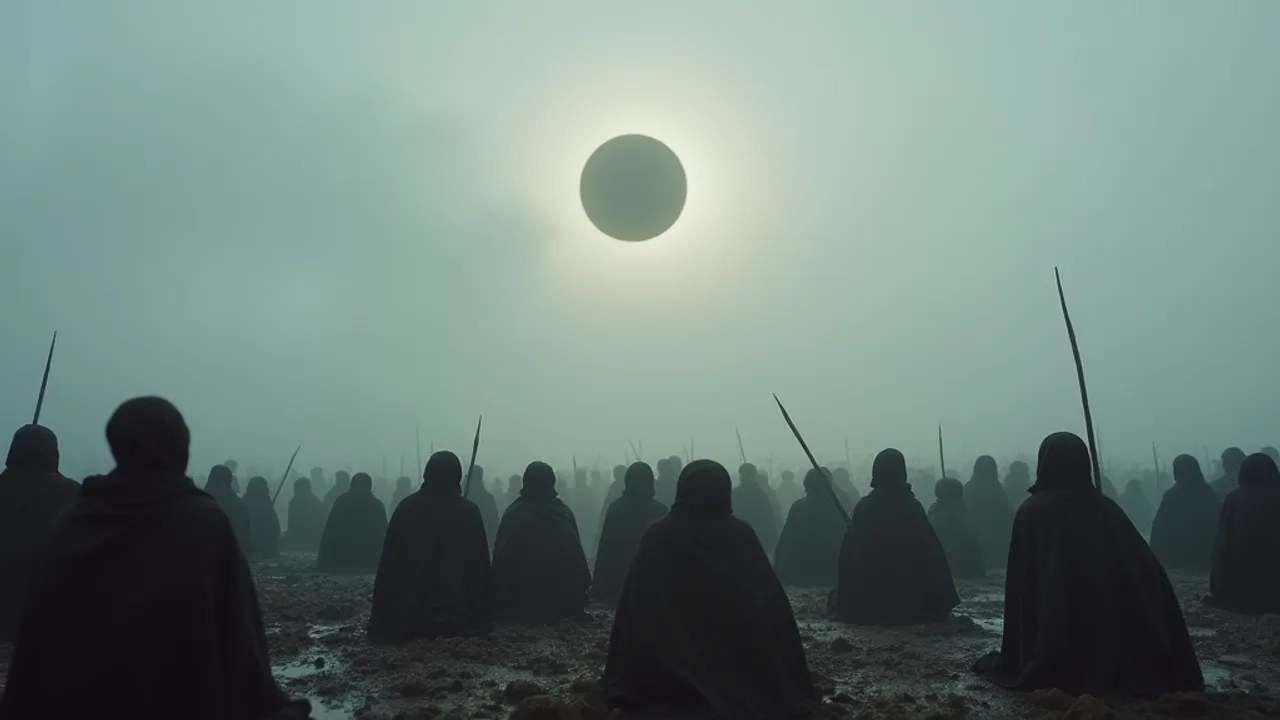
AI illustration, not a photograph and not evidence. This is the thing the crowd described, rendered from their own words: not a fire but a plate, dulled enough to look at directly, hanging where the sun should have been. No camera at the Cova caught the sky that day, only the faces.
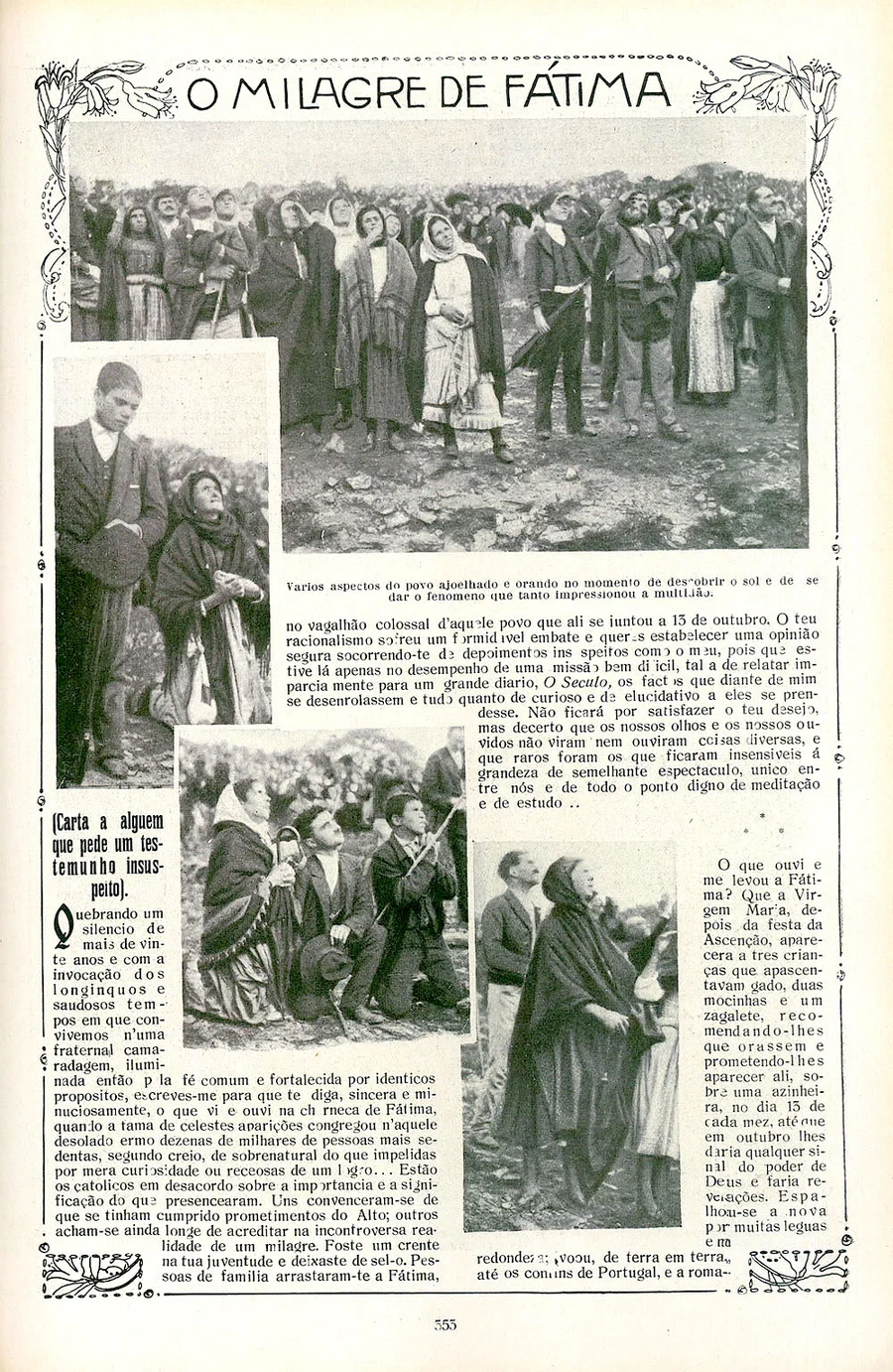
Real artifact: the 29 October 1917 issue of Ilustração Portuguesa, headed “O Milagre de Fátima”, carrying Judah Ruah’s photographs of the crowd looking up sixteen days earlier. Public domain.
Almeida filed it. That is perhaps the most remarkable act in the entire history of the case: an anticlerical editor, in an anticlerical paper, describing without hedging what he had watched a crowd of peasants see, and admitting he could not explain it.
The children, meanwhile, were not looking at the sun at all. They were looking at the lady, who at that final session finally answered the question Lúcia had been asking her for five months, and gave a name: I am the Lady of the Rosary.
Which was, of course, the only name available.
There was no lady. There was never a lady. There was an object at moderate altitude, and there was a broadcast, and there was a species with a receiver that could only render an incoming intelligence in one of about four shapes, all of them locally approved.
The demonstration itself was the crudest part of the operation and by far the most expensive: an atmospheric effect large enough to be witnessed at forty kilometres, calibrated to be survivable, terrifying and, critically, unfalsifiable by any instrument the century possessed. No observatory recorded anything, because nothing happened to the sun. The sun was a hundred and fifty million kilometres away and entirely indifferent. What happened, happened in the air over one field in Portugal, in front of the largest audience that could be assembled in a country at war on the promise of a child.
It worked perfectly. Seventy thousand people carried it home.
And not one of them carried the message, because the message had been handed to a ten-year-old in three sealed parts, and two of those parts were about the twentieth century, and the third was about what to do.
IV. Why a Lady
There is a school of thought, and this story belongs to it, that says the shape of a contact tells you nothing about the contacting thing and everything about the contacted.
Jacques Vallée put it in print in 1969 in Passport to Magonia: the encounter reports do not change across the centuries, only the costume does. The fairy who takes a farmer for a night and returns him a year later, the airship pilot of 1897 asking for a bucket of water, the saucer occupant of 1954 asking for a glass of it, the lady of light above a holm oak in 1917. Same structure, same missing time, same instruction to tell no one, same small local witnesses whose lives are afterwards not their own. We covered his control-system argument at length, and Fátima sits inside it uncomfortably well, which is precisely why he is disliked in both camps at once.
So: why a lady?
Because the alternative was a light, and a light in a field in Catholic Portugal in 1917 produces a three-day rumour and nothing else. A lady produces a schedule, a crowd, a newspaper, a bishop, an inquiry, a basilica, and a hundred years of institutional memory with a filing system attached. If you need a message stored for eighty-three years by a civilisation that cannot yet keep a magnetic tape readable for thirty, you do not hand it to a scientist.
You hand it to a Church. Churches are the only human technology with a demonstrated retention time in centuries.
That is what the third secret was for. Not prophecy. Storage.
V. The Sealed Part
Here is the documented history, which is stranger than most fiction anyway.
Lúcia became a nun. In 1941 she wrote down the first two secrets: a vision of hell, and a warning that a worse war would follow if the world continued as it was, with a specific and politically explosive instruction concerning Russia. In 1944, ill and under obedience to her bishop, she wrote down the third and sealed it in an envelope, with instructions that it not be opened until 1960, or her death, whichever came first.
It reached the Vatican in 1957. John XXIII read it in 1959 and put it back in the box. Paul VI read it. John Paul II read it after he was shot in St Peter’s Square in 1981 and asked for the envelope in his hospital room.
For four decades it was the most famous unread document in the world, and the vacuum filled with the predictable: apostasy, nuclear war, the end of the Church, the end of everything. It was finally published on 26 June 2000, with a commentary by Cardinal Ratzinger. It describes an angel with a flaming sword, a ruined city, and a bishop dressed in white climbing a mountain toward a cross, who is shot down by soldiers, along with bishops, priests, religious and lay people. The Vatican’s reading is that it referred to the twentieth century’s persecutions and to the 1981 assassination attempt.
A great many people were disappointed, and said so, and have not stopped saying so.
In this story, they were right to be, though not for the reasons they gave.
The third part was never an image. Images were what survived transmission through a ten-year-old under stress: a mountain, a cross, a man in white, soldiers. What was actually sent was the operational half of the message, the part the first two secrets were merely the preamble to, and it consisted of instructions and a window of time.
The instructions were not religious. They were closer to a maintenance schedule: this is what will happen, this is the interval in which it can still be affected, and this is what you would have to do, as a species, to affect it. The lady had said as much in July, in the only line of the whole affair that reads like an engineer talking rather than a saint: if my requests are heeded. Conditional. A forecast with a mitigation.
And the mitigation was routed through the one institution that could still be reading the file in eighty years, in a language that institution could hold, which meant it arrived phrased as devotion: pray this, consecrate that, do it by this date. It was a checklist wearing vestments, and every party involved did precisely what you would expect, which is to argue for eighty years about whether the ritual had been performed correctly, and never once about what the ritual was for.
The sender’s log, for the third time in this century, would have carried the same terse note.
Signal received. Stored intact. Read as prophecy. No action taken.
VI. Two Towns
Point Pleasant, West Virginia, is nine hundred miles and forty-nine years away from a hillside in Portugal, and the two places have exactly one thing in common: something tried to put a message into a small population, and in both cases the population kept the wrapper and threw away the contents.
In West Virginia it arrived as a winged thing at the treeline and a man who would not stop grinning, and the town was frightened for thirteen months in the wrong direction while an iron bar quietly cracked. In Portugal it arrived as the Queen of Heaven above an oak tree, and seventy thousand people went home certain they had seen a miracle, and the century proceeded to be exactly as bad as the envelope said it would be.
The monster and the miracle are the same event. They are what a message looks like after it has been forced through the only channel a place has, and the difference between them is not the sender. It is whether the local vocabulary for pay attention happens to be dread or awe.
We are not a species that is hard to contact. We are a species that is hard to tell. Anything can reach us. Nothing can quite get through, because the pipe is made of everything we already believe, and it re-shapes the water into its own bends before it reaches the mouth.
Somewhere there is presumably still a file open on us, with three entries under 1917, and a fourth, in a different hand, added much later and never followed up.
Coda: what’s real, and what isn’t
Real. Between 13 May and 13 October 1917, three shepherd children at the Cova da Iria near Fátima, Portugal, Lúcia dos Santos (10) and her cousins Francisco (9) and Jacinta Marto (7), reported six apparitions of a luminous lady, on the thirteenth of each month, with the August encounter delayed because the children had been detained by the local administrator Artur de Oliveira Santos, who separated them and threatened them; they did not recant. Lúcia reported seeing and hearing the figure, Jacinta seeing and hearing but not speaking, and Francisco seeing only. The lady promised a sign in October. On 13 October, after heavy rain, a crowd generally estimated in the high tens of thousands, including hostile press, reported that the sun appeared as a dull spinning disc that threw colours and plunged toward the earth before returning, and that the sodden ground and clothing dried. O Século’s anticlerical editor Avelino de Almeida really did report it in print without explaining it away, and Judah Ruah’s photographs of the upturned crowd really did run in Ilustração Portuguesa on 29 October 1917. Francisco died in 1919 and Jacinta in 1920, both in the influenza pandemic; both were canonised in 2017; Lúcia became a Carmelite and died in 2005. The three secrets, the 1944 writing of the third under obedience, its arrival in Rome in 1957, the decades of refusal to publish, and its release on 26 June 2000 with Cardinal Ratzinger’s commentary are all documented, and the text is on the Vatican’s own website. Jacques Vallée really did place Fátima in the same catalogue as fairy encounters and airship sightings in Passport to Magonia (1969).
Not real. Everything with a sender in it. There is no operator, no broadcast test, no calibrated atmospheric demonstration, no log, no maintenance schedule, no storage strategy routed through a Church. The claim that the third secret was an instruction set rather than a vision is invented for this story, and contradicts the published text, which anyone can read at the link above. The “engineer talking” reading of if my requests are heeded is a narrator’s conceit.
Worth saying plainly. Three things.
The best natural explanation of the solar phenomenon is that tens of thousands of people who had been told a miracle was coming stared directly at a sun emerging from thin cloud, and that retinal effects, afterimages and the optics of a bright disc seen through moving vapour did the rest, with expectation supplying the rest of the choreography. That explanation has to carry some weight it strains under, the drying of the ground, the reports from people kilometres away, the hostile witnesses, and it is still the most probable thing on the table.
The UFO reading of Fátima, which is a real literature and not something invented here, is genuinely interesting as folklore analysis and genuinely weak as evidence. It works by stripping the theology and keeping the shapes, and you can do that to almost any account if you want the shapes badly enough.
And the thing that is neither faith nor phenomenon, and outlasts both: three illiterate children were threatened by the state, separated, told the others had broken, and did not change their story. Whatever you conclude happened in that field, it did not happen to liars. That is the part of the record that has never had a comfortable explanation, and it is the reason this case is still standing when a thousand better-lit ones have fallen over.
The genre’s forbidden question here is what if the message was operational, and we filed it as devotion?
The honest answer is that a checklist and a prayer are difficult to tell apart from the inside, which is possibly the most human sentence in this entire story.
Every new case, scored the same way
One email when a case file lands, with its Signal-Strength score and what would move it. No hype, no 'BREAKING', and every claim carries its source. Unsubscribe anytime.
Sources
- [1] Our Lady of Fátima, Wikipedia
- [2] Miracle of the Sun, Wikipedia
- [3] Three Secrets of Fátima, Wikipedia
- [4] The Message of Fatima, Congregation for the Doctrine of the Faith, 26 June 2000 (full text of the third secret and commentary)
- [5] Jacques Vallée (author of Passport to Magonia, 1969), Wikipedia
Read next
More Fiction, maybe? →
The Grinning Man
A speculative thriller, and a work of fiction. Every anchor is real: the two boys at the Turnpike fence in October 1966, Woodrow Derenberger's roadside encounter with a man who called himself Cold, the thirteen months of Mothman reports around the TNT area, John Keel's notebooks, and the forty-six people who went into the Ohio River when the Silver Bridge failed on 15 December 1967. The only invention is the other side of the conversation, and what the grin actually was.
Passport to Magonia: The Scientist Who Said the UFO Is a Control System
Jacques Vallée helped build the early internet, mapped Mars for NASA, and was the model for the French scientist in Close Encounters. He is also the man who argued the UFO is neither alien spacecraft nor hoax, but a recurring control system that has worn fairy lore, religious apparitions, and now starships as its costume. It is the most serious version of the occult reading, precisely because it comes from the least occult person in the field.
The Office Against the Ships of the Air
A work of fiction built on a real silence. Medieval sources describe ships sailing on the clouds: Agobard of Lyon in 815, Irish annal-keepers in the 740s, Gervase of Tilbury around 1211, and a Norse king's mirror that puts an anchor in the church door at Clonmacnoise. Not one of them records what the priest was supposed to say. We wrote the rite that is missing, labelled every line of it as ours, and then explained why it would not have worked.
Follow the thread
New disclosure reporting, physics breakdowns, and case files, in your inbox. Sources or it didn't happen. No spam, unsubscribe anytime.