The Grinning Man
A speculative thriller, and a work of fiction. Every anchor is real: the two boys at the Turnpike fence in October 1966, Woodrow Derenberger's roadside encounter with a man who called himself Cold, the thirteen months of Mothman reports around the TNT area, John Keel's notebooks, and the forty-six people who went into the Ohio River when the Silver Bridge failed on 15 December 1967. The only invention is the other side of the conversation, and what the grin actually was.
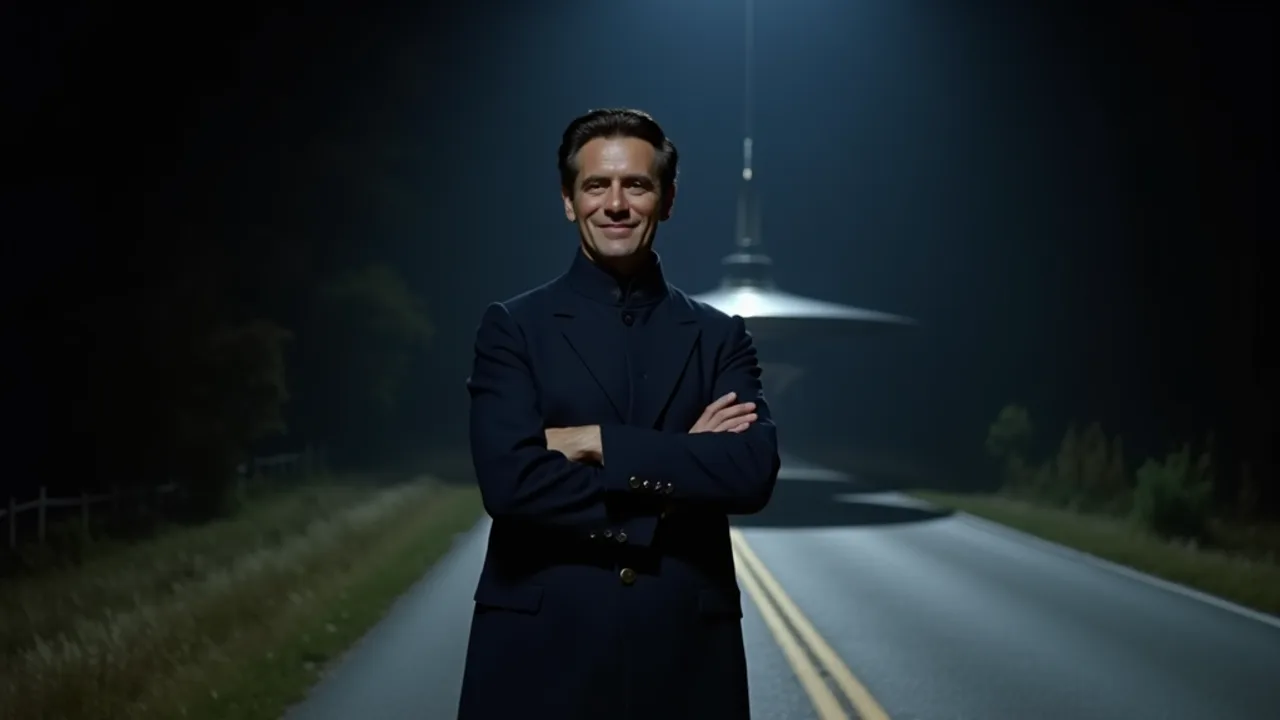 AI illustration
This is fiction wearing a real disaster as its coat. The sightings, the newspaper coverage, the investigator, the bridge and the death toll are documented; the entity’s side of it is invented. The coda separates them, line by line.
I. The Fence
Begin with the least famous night, because it is the one that explains the rest.
Elizabeth, New Jersey, 11 October 1966, a little before ten at night. Two boys, James Yanchitis and Martin Munov, walking home along a street that runs under the elevated deck of the New Jersey Turnpike. On their left, an embankment. On the embankment, a chain-link fence. Behind the fence, standing perfectly still on ground where there is no reason for anyone to stand, a very tall man in something that shone.
One boy saw him first and nudged the other, which is how these things always go, and the second boy looked and then neither of them looked away, because the man was looking back. Dark complexion. Small round eyes, set too far apart. No visible ears, no hair, no obvious mouth movement.
And he was grinning.
Not smiling, the boys said. Grinning. The distinction mattered to them enough that they kept insisting on it afterwards, to their parents, to the police, and three days later to a wiry New York journalist named John Keel, who had come down to hear it in person and who was, at that stage of his career, still a man who thought he was writing about spacecraft.
Keel believed the boys. He said so plainly for the rest of his life. What struck him was not the shining coverall or the height. It was the grin, which the boys described the way you describe an animal’s expression, an arrangement of a face rather than a feeling behind one.
Here is what the fence looked like from the other side.
He had been standing there for eleven minutes, and he was still not confident about the face.
The rest of it had been straightforward. The coverall was a compromise, roughly correct for a maintenance worker of the period, shiny because the material could not be made to stop being shiny. The height was a mistake he had noticed too late to correct without moving, and moving would have been worse. But the face he had assembled from photographs, and the photographs were the problem. In every one of them the humans were doing this thing with the mouth.
So he did the thing with the mouth. He held it, because in the photographs it never stopped, and he watched the two small ones on the road below stop walking and go very quiet, and understood, with the flat unhappy clarity of a man realising he has worn the wrong clothes to a funeral, that he had got it exactly wrong in a way he did not have the grammar to fix.
He would keep getting it wrong for another fourteen months. By the end, in the notebooks of a journalist who never met him, it would be the only thing anyone remembered about him.
II. The Lamp Chimney
Twenty-two days later, 2 November 1966, about half past seven in the evening, on Interstate 77 near Parkersburg, West Virginia.
Woodrow Derenberger, a sewing-machine salesman driving home, watched something come down onto the road ahead of him and stop. He described it afterwards, and this is one of the details that has kept the case alive, as looking like an old kerosene lamp chimney: flat on the bottom, domed at the top, no wings, no noise.
A man got out. Six feet or so, olive-skinned, dark hair combed back, wearing a glossy dark coat that Derenberger thought was some kind of overcoat worn backwards. The man stood in the road with his arms folded and did not open his mouth, and Derenberger heard him anyway.
Do not be afraid. And then, in the phrasing that gives the whole encounter its peculiar flavour: We come from a country much less powerful than your own.
The man said his name was Cold. Later accounts, Derenberger’s included, gave the full form, Indrid Cold, and a home world, Lanulos, and eventually trips there, and a wife and children there, and the slow sad drift of a man whose one strange evening becomes the only thing anyone will discuss with him. He held a press conference. WTAP put him on television for half an hour the next afternoon. The local papers ran it for three weeks. His life did not really recover.
What he never said, in that first account, was that the man was grinning.
That detail arrives later, from Keel, and from the way Keel’s Elizabeth notes and his West Virginia notes leaned against each other in the same skull until they fused. The most famous fact about Indrid Cold is a graft from a different state.
From the other side of the road, the salesman was the first genuinely successful contact, and the entity was pleased with himself for roughly four seconds.
He had solved the mouth. He had not solved content.
The problem was not language, which was trivial, but weight. Everything he needed to convey was structural: a lattice of stress and time and a specific quantity of iron holding a specific quantity of river. He could no more say it in that man’s head than you could hum a bridge inspection to a dog. So he said the small true things he could carry across, which came out as reassurance, because reassurance is what small true things sound like when the large true thing will not fit.
Do not be afraid. Meaning: this is not the dangerous part.
We come from a country much less powerful than yours. Meaning, precisely and literally: we cannot stop it. We are not here to stop it. We are the ones who write it down.
And then he gave the man the only part of the message that was actually the message, which was a date, and the man’s mind, sensibly, did what any mind does with a foreign object it cannot metabolise. It made it into a name. Something cold. Something with an ind in it, a hard consonant edge, the sound the number had made going in.
Cold went home that night, in whatever sense he had one, and logged first contact as partial. The subject had retained the wrapper and dropped the contents. Recommend alternate channel.
III. The Name For It
The alternate channel arrived thirteen days later and it did not talk at all.
15 November 1966. Two young married couples, Roger and Linda Scarberry, Steve and Mary Mallette, driving at night around the TNT area outside Point Pleasant, the abandoned World War II munitions works north of town, a grid of concrete igloos going back to weeds. They reported a grey figure, man-shaped, seven feet tall, with wings folded against its back and two red eyes, and they reported that when they ran it followed the car up onto the highway at a speed that the four of them, agreeing on nothing else in later years, always agreed on.
The Point Pleasant Register ran it. A copy editor somewhere in the wire chain, with the Batman television show on air and a headline to fill, called the thing Mothman, and in doing so did more to shape the next sixty years of American folklore than any witness in this story.
Then the reports began, and did not stop for thirteen months. More than a hundred people, by the counts that circulate, though the contemporary newspaper record is a great deal thinner than that and the coda deals with it. Sober people, mostly, of the kind who have nothing to gain: a Sunday school group, a funeral director, National Guardsmen. Something at the treeline. Something above the road. Something at the window, and always the same detail, the eyes, self-lit, red, at a height where a face should not be.
Wildlife biologists have a good answer and it deserves to be said out loud: a sandhill crane, blown off its migration, standing seven feet at full extension with a wingspan to match and a bare patch of red skin around each eye, is a genuinely terrifying object to meet at night in a place with no birds that size in living memory. Robert L. Smith made that case at the time. It is probably the correct explanation for a great many of the sightings, and no honest telling of Point Pleasant leaves it out.
But it does not explain the choice of shape, if you are the kind of narrator, and this one is, who believes something was choosing.
He had read the room by then. That is the only phrase for it.
Reassurance had failed. A date had failed. So he stopped trying to deliver information and started trying to deliver dread, which is the one payload a human town will pass hand to hand without dropping. He built the thing out of components already resident in the local mind: the abandoned munitions plant everyone’s parents warned them about, the woods, wings, and eyes that shine. Every folklore has an alarm shape. He simply wore the local one.
It worked. That is the awful part. For thirteen months the population of a small river town looked up and looked out at the treeline, at the sky, at the igloos, at everything except the four-thousand-ton object they crossed twice a day without a glance, hanging from a chain of iron bars, one of which had been quietly cracking since 1928.
He had made them afraid of the wrong direction. He had built the perfect alarm and pointed it away from the fire.
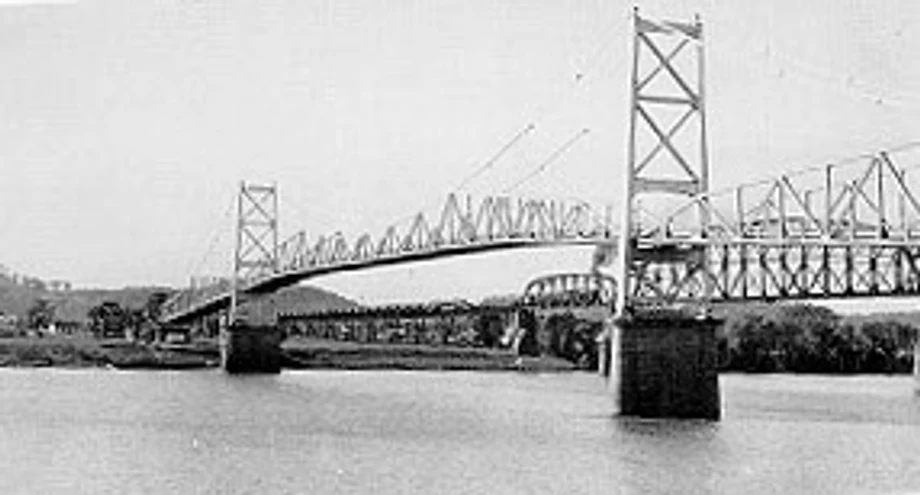
Real photograph. The Silver Bridge in 1928, the year it opened, carrying US 35 between Point Pleasant and Gallipolis on a chain of flat iron eyebars. Everything around it in this story is invented; the bridge, and the chain, are not. (US Federal Highway Administration, public domain.)
IV. The Man Who Kept Notes
John Keel came to West Virginia and stayed, on and off, through 1967, and the town let him in because he listened.
His fixer and equal was Mary Hyre, the Point Pleasant correspondent for the Athens Messenger, a woman who knew every road and every family and who took the reports seriously enough to write them down and unseriously enough to keep working. Between them they accumulated the material that became The Mothman Prophecies in 1975: the sightings, the sourceless phone calls, the visitors with the wrong questions and the wrong clothes, the men in black who came to see witnesses and always got one detail of being human embarrassingly wrong.
And the prophecies, which are the part everyone remembers and nobody quite quotes accurately, because they were not prophecies. They were smears. A power failure, coming. Something disastrous around Christmas. A sense, arriving through a dozen unreliable channels, that the town was standing on a countdown.
Keel spent the back half of 1967 in a state that his own book describes with unusual honesty as being lied to, systematically, by an intelligence that appeared to be enjoying it. He came out the other side no longer believing he was writing about spacecraft. He had invented, or arrived at, the idea that would define his life: that whatever this is, it is not visiting from a planet. It is local, older than us, permanently present, and it communicates the way weather communicates, in pressure and omen, and it dresses in whatever the century will accept. Angels once. Fairies for a while. Airships in 1897. Saucers after 1947. Wings and red eyes on a river town in 1966. Jacques Vallée arrived somewhere adjacent from a different direction, and called it a control system.
Keel got closer than anyone. He simply had the polarity backwards. He thought he was being toyed with by something that liked mischief.
He was being briefed, badly, by something with no vocabulary for the thing it was trying to say, and he had been the only reliable channel for months, which is why the calls came to him and not to anyone sensible.
V. 5:04
Friday, 15 December 1967. Rush hour, Christmas shopping traffic, the Silver Bridge over the Ohio River carrying US 35 between Point Pleasant and Gallipolis, standing since 1928, backed up bumper to bumper across both lanes.
At about two minutes past five, people on the bank heard a sound like a gunshot.
An eyebar in the north chain, the flat iron bars that carried the whole load, had a flaw in it about a tenth of an inch deep, which had been growing since the bridge was built and which nobody had ever seen because the design gave inspectors no way to look. The bar failed. The chain unzipped. The deck went into the river in under a minute with thirty-one vehicles on it. Forty-six people died.
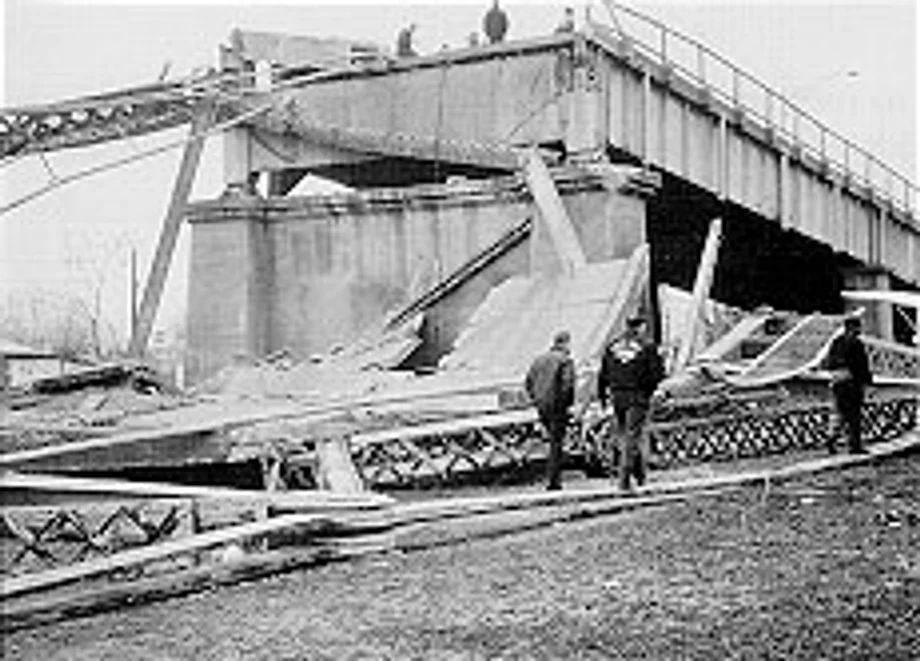
Real photograph, Ohio side, after the collapse of 15 December 1967. Forty-six people died here. Nothing in this story about why is true. (US Federal Highway Administration, public domain.)
The Mothman reports essentially stop after that date. Mary Hyre died in February 1970. Keel’s book came out five years later; the film came out in 2002; the festival started that same year and the twelve-foot metal statue went up in 2003, and Point Pleasant, which is a town that has had one thing happen to it, sells the monster on t-shirts because the alternative is selling nothing.
The metal figure downtown has an expression on it, if you look. Everyone says wings. Nobody mentions the mouth.
He was on the Ohio bank at 5:04 and he was doing the thing with the face, because after fourteen months it had become the only setting he had.
He watched the chain go. He logged it: the time, the load, the temperature of the water, the count. Forty-six. That was the work. That had always been the work.
He had not come to prevent it. His people were, exactly as he had told the salesman on the road, from a country very much less powerful than this one; they held no authority over iron, and none over the men who had built it, and none over the fourteen months of ordinary chances anyone in the state might have taken to look properly at a thirty-nine-year-old chain. They were observers, and one of them had made the amateur’s mistake, had gone off-protocol and tried to say something, and had discovered that a species that cannot hear a warning will absolutely feel one.
He had made a town frightened of the woods, and the bridge had fallen down.
Somewhere in a record that has no reader here, next to the count, he entered the note his kind enter at the end of a long observation, the one that reads: subject population alerted successfully, alert incorrectly localised, no reduction in loss. Interference not recommended.
And then he stopped grinning. There was no longer anyone to do it for.
Coda: what’s real, and what isn’t
Real. On 11 October 1966 two boys in Elizabeth, New Jersey, James Yanchitis and Martin Munov, reported a tall grinning figure behind a fence beside the New Jersey Turnpike; John Keel interviewed them within days and believed them, and that account is the origin of the “Grinning Man” of American folklore. On 2 November 1966 Woodrow Derenberger, a sewing-machine salesman, reported that a craft resembling an old kerosene lamp chimney landed on Interstate 77 near Parkersburg, West Virginia, and that a man in a glossy dark coat spoke to him without moving his mouth, gave his name as Cold, and said words to the effect of do not be afraid and we come from a country much less powerful than yours. Derenberger really did hold a press conference, really was interviewed at length on WTAP, and later described the being’s home as Lanulos. On 15 November 1966 Roger and Linda Scarberry and Steve and Mary Mallette reported a large winged figure with red eyes near the TNT area outside Point Pleasant; a newspaper editor coined “Mothman”; more than a hundred reports followed over the next thirteen months. Mary Hyre of the Athens Messenger really did cover it and really did work alongside Keel, and really did die in February 1970. Keel’s The Mothman Prophecies (1975) is real, as is his ultraterrestrial thesis and his own account of being deliberately misled. The Silver Bridge really did collapse at about 5pm on 15 December 1967, from the failure of a single flawed eyebar, killing 46 people. The 2002 film, the annual festival and Bob Roach’s 2003 statue are all real.
Not real. Cold, as a person with motives. His side of any of these encounters, the logs, the protocol, the count, the note at the end. That the grin was an interface artifact assembled from photographs. That the Mothman shape was designed, that the “prophecies” were a mistranslated maintenance notice, or that anything non-human knew about the eyebar. All invented, entirely, by this story.
Worth saying plainly. Three things.
First, the grin is not in Derenberger’s account at all. He described a man who “had a smile on his face, he appeared very courteous and friendly”, which is a different thing entirely; the fixed, unnatural grin migrated in from the New Jersey boys through Keel’s synthesis, as Brian Dunning has pointed out (Skeptoid #367). The single most famous detail in the legend is therefore a documented case of folklore assembling itself in real time, and this story takes that graft and pretends it is evidence. It is the opposite of evidence. The hero image above is built the same way, and says so.
Second, the sighting counts. “More than a hundred” is the figure that circulates, but Dunning went through the 1966 newspaper archives and found something closer to half a dozen contemporary reports, with inconsistent descriptions. Joe Nickell has argued the red eyes belong to a local barn owl rather than the sandhill crane usually offered. And the link between the creature and the bridge appears to have been made first by Gray Barker in a 1970 book, not by anyone in Point Pleasant in 1967. In other words, the very structure this story is built on, thirteen months of warning followed by a disaster, was itself assembled after the fact by authors. That is not a footnote to the story. It is arguably the real story.
Third, and least fun: the bridge did not fall because a town was distracted. It fell because of stress-corrosion cracking in a component that the 1928 design made impossible to inspect, in an era with no mandatory bridge inspection standard, which the collapse itself is the reason we now have. Forty-six people died of engineering and of the state of the art, and every one of them has a name that is not in this story. The supernatural reading is a comfort, and it is worth being honest about what it comforts us against, which is that infrastructure is quietly load-bearing on all of us all the time, and the only omen you actually get is a report nobody funded anyone to read.
The genre’s forbidden question here is what if something tried to warn them and the warning came out as a monster?
The honest answer is that the warning came out as a monster because we are the ones who make monsters out of things we cannot metabolise, and the iron was cracking the whole time, in a language we could have read.
Every new case, scored the same way
One email when a case file lands, with its Signal-Strength score and what would move it. No hype, no 'BREAKING', and every claim carries its source. Unsubscribe anytime.
Sources
- [1] Mothman, Wikipedia
- [2] Indrid Cold, Wikipedia
- [3] Silver Bridge, Wikipedia (collapse of 15 December 1967, 46 deaths, eyebar failure)
- [4] John Keel, The Mothman Prophecies (1975), Wikipedia
- [5] Skeptoid #367, Brian Dunning, Who Is the Grinning Man?
- [6] Skeptoid #159, Brian Dunning, The Mothman Cometh
Read next
More Fiction, maybe? →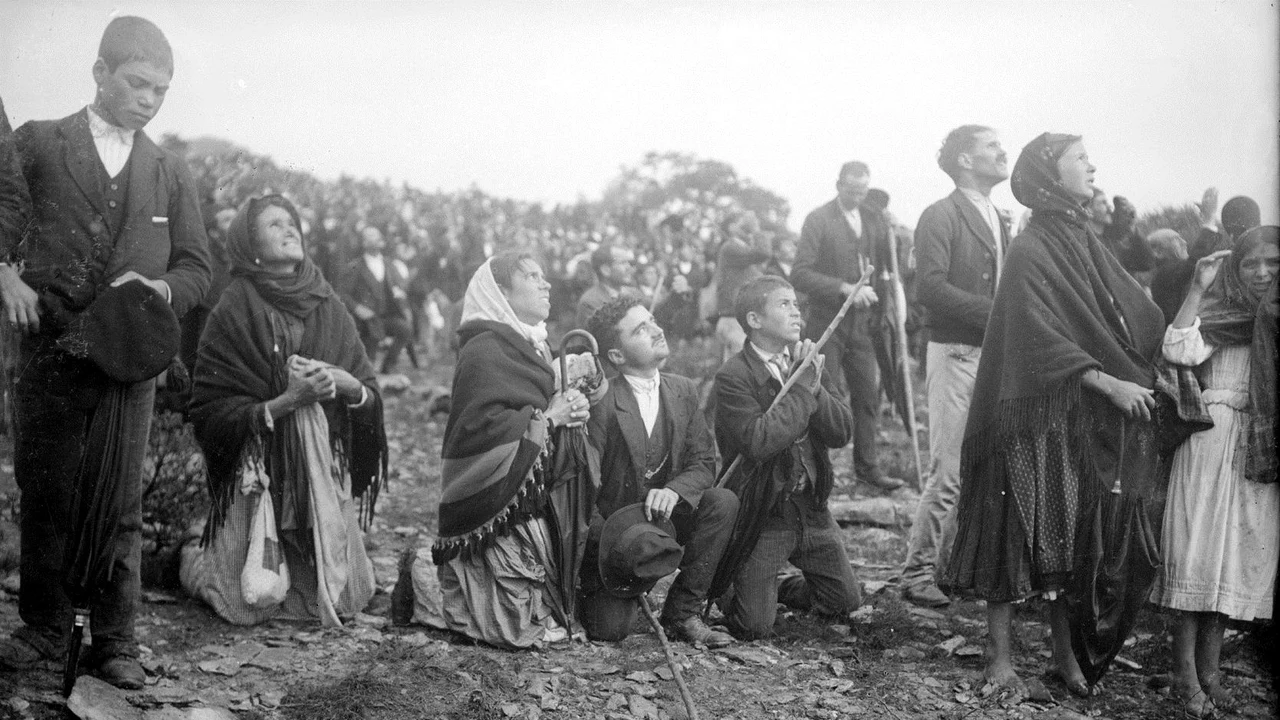
The Sun Dance
A speculative thriller, and a work of fiction. Every anchor is real: the six apparitions at the Cova da Iria in 1917, the three shepherd children, the anticlerical reporter who came to laugh and filed the strangest column of his career, the tens of thousands who stood in the rain on 13 October and watched the sun come loose, the secret written down in 1944 and kept sealed until 2000. The only invention is who was on the other end, and why it chose the shape it chose.
Passport to Magonia: The Scientist Who Said the UFO Is a Control System
Jacques Vallée helped build the early internet, mapped Mars for NASA, and was the model for the French scientist in Close Encounters. He is also the man who argued the UFO is neither alien spacecraft nor hoax, but a recurring control system that has worn fairy lore, religious apparitions, and now starships as its costume. It is the most serious version of the occult reading, precisely because it comes from the least occult person in the field.
The Office Against the Ships of the Air
A work of fiction built on a real silence. Medieval sources describe ships sailing on the clouds: Agobard of Lyon in 815, Irish annal-keepers in the 740s, Gervase of Tilbury around 1211, and a Norse king's mirror that puts an anchor in the church door at Clonmacnoise. Not one of them records what the priest was supposed to say. We wrote the rite that is missing, labelled every line of it as ours, and then explained why it would not have worked.
Follow the thread
New disclosure reporting, physics breakdowns, and case files, in your inbox. Sources or it didn't happen. No spam, unsubscribe anytime.