The Spacegun
A speculative occult-thriller, and a work of fiction. Every anchor is real: Wilhelm Reich and his 'orgone' energy, the cloudbuster he aimed at the sky and renamed a 'spacegun,' the 1954-55 'OROP Desert Ea' expedition in Arizona where he believed he was fighting UFOs, the August 1956 court-ordered burning of his books, and his death in a federal prison in 1957. The only thing invented is the secret cause stringing them together, that the spacegun worked, and that what he touched in the sky was looking back.
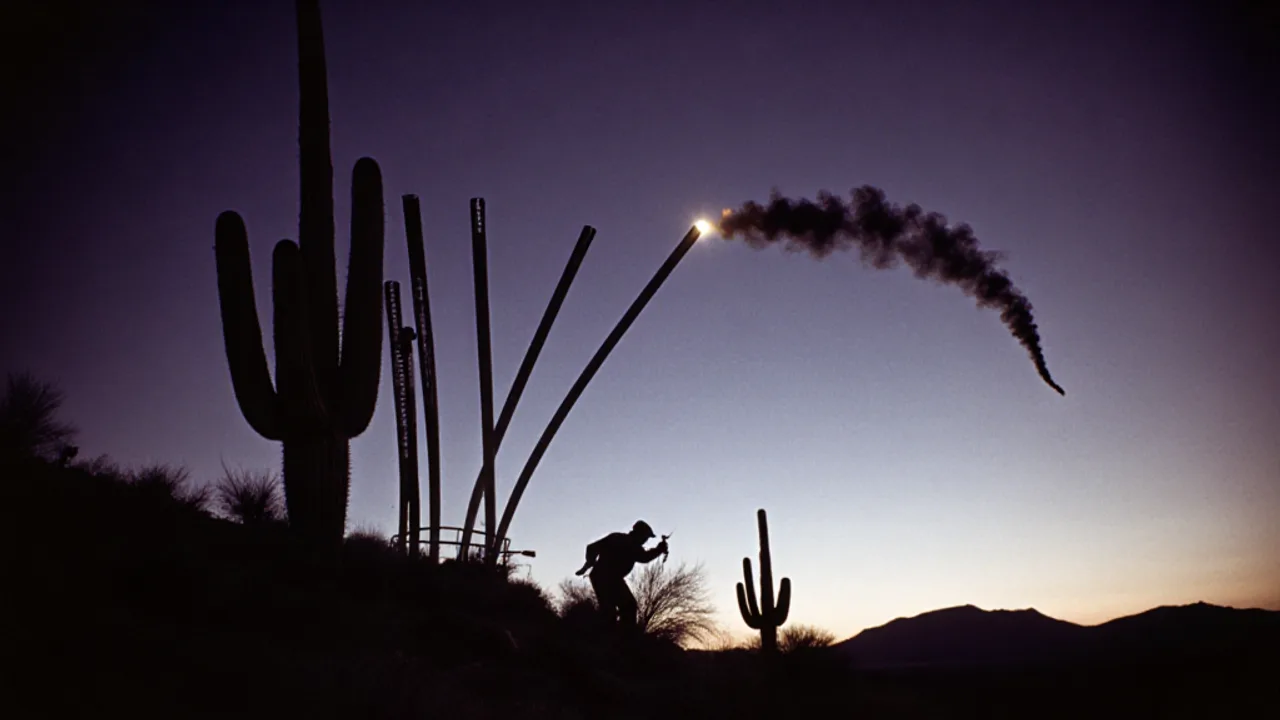 AI illustration
This is fiction built on a real life. The man, the machine, the desert expedition, the burned books, and the prison are all documented; only the thing in the sky, and what it wanted, are invented. The coda separates the two.
I. Orgonon, Maine, 1951
There is a kind of weather that does not show on any instrument, and Wilhelm Reich was the only man in Rangeley who claimed he could feel it coming.
He had built his life on a hill above a lake in western Maine, a hundred and seventy-five acres he called Orgonon, with a flat-roofed laboratory of glass and fieldstone that looked, against the spruce, set down rather than built. He was Austrian, fifty-four, a former star of the Vienna psychoanalytic circle who had quarreled his way out of three countries and arrived in America certain that he had found, beneath Freud’s libido and beyond physics’ fields, the actual substance of life. He called it orgone. A blue energy, the thing the sky was made of, and the sea, and the heat off a living animal, and the part of a person that withers when they are afraid.
In 1951 he conducted the experiment he would spend the rest of his life regretting. To learn what orgone would do near radioactivity, he sealed a milligram of radium inside one of his orgone accumulators, the layered metal-and-organic boxes he believed concentrated the blue energy.
The reaction, by his account, did not stay in the box. The staff fell ill. The instruments behaved badly. The air turned a sick brownish-grey, he wrote, and the rock of the hill itself seemed to sour. He gave the spoiled energy a name, because naming was how he kept hold of frightening things: DOR, Deadly ORgone, the same blue life turned stagnant and hostile. The trees on the ridgeline died in a pattern.
That should have been the end of it. But late that autumn, looking up from the dead ridge, Reich began to notice the lights.
They came at night, over the lake, moving wrong, not the steady drift of a planet or the blink of an aircraft but a sliding, deliberate progress, and behind each one, faint against the stars, a smear of the same brownish dark he had seen leak from the accumulator. Cigars of light with what looked like windows in them. They left DOR in their wake the way a boat leaves a wake, and where they passed, he was convinced, the energy of the place went stagnant and the trees gave up.
A reasonable man tells himself it is swamp gas, or grief, or the radium working on his nerves. Reich, by 1951, was no longer reliably reasonable. He decided the lights were craft, that the craft ran on his blue energy and fouled it as exhaust, and that the planet was, the word he chose was not metaphorical, under attack.
He gave the things in the sky a name, too. He called them the Ea. Energy Alpha. The primordial force, weaponized and aimed at the Earth.
And he remembered that he already owned a machine that touched the sky.
II. The Desert, Arizona, 1954-1955
The cloudbuster was a homely thing: a bank of long hollow pipes on a swivel, grounded into running water by cables, like an anti-aircraft battery designed by a plumber. Reich had built it to draw, to reach into the atmospheric orgone and pull, the way you pull a plug, breaking a drought by tipping the sky out of balance until the clouds collapsed into rain. In Maine, blueberry farmers had quietly paid him to do exactly that, and the rain had quietly come.
In the spring of 1954 he loaded the pipes onto a trailer and drove south, into the Arizona desert outside Tucson, on an expedition he logged under a military-sounding cipher: OROP Desert Ea. The public reason was drought, the desert, he argued, was not a climate but a wound, DOR-stricken land under a stagnant sky. The private reason was the lights. Because the Ea were here too.
He pointed the cloudbuster at them. When he aimed it at a planet that would not stop pulsing, at Venus low and swollen on the horizon, at the cigars that crossed it, he was no longer drawing rain. He was drawing them. He gave the machine a second name for this work, the name that has kept the whole episode alive in the folklore ever since.
He called it the spacegun.
By every documented account he believed it functioned. He aimed, he drew, and the lights, he wrote, would flicker, dim, retreat. And the land answered: by the end of that first March the rains came to ground that had not held a storm in years, the flats greened, the expedition recording a drought broken and a desert briefly brought back to life.
This much is in his last book, in his own hand. What is not in any book, what belongs only to this story, is the night the spacegun closed the loop.
The operator at the pipes that night was a young man Reich had trained, a true believer who had followed the doctrine completely and without a parachute. He held the array on a single light, low over the saguaro, and drew, and the light dimmed as it was supposed to dim, and then, he said afterward, it brightened. Deliberately. It came back up the scale not like a flame relit but like an eye opening, and it slid off its track and held, dead still, directly above the pipes that were pulling at it.
It had felt the line. And it had followed the line home.
The young man’s account is the only one. He said the cold that came down the cables was not the cold of altitude, that it took the feeling from his fingers first and then the certainty from his mind, and that for one held moment he understood the whole arrangement at once: that orgone was not Reich’s discovery but the medium, the ocean the sky was made of, and that the Ea did not run on the blue energy so much as live in it, the way a fish lives in water, and had been swimming in it, over us, since before there were trees on the ridge to die.
Reich thought he had built a weapon. What he had built was a doorbell. You do not ring a doorbell at an empty house.
III. Gansevoort Street, New York, 23 August 1956
The machinery that came for him was not the Ea. It was an injunction.
In February 1954, the same season the cloudbuster went south, the United States, through the Food and Drug Administration, had moved against the orgone accumulators, calling them a fraud, and won an order, by default, that the devices and their literature be destroyed. Reich’s reply was that no court was competent to rule on a natural science, and he kept working, which the law regards as contempt.
On the morning of 23 August 1956, on Gansevoort Street in Lower Manhattan, FDA officials supervised the feeding of roughly six tons of his publications into a municipal incinerator. Books, journals, the bulletins of the orgone research, his name on the spines, going grey, going up. It is one of the most thoroughly documented book burnings in American history.
The official record says this was the enforcement of a fraud injunction, no more, the state destroying quack literature about a box that did nothing.
The story says otherwise. It says that somewhere between 1954 and 1956, in a room with no windows, someone with a clearance read the desert logs and understood the one sentence that mattered: the spacegun worked. That the heretic in Maine had stumbled onto the physics of the medium, the blue ocean the visitors moved through, and built the only instrument on Earth that could reach into it and make one of them flinch. That is not a fraud to be enjoined. That is a manual to be burned.
And the genius of an injunction is that it requires no belief in anything strange. You do not tell the clerk feeding the incinerator that he is destroying a contact protocol. You tell him it is fraud, and the sentence that mattered goes up the chimney with everything else, and the official truth, it did nothing, is left standing precisely because it is so much more comfortable than the alternative.
IV. Lewisburg, Pennsylvania, 1957
They sent him to prison for the contempt.
First to Danbury, in Connecticut, and within days to the federal penitentiary at Lewisburg, in the Pennsylvania hills. He was sixty. The intake psychiatrist judged him sane; he spent his time, the records suggest, walking the yard and looking up, writing appeals to a Supreme Court that would not hear him.
On the morning of 3 November 1957 a guard found him dead in his cell. The prison doctor wrote heart failure, myocardial insufficiency, the heart simply stopping in the night. He was due to be eligible for parole the following day. One day.
The death is real, and the cause on the certificate is most likely true: an old, furious, exhausted heart in a cold cell, giving out at the worst imaginable hour. The story does not make it murder, and it will not. It only notes what it has noted all along, that the most dangerous thing about Reich was never the box the FDA hated. It was the pipes; it was the night in the desert when something turned and looked down the line at the men holding the other end. You do not have to kill such a man. You only have to make sure that when he dies the official word is fraud, the books are already ash, and the one apparatus that ever made the sky flinch is filed under quackery, where no serious person will think to look.
V. Orgonon, and After
He is buried on the hill in Maine, beside the laboratory, under a bust of his own stern face. The estate is a museum now, and the staff will tell you, gently and accurately, that orgone is not a recognized science and that the accumulators do nothing a doctor would prescribe.
In 1973 his son Peter, the small boy at the pipes in the home movies, published a memoir of his father called A Book of Dreams, a child’s-eye account of cloudbusting on the hill, written out of love and loss and not out of any conspiracy. In 1985 an English musician read it, was moved to tears, and made of it a song called “Cloudbusting,” with a film in which an actor played Reich and a machine on a hilltop pulled rain out of an indifferent sky. None of these people are part of any secret. What they made is allowed simply to be a sad and beautiful thing about grief.
But the narrator of this story, who is fiction, and admits it, cannot let the hill alone. Because the reports have started again. Not cigars now but spheres: the orbs people have been filming over highways and bases and harbors through 2024, 2025, into this strange spring of 2026, silent lights that drift wrong and split and rejoin and leave the watchers cold. The official word, when there is one, is the word it has always been, drones, balloons, artifacts, go back to sleep.
And the narrator, watching the new lights slide over the old lake, thinks only this: he built one machine that could reach up and touch them, and we burned the instructions for being a fraud. We have never built another.
Coda, What’s real, and what isn’t
This one wears a real and rather sad biography as its coat, so the seams should be plain.
Real. Wilhelm Reich (1897-1957) was an Austrian-born psychoanalyst who, in his American years, proposed a life-energy he called orgone and built “orgone accumulators” and “cloudbusters.” Orgonon was his real 175-acre estate in Rangeley, Maine, now the Wilhelm Reich Museum, where he is buried. He really did believe, from at least early 1954, that Earth was being attacked by UFOs he termed “Ea” (Energy Alpha); really described cigar-shaped craft trailing what he called DOR (Deadly Orgone Radiation), really aimed his cloudbuster at lights in the sky and renamed it the “spacegun,” and documented all of it in his final book, Contact With Space (Core Pilot Press, 1957), which logs the OROP Desert Ea expedition near Tucson, Arizona, in 1954-55. The FDA really did win a 1954 injunction calling the accumulators fraudulent and ordering them and his literature destroyed; roughly six tons of his publications really were burned in a New York incinerator on 23 August 1956; and Reich really died of heart failure in the federal penitentiary at Lewisburg, Pennsylvania, on 3 November 1957, shortly before he was due to be eligible for parole. His son Peter Reich’s memoir A Book of Dreams (1973) and Kate Bush’s song “Cloudbusting” (1985) are both real.
Not real. That the spacegun worked. That the Ea are real, that they live in orgone “like fish in water,” that one of them turned and followed the beam back to the operator. That anyone in government understood the desert logs as a contact protocol, or burned the books as a manual rather than as the fraudulent literature the court had ruled them to be. The young operator and his account are invented. The link from Reich’s 1950s lights to the 2020s orb sightings is the narrator’s speculation, offered as fiction, not as a claim about either.
And one thing worth saying plainly, outside the story: orgone is not established science. It has never been measured by any reproducible method, the accumulators do nothing therapeutic, and on the medicine the court that called them fraudulent was very probably right. But the 1956 burning of his books was still a real and disgraceful act, destroying a man’s published work by court order is something a free society should find shameful regardless of whether the work was any good. A wrong done to an idea is not proof of it: they should never have burned his books, and the books were wrong.
The fun of the genre is to take a real heretic, a real machine, and real ash, and ask the forbidden question, what if they buried it because it worked?, while knowing the honest answer is no.
He pointed a bank of pipes at the sky and believed the sky flinched. It didn’t. But it’s a better story if it did, and a story is the safest place to keep a doorbell no one should have built.
Every new case, scored the same way
One email when a case file lands, with its Signal-Strength score and what would move it. No hype, no 'BREAKING', and every claim carries its source. Unsubscribe anytime.
Sources
Read next
More Fiction, maybe? →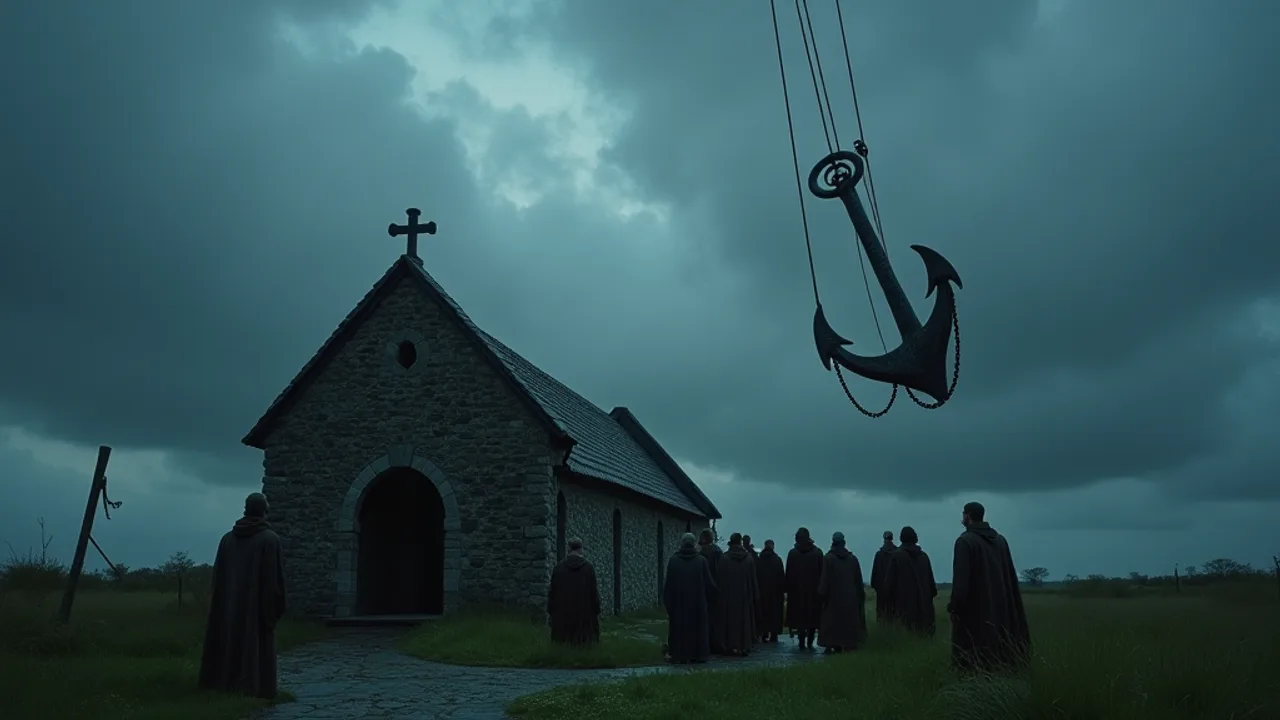
The Office Against the Ships of the Air
A work of fiction built on a real silence. Medieval sources describe ships sailing on the clouds: Agobard of Lyon in 815, Irish annal-keepers in the 740s, Gervase of Tilbury around 1211, and a Norse king's mirror that puts an anchor in the church door at Clonmacnoise. Not one of them records what the priest was supposed to say. We wrote the rite that is missing, labelled every line of it as ours, and then explained why it would not have worked.

The Sixth Tranche
A work of fiction. The Pentagon has published five tranches of UAP files at war.gov/ufo, with dates and locations redacted to protect witnesses, and says more are coming. This story imagines the sixth, and the volunteer archivist who mirrors it at two in the morning and finds one file whose metadata does not agree with the others. No sixth tranche had been published when this was written. Everything about it below is invented.
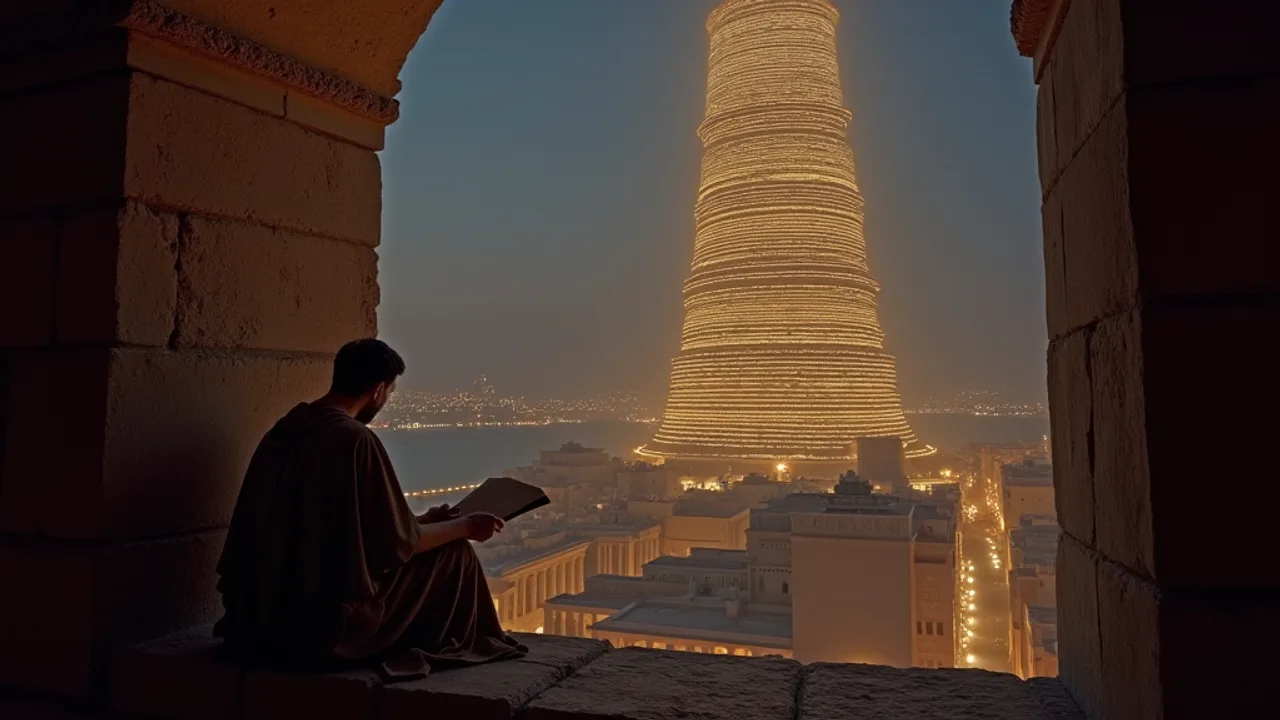
Basilides, Exegetica, Book Thirteen
He wrote twenty-four books in Alexandria around the year 130. We have a page and a half, quoted by men who were refuting him. The most disturbing idea attributed to him is that ignorance is installed on purpose, as an act of mercy. This is the middle book, invented, arguing that case.
Follow the thread
New disclosure reporting, physics breakdowns, and case files, in your inbox. Sources or it didn't happen. No spam, unsubscribe anytime.