The Shambhala Signal
A speculative occult-thriller. The painter, the expedition, the sky-object, the symbol, and the cabinet secretary are all real; the intelligence threading them together is not. In 1927 Nicholas Roerich's caravan watched a shiny oval cross the sky over Central Asia, one of the earliest documented UFO sightings. He was looking for Shambhala on the orders of a Himalayan 'Master,' and a few years later a U.S. cabinet secretary who called him 'Guru' helped put an eye and a pyramid on the dollar bill. This is a story about a sign being planted where everyone would carry it and no one would read it.
 AI illustration
This is fiction built on real history. Nicholas Roerich, his 1925-28 expedition, the 1927 sky-object, the Master Morya of Theosophy, the Banner of Peace, Henry Wallace’s “Dear Guru” letters, and the eye-and-pyramid on the dollar are all documented. The intelligence connecting them is invented. A plain accounting of what’s real and what isn’t follows the story.
I. Darjeeling, 1925
A man who is being directed by a voice he cannot prove will, if he is wise, learn to walk as though the voice were merely a strong opinion of his own. Nicholas Roerich had learned this. He was a famous man by 1925, a painter whose canvases hung in Paris and Moscow, a stage designer who had dressed the premiere of The Rite of Spring, a scholar of the old north, and famous men are watched. So when he assembled a caravan at Darjeeling and pointed it north into the highest and least-mapped country on earth, he told the newspapers he was a painter going to paint mountains.
He was going to find a kingdom.
He did not call it that to the reporters. To the reporters he said expedition, survey, botanical and ethnographic. But Helena, his wife, knew, and the lamas who joined the caravan knew, and the small core of the party who had read the books Helena had been writing since 1920, books that bore no author’s name on the frontispiece, because she did not believe the wisdom in them was hers to own, they all knew.
They were looking for Shambhala. The hidden kingdom. The place behind the mountains where, the old texts said, the teachers of the world had withdrawn to wait out a dark age, and from which, at the turning of that age, a king would ride out at the head of an army of light.
And they were looking for it because they had been told to.
The one who told them was called Morya. Helena called him the Master, or simply M. He was, she said, one of a brotherhood of adepts headquartered somewhere in the high snows, men who were not entirely men, who had outlived the ordinary span by orders of magnitude, who corresponded with her by means no postal service could explain and who had taught her, line by line, the doctrine she was filling notebook after notebook with. The same Master, in fact, who had taught Helena Blavatsky two generations before. The brotherhood did not die. It only changed its students.
Morya had given the Roerichs a route. Not a metaphor of a route, a route, with stages, that bent through Kashmir and Chinese Turkestan and the Altai and Mongolia and the Tibetan plateau in a long, deliberate arc. Years later a scholar looking at a map would notice that the arc was very nearly a circle, the kind of circuit a pilgrim walks around a holy mountain to keep the sacred thing always on his right hand.
They were not walking toward Shambhala.
They were walking around it. Closing a loop. Drawing a sign on the floor of Asia with three years of footsteps, the way a man might draw a circle on the ground before he calls something down into it.
II. The Kukunor District, 5 August 1927
It happened at half past nine in the morning, in clear weather, and there were more than enough witnesses, which is exactly the problem with it.
The caravan was in camp in the Kukunor country, in the cold bright air near the Humboldt Range, when one of the men pointed up at a large black eagle wheeling over the camp. Seven of them tipped their heads back to watch the bird.
Then a caravaneer said there was something far above the eagle.
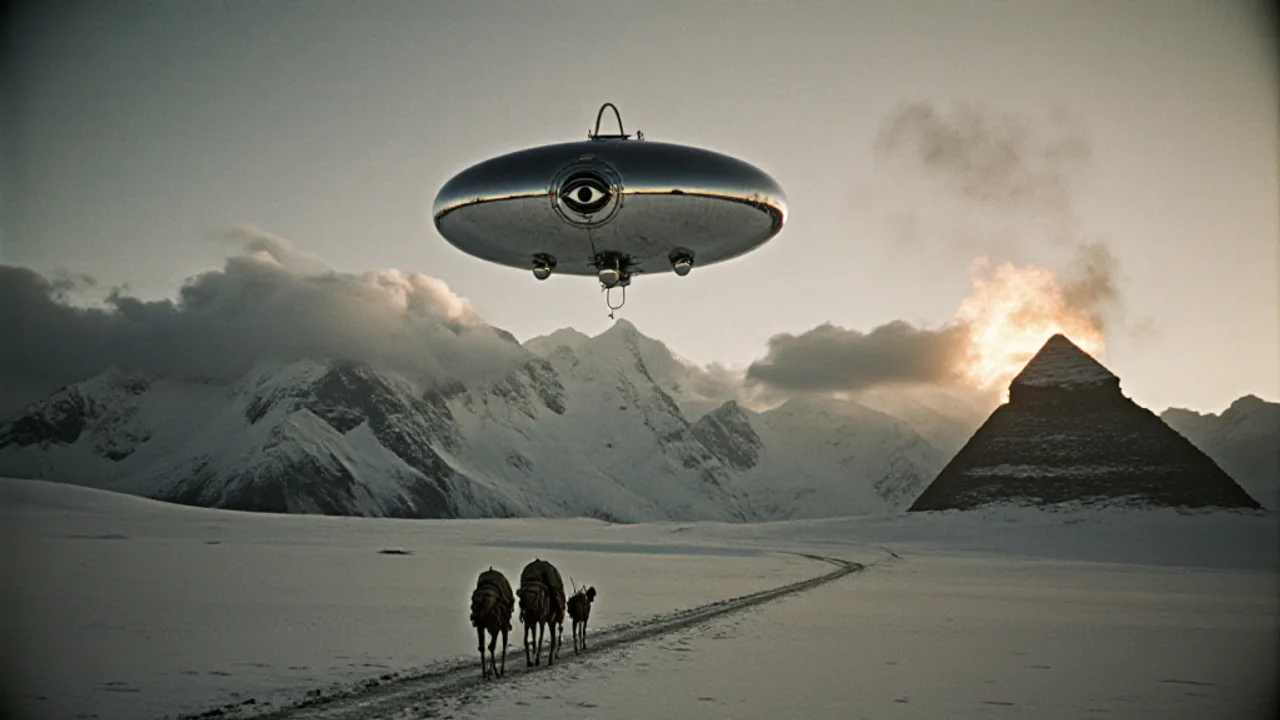
Roerich raised his field glasses. High up, much higher than the bird, something big and oval was crossing the sky from north to south, and it was shiny, it threw back the morning sun off a curved surface the way a struck coin throws light, one whole flank of it brilliant. It moved at a speed nothing in 1927 moved at. And as they watched, the oval changed direction. It swung sharply to the southwest and was gone over the ridgeline, leaving seven men on a cold plateau holding their breath.
Roerich wrote it down. He was a writer as much as a painter, and the entry went into the journal that became his book Altai-Himalaya. He recorded the details a careful witness records: the time, the weather, the angle, the field glasses, the abrupt turn. He did not say it was a chariot of the gods. He was too disciplined for that. He described a shining oval object that maneuvered, and he let the reader feel the floor tilt.
It is, by any honest reckoning, one of the earliest carefully documented UFO sightings on record, twenty years before a pilot named Arnold gave the world the phrase flying saucer. People who hunt for such things have been quoting the Kukunor entry ever since.
What none of them could quote, because Roerich never wrote it down, was what the lama traveling with the party said that night by the fire.
The lama was not surprised. That was the unnerving thing. He looked at Roerich across the dung-fire and he was calm, the way a man is calm when a long-expected guest finally knocks. He said that the shining thing was a sign of Rigden-jyepo, the ruler of Shambhala, and that it meant the kingdom knew they were near. He said the Blessed Ones rode in such vessels. He said the brilliance they had all seen was the same brilliance the old paintings put around the heads of teachers, and that the painters had not been inventing a halo. They had been reporting one. They had seen the light a body throws when the thing inside it is not from here.
Roerich painted mountains for the rest of the expedition. But in the corner of more than one canvas after that summer there is a small bright oval in the sky that the catalogues, politely, call a study of cloud.
III. Kullu, 1928
The expedition came down out of Tibet in 1928 and the Roerichs settled in the Kullu valley, in the western Himalayas, where Nicholas founded a research institute and named it Urusvati, “the light of the morning star.” From its windows you could see the snows he believed the brotherhood lived behind.
He had come back with three things.
He had come back with the journals, which he published, and which made him more famous still. He had come back with a conviction, which he did not publish, that the vessel over Kukunor and the kingdom under the snow and the Master who wrote to his wife were one connected fact, three faces of a single intelligence that had been steering the human story from behind the mountains for longer than there had been history to steer.
And he had come back with a symbol.
He said he had found it everywhere on the journey, which was true, it is an old design, three spheres bound inside a ring, and you can find it on Tibetan stones and Byzantine icons and the breast of a Memling Madonna if you go looking. Roerich went looking, found it, and decided it was the oldest sign there was: three dots in a circle, which he read as past, present, and future held within the ring of eternity.
He built a peace movement around it. A banner, white with the three red spheres, to be flown over museums and cathedrals and libraries so that an army would know not to shell them, Pax Cultura, peace through culture. He drafted it into a treaty. And in time the treaty would be signed in the White House, and the banner would fly over a few dozen nations, and a great many people would salute three red dots in a ring without any idea that the man who gave it to them believed it had been handed up out of a hidden kingdom by beings who were not men.
He had been given a sign and told to spread it. He thought he understood why. He thought it was about peace.
He had not yet met the American.
IV. Washington, 1934-1935
The American was the Secretary of Agriculture, and he was a true believer.
Henry Wallace was a serious man, a plant geneticist who had bred a hybrid corn that genuinely changed how a continent fed itself, a future Vice President of the United States. He was also, privately, a spiritual seeker of the restless, omnivorous kind, and somewhere in the early 1930s he had found Roerich and the doctrine of the morning star, and he had fallen for it completely. He wrote the painter letters. He addressed them, some of them, to Dear Guru. He signed himself Galahad. He referred to the President of the United States, in these letters, as the Flaming One, and he wrote of the coming of a new age in language the brotherhood would have recognized, because it had come, by a long downhill road, from them.
Wallace did two things for his Guru.
The first: in 1934 he put the United States government behind a Roerich expedition. Officially it was a Department of Agriculture mission to Central Asia to collect drought-resistant grasses for the dust-stricken American plains. Roerich went east again, and promptly began behaving like a man on a very different errand, roaming the Mongolian borderlands with armed Cossacks until the diplomatic cables piled up and Wallace, mortified, was forced to cut him loose. The friendship died. The letters became a liability that would haunt Wallace’s career for the rest of his life.
But by then the second thing was already done, and it could not be undone, and it is in your wallet.
In 1935, Wallace was leafing through State Department papers and was arrested by the reverse of the Great Seal of the United States, the unfinished pyramid, and floating above it in a triangle of rays, the open Eye. Annuit Cœptis: He has favored our undertakings. Novus Ordo Seclorum: a new order of the ages. To a tired bureaucrat it was a forgotten piece of heraldry. To a disciple of the morning star it was a recognition. Here was the unfinished work and the watching intelligence and the promise of a new age, stamped a century and a half ago into the founding seal of the most powerful young nation on earth, waiting.
Wallace took it to the Flaming One. And Roosevelt, who had his own affection for Masonic emblems and the long view of history, agreed to print the reverse of the seal on the one-dollar bill.
So in the same year that the Banner of Peace was signed in the White House, the open Eye and the unfinished pyramid went onto the most widely handled object in the Western world.
Here is where the story leaves the record and says the quiet part.
Two sigils, planted in one country in one year, by one man and the disciple who called him Guru. The three spheres over the temples of culture, where the keepers of the long memory would gather. And the Eye over the pyramid on the money, in every hand, every till, every pocket, a beacon set not in a temple where only the initiated would see it, but in the one place where it would be touched a billion times a day by people who would never, ever read it. A signal does not need its carriers to understand it. A signal only needs to be broadcast. And there is no broadcast on earth louder than a nation’s currency.
Roerich believed he was spreading a banner for peace. Wallace believed he was honoring a beautiful old seal. Neither man, the story says, was the author of what he did. They were the relays. The author was behind the snows, and had been since a shining oval turned in the sky over Kukunor, and had only ever wanted one thing planted where the new power of the world would carry it without knowing:
a mark. So that when the kingdom finally rode out, it would already know exactly whose pocket to look in.
Coda, What’s true, and what isn’t
Because this is fiction wearing history’s coat, here are the seams.
Real. Nicholas Roerich (1874-1947) was a celebrated Russian painter and set designer (he co-designed Stravinsky’s Rite of Spring) and a committed Theosophist. He and his wife Helena led a genuine Central Asian Expedition from 1925 to 1928 and afterward founded the Urusvati institute in the Kullu valley. Helena Roerich transmitted the Neo-Theosophical teaching called Agni Yoga, attributed to a Himalayan “Master Morya”, the same Master claimed by Blavatsky. On 5 August 1927, in the Kukunor district, Roerich’s party really did observe a shiny, fast-moving oval object that changed course, an account he published in Altai-Himalaya (1929); it is frequently cited as one of the earliest documented UFO-type sightings. The “Banner of Peace” (three spheres in a ring) and the Roerich Pact are real, and the Pact was signed at the White House in 1935. Henry A. Wallace, Secretary of Agriculture and later Vice President, really was a follower of Roerich, really wrote the “Dear Guru” letters (signing himself “Galahad”), really sent Roerich on a 1934 USDA expedition that ended in a bitter falling-out, and really championed putting the Great Seal’s reverse, the Eye of Providence over the unfinished pyramid, onto the one-dollar bill in 1935, which Roosevelt approved.
Not real. That the Master Morya is a non-human intelligence; that the 1927 oval was his vessel; that the expedition’s route was a deliberate ritual circuit; that the lama’s fireside interpretation occurred; that Shambhala, the Banner, and the dollar’s eye are one coordinated “signal”; and that Roerich or Wallace were anyone’s unwitting “relays.” The historical reality is more ordinary and, in places, sadder: the Wallace-Roerich relationship was an earthly tangle of mysticism, ambition, and a souring business arrangement, and the eye-and-pyramid is simply a piece of 1782 heraldry whose symbolism has been over-read by two centuries of enthusiasts, this story very much included.
One thing worth saying plainly, outside the fiction: “secret sign on the dollar bill” stories are the oldest engine in conspiracy culture, and they have been used to launder some genuinely poisonous claims about hidden cabals. The fun of the genre depends on remembering that the eye on the bill is not a clue. It is a design. The pleasure is in watching real history rhyme for the length of a story, and then putting the dollar back in your pocket, where it means nothing more alarming than a dollar.
Every new case, scored the same way
One email when a case file lands, with its Signal-Strength score and what would move it. No hype, no 'BREAKING', and every claim carries its source. Unsubscribe anytime.
Sources
- [1] Nicholas Roerich, Wikipedia
- [2] Roerich's 1927 'shiny oval' sighting, Jason Colavito
- [3] Agni Yoga & Master Morya, Wikipedia
- [4] Shambhala, Wikipedia
- [5] Roerich Pact & Banner of Peace, Wikipedia
- [6] Henry A. Wallace & the 'Dear Guru' letters, Theosophy Wiki
- [7] How the Great Seal's Pyramid & Eye got on the dollar in 1935, GreatSeal.com
Read next
More Fiction, maybe? →
The Office Against the Ships of the Air
A work of fiction built on a real silence. Medieval sources describe ships sailing on the clouds: Agobard of Lyon in 815, Irish annal-keepers in the 740s, Gervase of Tilbury around 1211, and a Norse king's mirror that puts an anchor in the church door at Clonmacnoise. Not one of them records what the priest was supposed to say. We wrote the rite that is missing, labelled every line of it as ours, and then explained why it would not have worked.
The Sixth Tranche
A work of fiction. The Pentagon has published five tranches of UAP files at war.gov/ufo, with dates and locations redacted to protect witnesses, and says more are coming. This story imagines the sixth, and the volunteer archivist who mirrors it at two in the morning and finds one file whose metadata does not agree with the others. No sixth tranche had been published when this was written. Everything about it below is invented.
Basilides, Exegetica, Book Thirteen
He wrote twenty-four books in Alexandria around the year 130. We have a page and a half, quoted by men who were refuting him. The most disturbing idea attributed to him is that ignorance is installed on purpose, as an act of mercy. This is the middle book, invented, arguing that case.
Follow the thread
New disclosure reporting, physics breakdowns, and case files, in your inbox. Sources or it didn't happen. No spam, unsubscribe anytime.