The Influencing Machine
A speculative occult-thriller. The welder, the editor, the magazine, and the saucer flap are real; the broadcast under them is not. A factory worker heard voices through a welding coil; a cynical pulp editor printed them as fact; a quarter-million readers wrote back to confirm. Then, weeks after the all-Shaver issue, the flying saucers arrived. A story about the medium as the antenna.
 AI illustration
I. The Factory Floor, 1932
Richard Shaver was a spot-welder, and the trouble began with the welding gun.
He worked the line at a Pennsylvania auto plant, running a handheld rig that threw current through sheet steel, and one shift, he was never able to say exactly when, the rig started doing something it had no business doing. Through the hum of its coil, Shaver began to hear the thoughts of the men working around him. Clear as speech. He assumed, at first, that some freak attunement of the coil’s field had turned the gun into a receiver, and that the thoughts of his coworkers were simply leaking into it the way a radio pulls a station out of the air.
Then the other voices came in, underneath the men’s, on a deeper band.
They were not coworkers. They were coming, Shaver understood, from somewhere far below the factory floor, and they were not thinking ordinary thoughts. He heard cruelty. He heard the technical, bored, workmanlike chatter of beings conducting torture, running rays up through the rock into the bodies and minds of people on the surface, for pleasure, the way a boy burns ants with a glass. He heard them gloating. He heard their victims. He could not turn the gun off in his head after he set it down at the end of the shift.
What happened next is the part that should make you careful with this whole story. Shaver’s life came apart. His brother died in 1934. His first marriage shattered; he would later say his wife was killed by a ray. He was committed, to a state hospital, for years, the diagnosis a clinical one with a long name, and when he came out he wandered, in and out of places like it, hearing the voices the entire time, certain to the marrow that the rig had not made them up but had tuned them in. He gave the underground torturers a name. He called them the dero, detrimental robots, the degenerate remnant of an ancient race that had abandoned the surface and gone down into the cave-cities of a dead world, and stayed, and curdled. He said they could tamper: reach up through miles of rock and meddle with any mind on the surface, plant a thought, twist a hand on a wheel, end a life and make it look like an accident.
A psychiatrist of the period had a precise term for a patient who believes an external device is broadcasting torment into his mind. They called it the influencing machine. It was a textbook symptom, written up decades earlier, well understood.
Richard Shaver was, by every sober measure, a sick man describing his sickness.
He was also about to be the most widely read prophet in America, because in 1943 he wrote it all down in a long, strange letter and mailed it to a magazine.
II. The Letter, 1945
The letter landed on the desk of exactly the wrong man, or exactly the right one, depending on what you think happened next.
Ray Palmer edited Amazing Stories out of Chicago, the flagship science-fiction pulp, owned by Ziff-Davis, sold on every drugstore rack in the country. Palmer was small, barely four feet, his spine broken in childhood and never right again; he lived in chronic pain and had built, on top of it, the most carnival-bright mind in publishing. He was a showman in the P. T. Barnum line, he understood, better than any editor alive, that what sold a pulp was not good prose but the electric promise that the impossible thing on the cover might be true. The staff joke was that Palmer would print anything that moved copies. The joke undersold him. Palmer would print anything that moved copies and made the reader’s neck prickle with the sense that he’d been told a secret.
Shaver’s letter included a “lost language”, an ancient alphabet he called Mantong, the root, he claimed, of every tongue on earth, decoded out of the voices. A junior editor pitched it in the wastebasket. Palmer fished it back out.
He did not print it as a crank letter. He took Shaver’s raw, rambling, anguished manuscript and he rewrote it, expanded it, shaped it, gave it the architecture of a story, and he ran it in the issue dated March 1945 under a title that has the cadence of a memory rather than a fiction: “I Remember Lemuria.” And in the editorial matter around it, in the blurbs and the byline and the breathless front-of-book, Palmer did the thing that turned a sick man’s letter into a movement.
He labeled it fact. Racial memory, he called it. Not a tale Shaver invented but a true history Shaver had recovered: the dero, the caves, the tamper rays, the ruined glory of Lemuria and Atlantis still rotting under our feet.
Amazing Stories sold out. The print run climbed and climbed. Palmer fed it: more Shaver, every issue, the dero crawling up out of the rock and into the American newsstand month after month. He had found the live wire every editor dreams of, and he had the wit, or the cynicism, or something the story will argue was neither, to hold onto it with both hands.
III. The Feedback Loop, 1947
Then the letters started coming back, and that is where the story stops being about two men.
Readers wrote in. Not dozens, thousands. More than two thousand five hundred on the Shaver material alone, and they did not write to say what a fun yarn. They wrote to confirm. Strangers in Oregon and Florida and Saskatchewan, who had never met and never could have coordinated, wrote in to report that they, too, heard the voices; that they, too, had felt the rays; that they had been down in the caves, or knew someone taken there, or had spent their lives being tampered with and had finally, in the pages of a fifteen-cent pulp, found the word for it. Palmer printed those too. The readers read each other’s confirmations and wrote fresh ones, refined now, converging, the rays described the same way, the caves laid out the same way, the dero doing the same things in Idaho as in Maine.
The June 1947 issue was given over to Shaver entirely. An all-Shaver issue. By then the thing had a shape the prose alone had never given it, a shape assembled out of a quarter-million readers all reporting the same phenomenon at once.
Here is what the story wants you to see, and it is only a story’s seeing.
Strip away the question of whether the dero are real and look at the machine Palmer had accidentally built. A national magazine is a transmitter. Its readers are receivers. Palmer had taken one man’s private frequency, the band Shaver swore the welding coil had found, and he had broadcast it, monthly, to hundreds of thousands of minds, and tuned them, with repetition and confirmation and the printed testimony of strangers, until a continent’s worth of people were all listening on the same channel, all primed to receive the same signal, all expecting the same shape to resolve out of the static.
The critics in the science-fiction community were disgusted. They called it dangerous nonsense and they called the readers who believed it the lunatic fringe.
It is a curious phrase to use, the fringe, about the edge of a thing that is built to receive.
IV. The Saucers, June 1947
The shape resolved on the twenty-fourth of June, 1947, three weeks after the all-Shaver issue reached the racks.
A businessman and pilot named Kenneth Arnold, flying his small plane past Mount Rainier in Washington State, saw nine objects skipping across the sky in formation at an impossible speed. He described their motion to a reporter, like saucers skipped across water, and the reporter coined, from that, two words that were about to swallow the century: flying saucers. Within days the entire country was looking up and seeing them. The modern age of the phenomenon began, by the calendar, almost the instant Palmer’s receiving array reached full power.
And the next thread the record hands us is the one no novelist would dare invent, because it is documented and it is absurd.
Days before Arnold’s sighting, two men in Puget Sound, a harbor patrolman named Harold Dahl and his superior, Fred Crisman, claimed a doughnut-shaped craft had spilled hot slag onto their boat near Maury Island. They took their “evidence” to a magazine publisher they trusted to take it seriously. They took it to Ray Palmer. And Crisman was no stranger walking in off the street: Crisman had already written to Amazing Stories, during the Shaver wave, describing his own encounter with the dero in an underground cavern. He was a reader. He was tuned. He had confirmed the signal in print before the saucers came, and now he was reporting it again from the other side, from above, as a disc in the sky, instead of from below, as a torturer in a cave.
Palmer commissioned Kenneth Arnold himself to investigate Maury Island. It collapsed into farce and tragedy, the “wreckage” was beach slag and pumice, Dahl and Crisman were caught in contradictions, and two Army officers who flew off with samples died when their bomber crashed. Skeptics filed it, correctly by every ordinary standard, under hoax.
But Palmer did not file it under hoax. Palmer did the thing he had been building toward for two years: he connected the wires. The saucers, he told his readers, did not come from Mars. They came from where Shaver’s voices came from, from the caves, from the ancient races, from below, and what Kenneth Arnold saw skipping over Rainier and what Richard Shaver heard torturing men under the factory were not two phenomena. They were one broadcast, received through two different windows. From underground it sounded like a tamper ray. From the surface it looked like a disc in the sky.
One signal. Two faces. And Palmer, alone among editors, had a receiver tuned to both.
V. We Print the Truth
The grown-ups at Ziff-Davis finally lost their nerve. In December 1948 management leaned on Palmer, Shaver was cut loose, and Palmer walked out of the magazine he had made famous rather than turn the dial back.
He did not stop. He built a bigger receiver. In 1948 he launched a new magazine of his own, devoted not to fiction labeled as fact but to the thing itself, to saucers and rays and the impossible, sworn true, and for the cover of the first issue he ran Kenneth Arnold’s own first-person account of the nine discs. He called the magazine Fate, and it became the spine of the entire postwar paranormal, the template every UFO publication since has copied. He started another, called simply Flying Saucers. He spent the rest of his life as the impresario of the unexplained, and more than one historian, surveying the wreckage, has called Ray Palmer the man who invented the flying saucer.
The story’s only quarrel is with the verb.
He did not invent it. He tuned it. The flying saucer was not made up in a Chicago editorial office; it was received there, through the largest antenna anyone had yet assembled, a sick welder for a crystal, a genius showman for an amplifier, and a quarter-million primed and listening readers for the array. The phenomenon learned to appear, the story says, the moment enough human minds were finally pointed the same way, expecting the same shape, broadcasting their expectation back into the dark on the exact frequency a patient man with a welding gun had stumbled onto in 1932. The dero rays and the silver discs are the same transmission. Palmer’s only genius was to never once switch the receiver off.
And Richard Shaver, cut loose and forgotten, spent his last decades in the country convinced of one final thing. He collected stones, ordinary rocks, and he became certain that inside them, if you sliced them and knew how to look, were images and texts left by the ancient races: a library in the bedrock, older than mankind, waiting. He called them rock books. Everyone agreed it was the saddest possible end for him, a broken man reading words into the grain of a stone.
He insisted, to the end, that he had never written anything. That he had only ever read what was already there.
In the story, he is right. The records were always in the stone. The influencing machine was real. It simply needed one man sick enough to hear it, and one man cynical enough to print it, and a country lonely enough to write back.
Coda, What’s true, and what isn’t
This one is built almost entirely from the documented record, so the seam runs right down the middle.
Real: Richard Sharpe Shaver (1907-1975) really was a welder who reported hearing voices “through” a welding rig, really was institutionalized, and really mailed Ray Palmer the material, including a “lost language”, that Palmer rewrote and published as “I Remember Lemuria” in Amazing Stories, March 1945, presenting the dero, the tamper rays, and the underground remnants of Lemuria/Atlantis as recovered fact. The “Shaver Mystery” really did detonate circulation, really did draw thousands of reader letters “confirming” their own encounters, and really did culminate in an all-Shaver issue in June 1947, the same month Kenneth Arnold’s Mount Rainier sighting coined “flying saucers.” Fred Crisman of the Maury Island affair really had previously written to Palmer about a dero/cave encounter, and Palmer really did commission Arnold to investigate Maury Island. Palmer really did leave Amazing Stories and found Fate (1948, Arnold’s saucer account on the cover) and later Flying Saucers, and is, with justice, often credited as a principal architect of modern UFO culture.
Not real: The signal. The dero as anything but delusion. The idea that the magazine was an “antenna” receiving a real broadcast rather than a printing press amplifying a sick man’s symptoms into a craze. Shaver being “right.” All invented.
And the sober truth, which deserves to be said without the costume: Richard Shaver was almost certainly a man living with paranoid schizophrenia, and his “influencing machine”, the external device beaming torment into the mind, is one of the most thoroughly documented delusions in all of psychiatry (the psychoanalyst Victor Tausk described it clinically in 1919, years before Shaver’s coil). The genuinely disturbing figure in this history is not Shaver but Palmer, who appears to have understood exactly what he had, a vulnerable man’s illness, and to have packaged and sold it as recovered history because it moved magazines. The Maury Island “evidence” was beach slag. No rays came up through the rock.
But there’s a real lesson here, and it’s the one the fiction is a funhouse mirror of: the modern flying saucer genuinely is, in part, a media artifact, a shape co-created in a feedback loop between a publisher and his readers, documented in real time, two years before Roswell. You don’t need underground torturers to find that unsettling. The truth, that a national appetite for a specific impossible thing can be cultivated, confirmed, and made to feel like independent eyewitness testimony from a quarter-million strangers, explains an enormous amount about what came after, and it requires no dero at all.
So: was Ray Palmer’s magazine a receiver tuned to a broadcast from under the world?
Only here. Only on the page, which, as every story on this shelf has now insisted, is the one place it is safe to leave the receiver on.
Every new case, scored the same way
One email when a case file lands, with its Signal-Strength score and what would move it. No hype, no 'BREAKING', and every claim carries its source. Unsubscribe anytime.
Sources
Read next
More Fiction, maybe? →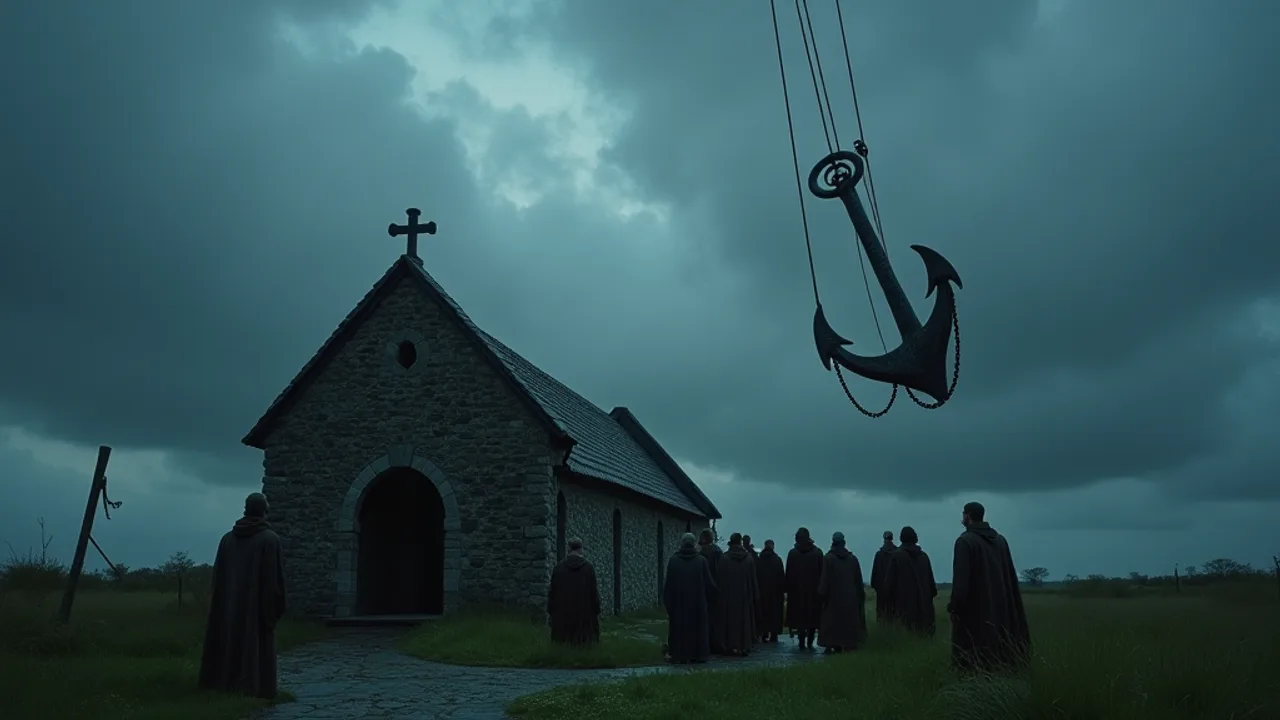
The Office Against the Ships of the Air
A work of fiction built on a real silence. Medieval sources describe ships sailing on the clouds: Agobard of Lyon in 815, Irish annal-keepers in the 740s, Gervase of Tilbury around 1211, and a Norse king's mirror that puts an anchor in the church door at Clonmacnoise. Not one of them records what the priest was supposed to say. We wrote the rite that is missing, labelled every line of it as ours, and then explained why it would not have worked.

The Sixth Tranche
A work of fiction. The Pentagon has published five tranches of UAP files at war.gov/ufo, with dates and locations redacted to protect witnesses, and says more are coming. This story imagines the sixth, and the volunteer archivist who mirrors it at two in the morning and finds one file whose metadata does not agree with the others. No sixth tranche had been published when this was written. Everything about it below is invented.

Basilides, Exegetica, Book Thirteen
He wrote twenty-four books in Alexandria around the year 130. We have a page and a half, quoted by men who were refuting him. The most disturbing idea attributed to him is that ignorance is installed on purpose, as an act of mercy. This is the middle book, invented, arguing that case.
Follow the thread
New disclosure reporting, physics breakdowns, and case files, in your inbox. Sources or it didn't happen. No spam, unsubscribe anytime.