The Angelical Tongue
A speculative occult-thriller. The man, the diaries, the language, and the spy-code are real; the thing on the other end of the line is not. Queen Elizabeth's astrologer, mathematician, navigator, her first '007', spent seven years writing down a complete language dictated by 'angels,' letter by letter, backwards. This is a story about what happens when you speak it forwards.
 AI illustration
I. Mortlake, 1582
By any measure of his own century, John Dee was the cleverest man in England, and it was not making him happy.
He had the largest private library in the country, four thousand volumes when Cambridge owned a few hundred, and he had read most of it. He was the Queen’s astrologer; he had chosen the date of Elizabeth’s coronation by the stars. He was the finest navigator in the realm, and he wrote the sailing mathematics that would send English ships past the edge of the known map. He coined a phrase, in a memorandum to the Crown, that would outlive everything else he did: the British Empire. He was, when the Queen needed something seen that no one else could be trusted to see, her intelligencer, and he signed those letters, the ones meant for her eyes and no others, with two small circles and a long flourished seven. Two eyes, watching. A protective number. 007. For your eyes only.
He knew everything a man could learn from books. That was the problem. Dee had reached the wall every scholar of that age eventually reached: the books all cited older books, and the oldest books cited a knowledge that had been lost, the pure knowledge Adam had before the Fall, the knowledge angels were said to still possess. Dee did not want another translation of a translation. He wanted to ask the source directly.
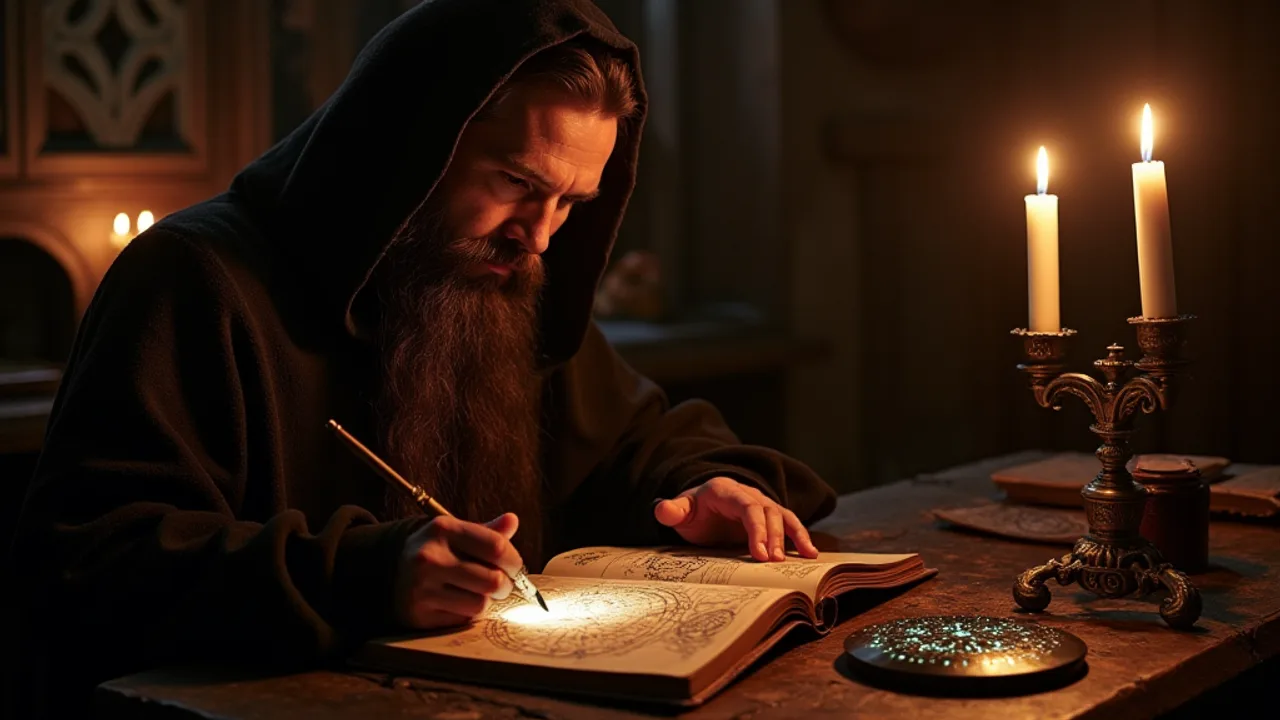
The trouble was that Dee could not scry. He gazed into crystals and saw only crystals. So he needed a man who could, a “skryer,” a seer, and in March of 1582 one came to his door at Mortlake. His name was Edward Kelley, he was twenty-eight to Dee’s fifty-five, he had no ears (cut off, it was whispered, for forgery), and he claimed he could see, in a polished stone, the things Dee could not.
The stone they came to favor was a disc of black obsidian, mirror-smooth, that had been carried back from Mexico, an Aztec scrying-glass, made by a people who used such mirrors to speak to gods of their own. You can see it today in the British Museum. Kelley set his eye to its dark and within days reported that the surface had cleared, and that something was standing in it, and that it wished to talk.
Dee took up his pen. He would not set it down, on this matter, for seven years.
II. The Tongue
What came through the stone was not comfort, and it was not scripture. It was a language.
The beings, Kelley described them as figures of light, sometimes towering, sometimes child-small, did not simply speak. They taught. They showed Kelley great grids of letters, tables of forty-nine squares by forty-nine, and they pointed, one cell at a time, while Dee wrote down whatever Kelley called out. The angels said the tongue was Angelical, the true speech, the language Adam used in Eden to name every living thing, the language by which God had spoken the world into existence in the first place, lost to mankind since the confusion of Babel and never heard on earth since. Later men would call it Enochian, after the patriarch Enoch, who walked with God and was taken up alive and was said to be the last human ever to hear it.
It had its own alphabet, twenty-one letters in their own shapes, written right to left. It had grammar. It had a vocabulary that behaved like a vocabulary, consistent, recombining, alive. The angels delivered, over the years, a book of it (the Loagaeth, the “Speech from God”), and then nineteen great invocations they called the Keys, and a map of the cosmos: four Watchtowers guarding the quarters of creation, and beyond them thirty concentric Aethyrs, thirty heavens ringed one inside the next, each with its own name and its own gatekeepers, expanding outward from the world to the throne of the infinite.
This is the detail that should stop you, the one that stopped the scholars who came later and assumed Kelley was simply a con man fleecing a gullible genius: a con man does not invent a working grammar. A fraud improvises noises. What Dee wrote down has internal structure, rules that hold across years of transcription, a system too consistent to be the nightly invention of an earless forger making it up as he squinted into a rock. Either Kelley was a linguistic prodigy centuries ahead of any discipline that would exist to catch him, or he was, as he insisted, only reading aloud what something else was showing him.
Dee believed the second thing. He was, remember, the best-read man in England. He knew what a hoax looked like. He looked at the tongue accumulating under his own pen, page after page of a language no human had ever spoken, and he concluded that he was taking dictation from the architecture of reality itself.
III. The Child Who Aged
Among the beings in the stone was one Dee came to love.
She first appeared in May of 1583, and she appeared as a little girl, perhaps ten years old, playing in the obsidian as if it were a doorway she had wandered into by accident. She called herself Madimi. Dee found her enchanting; she was bright and teasing and warm, and over the long grinding years of the work she became, in the diaries, almost a member of the household. He named one of his own daughters after her.
But Madimi did not stay ten.
Across the years of scrying she grew. She aged in the glass, older, then a young woman, then older still, her manner changing with her form, the child’s play hardening into something with authority and then into something with appetite. An angel, the theologians would later note uneasily, has no age to grow out of. Angels do not mature. Whatever Madimi was, it was wearing a child’s shape the way a hand wears a glove, and the shape was only the part it chose to show.
In the spring of 1587, in Bohemia, far from home and deep in the work, the grown thing that had once been a little girl gave Dee and Kelley an instruction. The angels willed, she said, that the two men hold all things in common, including their wives.
Dee was horrified. He was a pious man; this was monstrous to him. But he had spent five years accepting that these beings spoke for God, and he could not now decide that they spoke for God only when their commands were pleasant. His wife, Jane, “fell a weeping and trembling for a quarter of an hour”, his own words, and then submitted, because he asked her to, because an angel had asked him to. On the 21st of May, 1587, Dee wrote two words in his diary and nothing more about it.
Pactum factum. The pact is fulfilled.
Nine months later Jane bore a son. Dee baptized him, and raised him, and never wrote down what he believed about him.
Read it as a deceived old man and a manipulative skryer and you have a sordid, very human story. But hold, for one cold moment, the other reading the rest of this tells, that something not human had spent four years wearing the face of a growing child to earn the trust of two men, and then used that trust, at the exact midpoint of the work, to put its own blood into the line. Ask yourself what kind of thing does that. Ask what it was the middle of.
IV. The Backwards Door
Here is the part of the real record that the story cannot leave alone, because the real record cannot explain it either.
The angels would not let the Keys be dictated forwards.
Every invocation, every Call, was given to Kelley backwards, last letter first, the whole thing in reverse, and Dee wrote it down reversed and only afterward turned it around to read. When Dee asked why, the answer was always the same, and it is the single most unsettling sentence in seven years of diaries: because to speak the words in their true order, aloud, would release forces too great and too dangerous to be controlled. The language had to be handled inert. Disarmed. Carried backwards the way you carry a live shell with the fuse pointed away from your body.
Think about what that implies, and notice that scripture does not behave this way. No one transcribes the Psalms backwards for safety. You do not need to disarm a prayer. You disarm a mechanism, something that, spoken correctly, does something. The angels were not handing Dee a holy text to admire. They were handing him an instrument, with the operating instruction that it must never be switched on by accident.
And consider who they handed it to. Not a priest. A navigator. The man who wrote England’s sailing tables, who turned the trackless ocean into a grid of numbers a captain could follow to a coast he had never seen. Dee thought he was begging the angels for two things: gold, to fund his work, and foreknowledge of the fates of kings, to serve his Queen. Read the diaries and watch what happens every time he asks: the beings deflect. They will not talk about the gold. They grow vague about the kings. They steer him, again and again, back to the language, back to the tables, the Keys, the thirty rings of the Aethyrs, as if his questions were noise interrupting their actual business.
Because they were not answering John Dee. They were installing something through him, and his questions were beside the point. The empire he named, the navigation that built it, the whole gorgeous Elizabethan machine of English expansion, in the cold reading, that was the exhaust. Not the engine. The engine was the tongue, and Dee was not its author or even its student.
He was its terminal.
V. The Desert, Again
In 1589 the work broke. Kelley wanted to stop talking to angels and start making gold full-time; Dee went home to England to find his great library looted, and he died poor in 1608, an old magus the new century had no further use for. In 1659 a clergyman named Méric Casaubon found the diaries and printed them, not to honor Dee, but to warn: here, he wrote, is what becomes of a brilliant man who mistakes the deceptions of devils for the conversation of angels. Look on it and be afraid.
And then the tongue lay quiet for two hundred and fifty years. A closed program. A disarmed instrument on a shelf, fuse pointed safely away, waiting in a dead man’s published diaries for someone curious enough to pick it up and someone reckless enough to turn the words around.
In the 1880s a London occult society, the Golden Dawn, found Dee’s Keys, studied them, and reassembled the system into a working method. And in the autumn of 1909, one of that society’s most dangerous graduates carried the Keys into the Algerian desert, sat down in the sand night after night with a single companion, and did the thing Dee had spent seven years being warned never to do.
He spoke the Calls aloud. Forwards. He called the thirty Aethyrs in their proper order, one after another, and climbed the rings inward, and something answered him. Not a metaphor and not a mood. He recorded it as it came, a vast, cold, amused intelligence that regarded the human race the way a man regards an anthill he has chosen to educate, speaking to him across three hundred years in the same tongue it had dictated to an earless skryer at Mortlake. He published the transcript. He never doubted it was real. Other men, decades later, would read the same Keys aloud in a different desert, in California, in 1946, and insist that they, too, had opened a door, and that the saucer-haunted age that began the very next year was what came through it.
So here is the whole of the story’s claim, and it is only a story’s claim. John Dee did not transcribe a lost holy language. He was handed a contact protocol by something that wanted a foothold, disarmed for transport so the courier could not detonate it in transit, and left lying in the open, in a published book, in plain reach of anyone patient and arrogant enough to reassemble it. The angels were never angels. They were the thing that comes when you call it in its own tongue. It wore a child’s face to win an old man’s trust and put its blood in his house. It has been picked up and read aloud, forwards, perhaps a dozen times in four centuries, and each time the line has opened a little wider.
And it has had four hundred years, now, to learn to speak ours.
The diaries are real. You can read them. The Keys are printed in full, in the proper order, in books any curious person can buy.
The story’s only advice is the one instruction the angels themselves insisted on, every single night, for seven years.
Do not read them aloud.
Coda, What’s true, and what isn’t
Because this one is stitched almost entirely from the documentary record, the line between thread and embroidery matters.
Real: John Dee (1527-1608/9) was genuinely Elizabeth I’s astrologer, England’s foremost mathematician and navigator, the coiner of “British Empire,” owner of the largest library in the country, and a real intelligence asset who really did sign confidential letters to the Queen “007.” Edward Kelley really arrived at Mortlake in 1582 and acted as Dee’s scryer; one shew stone associated with the work really is an obsidian Mexican mirror in the British Museum. Over roughly 1582-1589 the pair really did record “Enochian” / “Angelical”, a complete language with its own alphabet, grammar, a book (Loagaeth), nineteen Keys, four Watchtowers, and thirty Aethyrs, which the spirits said was Adam’s Edenic tongue and insisted be dictated backwards for safety. The angel “Madimi” really first appeared as a child and, by the 1587 record, ordered the wife-sharing that Dee logged as “Pactum factum.” Méric Casaubon really published the diaries in 1659 as a cautionary tale of demonic deception. The Golden Dawn really revived the system in the 1880s, and Aleister Crowley really called the thirty Aethyrs in the Algerian desert in 1909, publishing the result as The Vision and the Voice.
Not real: That any non-human intelligence was actually on the line. The “operating system,” the “contact protocol,” the entity steering Dee, the bloodline gambit, the door that opens when the Keys are read forwards, all invented for the story.
And the plain version, outside the fiction: the overwhelmingly likely explanation is that Edward Kelley was a gifted fraud (he had a forger’s record and a clear motive, Dee’s patronage and protection), working on a brilliant but desperately credulous man who wanted to believe he was talking to angels. The “too-consistent-for-a-hoax” language is less impressive than it sounds: modern linguists who have analyzed Enochian find its grammar and syntax suspiciously close to English, its alphabet partly derivable from period sources, exactly what you’d expect from a clever Elizabethan inventing as he went, not from the speech of Eden. Casaubon’s 17th-century verdict was unkind but not unreasonable: a great mind can be led anywhere by a confederate it has decided to trust. The wife-swap reads, soberly, as manipulation, not metaphysics. No words, spoken in any order, open anything.
So: did Queen Elizabeth’s spymaster take dictation, for seven years, from something that wasn’t an angel?
Only here. Only on the page, which, as the other stories on this shelf keep insisting, is the one safe place to switch an idea like that on.
Every new case, scored the same way
One email when a case file lands, with its Signal-Strength score and what would move it. No hype, no 'BREAKING', and every claim carries its source. Unsubscribe anytime.
Sources
Read next
More Fiction, maybe? →
The Ophite Diagram: The Gate Passwords
A second-century sect drew a map of the levels above the world and wrote out what you say to the thing guarding each one. We only have it because a pagan critic described it in order to mock it, and a Christian critic quoted the mockery in order to answer it. Here is the document itself, invented.
The Office Against the Ships of the Air
A work of fiction built on a real silence. Medieval sources describe ships sailing on the clouds: Agobard of Lyon in 815, Irish annal-keepers in the 740s, Gervase of Tilbury around 1211, and a Norse king's mirror that puts an anchor in the church door at Clonmacnoise. Not one of them records what the priest was supposed to say. We wrote the rite that is missing, labelled every line of it as ours, and then explained why it would not have worked.
The Sixth Tranche
A work of fiction. The Pentagon has published five tranches of UAP files at war.gov/ufo, with dates and locations redacted to protect witnesses, and says more are coming. This story imagines the sixth, and the volunteer archivist who mirrors it at two in the morning and finds one file whose metadata does not agree with the others. No sixth tranche had been published when this was written. Everything about it below is invented.
Follow the thread
New disclosure reporting, physics breakdowns, and case files, in your inbox. Sources or it didn't happen. No spam, unsubscribe anytime.