The Dark Companion
A speculative occult-thriller. The people, books, and star are real; the signal binding them is not. From a blind cliff-priest in Mali to Aleister Crowley's 'Silver Star,' to the magician who in 1955 named the dark twin of Sirius, to a novelist who thought the Dog Star called him on a July night in 1973, an 'ancient contact' tale about the one star no naked eye can see.
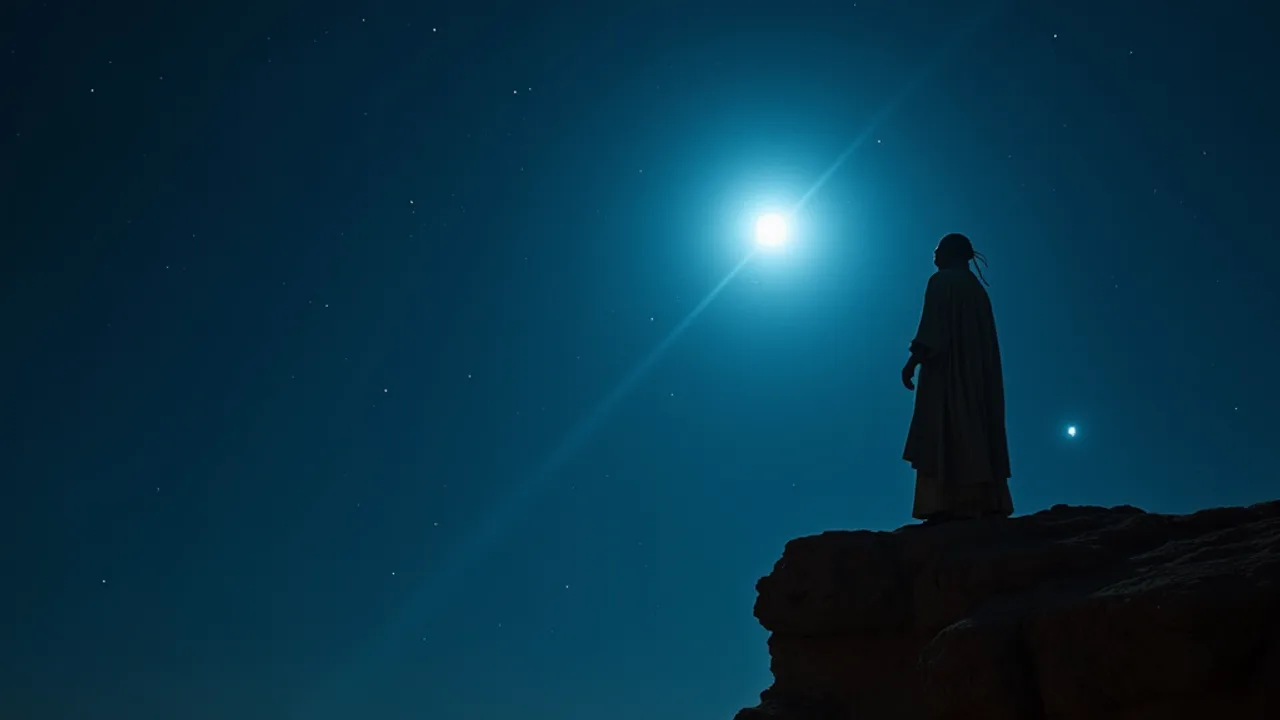 AI illustration
I. The Cliffs of Bandiagara, French Sudan, 1946
The old man was blind, and he wanted to talk about a star no one could see.
Marcel Griaule had been coming to the Bandiagara escarpment for fifteen years, long enough that the Dogon elders had stopped treating him as a Frenchman with a notebook and started treating him as a slow but persistent student. In the autumn of 1946 the council decided he had earned the deep instruction, and they sent him to Ogotemmêli, a hunter who had lost his sight to an accident years before and had spent the dark time since assembling, in his head, the entire architecture of the world.
For thirty-three days Griaule sat in the old man’s compound while Ogotemmêli took it apart for him, piece by piece, in the unhurried way of a man with nothing left to do but remember correctly.
He spoke of the Nommo.
They had come down from the sky, the old man said, in the beginning, not as light, not as spirit, but as bodies: amphibious, gleaming, more at home in water than on land, teachers who arrived in a thing that spun as it descended and left a wound in the earth where it set down. They gave the people grain, and speech, and the count of the seasons, and the names of things. The Nommo were the keepers of the waters and the menders of the world, and the Dogon owed them everything, and the Dogon were still waiting for them to come back.
Griaule wrote it down. Amphibious sky-teachers in a spinning vessel were not, by the standards of the world’s myths, unusual. He had read his Frazer. He had read his Berossus, the Babylonian priest who, two thousand years before, had recorded the same story on the other side of a continent: Oannes, the fish-bodied sage who rose from the sea each morning to teach men writing and law and the working of metal, then sank back into the water at dusk. The amphibious civilizer was an old archetype. Griaule expected the Nommo to be a local dialect of it.
Then Ogotemmêli told him where the Nommo had come from, and the notebook stopped.
They had come, the old man said, from Sigi tolo, the star of the Sigui festival, the brightest light in the sky, the one the French called the Dog Star. But not from the bright star itself. From its companion.
There was a second star there, Ogotemmêli said. A small one. The eye could not find it, not his ruined eyes, not Griaule’s good ones, not anyone’s, because it was not made to be seen. It was the oldest of stars and the heaviest. So heavy that a fragment of it the size of a seed would outweigh everything in the village. It circled the bright star slowly, on a path that took half a long lifetime to close, and when the people danced the great Sigui, once every sixty years, the most important thing the Dogon ever did, they were keeping the count of that circling. The festival was the orbit. They had been counting it for longer than anyone could say.
The Dogon called the invisible heavy star pō tolo. The seed-star. The dark companion.
Griaule was an anthropologist, not an astronomer, and he did not yet understand what he had been told. He only knew that a blind hunter on a cliff in the middle of Africa had just described, in detail, a star that cannot be seen, and had insisted his ancestors learned of it from the amphibious beings who came down spinning from beside it.
He closed the notebook for the night. Outside, low over the escarpment, the Dog Star was rising.
II. The Companion, 1862
Here is the part the story does not have to invent.
In 1844 the German astronomer Friedrich Bessel noticed that Sirius, the Dog Star, the brightest in the sky, did not move in a straight line across the years. It wobbled, as though something were pulling it. Bessel reasoned there had to be an unseen companion: a star massive enough to tug the brightest light in the heavens off its course, yet too faint for any instrument then living to find. He died without ever seeing it.
In 1862, in Massachusetts, the telescope-maker Alvan Graham Clark turned a new lens on Sirius to test it and caught a pinprick of light hiding in the glare, the companion Bessel had predicted, exactly where the wobble said it must be.
It took decades more to understand what it was. Sirius B is a white dwarf: a sun that has burned out and collapsed, packing the mass of our own star into a body the size of the Earth. It is one of the densest things human beings have ever measured. A teaspoon of it would weigh tonnes. It is, by any honest description, the heaviest small thing in that part of the sky, and it is utterly invisible to the naked eye, drowned in the light of its brilliant twin.
The civilization that built the telescope learned in 1862 that Sirius has a dark, impossibly heavy companion.
The blind man on the cliff had said the same thing, and his people had been dancing its orbit, they claimed, for ten thousand years.
The story now has two facts that should not fit together. Everything that follows is the story trying to make them fit, and you should watch it do so the way you watch a magician’s hands, because the fitting is the trick.
III. The Silver Star, Bou Saâda, 1909
Long before Griaule climbed the escarpment, a fat Englishman in robes was lying in the Algerian desert, also receiving instruction from a star.
Aleister Crowley, mountaineer, poet, “the wickedest man in the world,” and the most influential occultist of the modern age, had founded his magical order in 1907 and given it a name in Latin that he kept, for the public, abbreviated to three letters and two dots: A∴A∴. Initiates were told many things about what the letters stood for. The truest, Crowley said, was Argenteum Astrum. The Silver Star.
The star was Sirius.
Crowley taught that behind the visible sun there was another sun, a hidden source from which the real current of illumination flowed, the “Sun behind the Sun,” he called it, and he identified that hidden source with the Dog Star. The light a magician chased was not the light anyone could see in daylight. It came from the silver star, the secret one, and the whole apparatus of his system was built to open a channel to it.
In the winter of 1909 he went into the desert near Bou Saâda with a young poet named Victor Neuburg to test the channel directly. Night after night Crowley scryed the “Aethyrs”, the visionary worlds of an angelic language first recorded by Elizabethan magicians, and copied down what spoke through them. He came back from the sand insisting, to anyone who would listen, that he had reached something. Not a ghost. Not a god of the old comfortable kind. An intelligence, vast and cold and amused, that regarded the human race the way a man regards an anthill he has decided, for reasons of his own, to educate.
He never drew it the way he drew the entity he called Lam. But he wrote, more than once, that the source sat in the sky near the Dog Star, and that the current came from there, and that one day it would come here.
Aleister Crowley died on the first of December, 1947.
It was the year a salesman named Kenneth Arnold saw nine objects skipping over the Cascades, the year the word flying saucer was minted, the year the thing that fell near Roswell did or did not fall. The Silver Star had spent forty years insisting the current would arrive. The same summer it began to arrive, the man who had spent his life tuning the receiver lay down and stopped.
The story does not claim he caused it. The story only notes the dates, and lets you do with them what the desert did with Crowley.
IV. The Set Current, London, 1955
Crowley’s heir made the connection explicit, and that is where the story stops being able to pretend it is only about archetypes.
Kenneth Grant had been Crowley’s secretary in the old man’s final year, and he spent the rest of his life building out what his teacher had only gestured at. In April 1955 Grant issued a manifesto announcing the founding of a new lodge and the discovery of what he called, in plain words, a “Sirius/Set current”, an extraterrestrial influence, he said, emanating from the Dog Star and flowing into the work of his order. For this he was promptly expelled from the larger organization. He did not care. He had found the source, and he spent nine books mapping it.
The map is the thing that should make the hair on your arms stand up.
Grant took the binary star apart the way Ogotemmêli had. The bright, visible Sirius he assigned to Horus, the falcon, the open day, the light everyone can see. And the companion, the dark star, the dense invisible twin that astronomy had only confirmed in 1862, he assigned to Set: the old adversary, the god of the desert and the outer dark, the lord of the thing that comes from beyond.
He did not have a telescope. He was not reading astronomy journals. He was working from Crowley’s “Silver Star,” from Egyptian myth, from the angelic visions of the Aethyrs, and out of that material he produced, in 1955, the same structure the blind Dogon priest produced from masks and millet and the Sigui count, and the same structure Alvan Clark’s lens produced in 1862: Sirius has a dark companion, and the companion is where the power lives.
Grant read the horror stories of H.P. Lovecraft, the drowned cities, the amphibious Deep Ones, the vast indifferent intelligences from the gulf, not as fiction but as leakage. Someone, he believed, kept receiving the same broadcast and writing it down without knowing what it was: a pulp author in Providence, a magician in the desert, a priesthood on a cliff. Different hands. One signal. And the signal came, he wrote, from the dark companion of the Dog Star, the amphibious teachers’ home, the seed-star, pō tolo, Set, and it had been transmitting for a very long time, and it was getting closer.
V. The Transmission, 1973-1976
It reached a science-fiction novelist in California on the twenty-third of July, 1973.
Robert Anton Wilson was a skeptic by trade, a satirist, a debunker’s debunker, a man constitutionally suspicious of his own beliefs. He had been experimenting, in the loose Californian style of the era, with the rituals Crowley had left behind, layered over the psychedelics Timothy Leary had championed. He did not expect anything to answer.
On July 23, 1973, the night, in the old Egyptian reckoning, when the Dog Star rises with the sun and the new year begins; the festival the Dogon would have recognized, something answered. Wilson experienced what he could only describe as contact: a flood of information he was certain had not come from inside his own head, originating, the impression insisted, from the system of Sirius. It went on, in waves, for the better part of a year.
What makes Wilson the most honest narrator in this story is that he refused to believe it. He laid out every explanation he could find and declined to choose: maybe it was a genuine signal from a planet of the Dog Star. Maybe it was the “current” Crowley had spent his life describing. Maybe it was his own unconscious, dressed in the costume his reading had hung in the closet. Maybe he had simply gone, for a while, insane, he had a name for the place you go, Chapel Perilous, the room you enter where you cannot tell revelation from breakdown and from which “you come out either a paranoid or an agnostic.” He chose agnostic. He published the whole thing in 1977 as Cosmic Trigger, and he never once asked you to believe it was real. He only asked you to notice the coincidence.
The coincidence was getting crowded. Leary, in a prison cell, claimed to be receiving the same kind of transmission in the same years, his “Starseed” messages, and had not compared notes with Wilson first. And in 1976, an American scholar named Robert Temple published The Sirius Mystery, dragging the whole thing into daylight: he had found Griaule’s Dogon reports, connected the Nommo to Berossus’s Oannes, and argued in earnest that Earth had been visited, in deep antiquity, by amphibious intelligences from the Sirius system, the same blue-white star, the same dark companion, the same teachers who came down spinning and promised to return. Temple later said he had been followed and harassed for writing it. Make of that what the desert made of Crowley.
So here is the shape of it, laid flat:
A Babylonian priest, writing down a fish-god who taught civilization. A blind hunter on an African cliff, counting the orbit of a star no eye can see. A magician in the Algerian sand, naming his order for the Silver Star. His student in London, assigning the dark companion to the god of the outer dark, a decade before any of them could have read the same book. A novelist in California, certain the Dog Star phoned him on the night of its rising. A scholar tying the knot in 1976 and being followed for it.
Six hands. Different centuries, different continents, different reasons to lie. And every one of them points at the same point of light, and then past it, to the dark, heavy, invisible thing beside it that the human eye was never built to find.
The story’s whole and only claim is this: they were not guessing. They were receiving. The dark companion has been transmitting since before Babylon, and the priesthoods and the magicians and the acid-soaked novelists are simply the ones, in each age, who happened to pick up the phone. The Sigui count is the appointment book. And the orbit is closing.
The Dog Star rises every July, the way it rose over Ogotemmêli’s compound, the way it rose the night it called Robert Anton Wilson. Look east before dawn at the end of summer and you will find it easily, the brightest star in the sky, impossible to miss.
You will not find the companion. That is rather the point.
Coda, What’s true, and what isn’t
Because this is fiction wearing the coat of real scholarship, the seams matter more than usual.
Real: Marcel Griaule and Germaine Dieterlen did record an elaborate Dogon cosmology, including the amphibious Nommo, the bright star Sigi tolo, and a companion called pō tolo said to be small, heavy, invisible, and orbited on a roughly sixty-year cycle marked by the Sigui ceremony (Dieu d’eau, 1948; “A Sudanese Sirius System,” 1950). Sirius B is genuinely a real, invisible white-dwarf companion, predicted by Bessel in 1844, first seen by Alvan Graham Clark in 1862, and astonishingly dense. Aleister Crowley really did name his order the Argenteum Astrum (“Silver Star”) and associate it with Sirius. Kenneth Grant really did proclaim a “Sirius/Set current” in 1955, map Set onto the dark companion star, and read Lovecraft as something more than fiction. Robert Anton Wilson really did describe a 1973 “Sirius” contact experience in Cosmic Trigger (1977), and really did refuse to claim it was objectively real. Robert Temple’s The Sirius Mystery (1976) really did argue for ancient amphibious visitors from Sirius. Oannes and the Apkallu are real Mesopotamian myths, recorded via Berossus.
Not real: The single transmitting signal. The idea that these people were all receiving the same broadcast rather than reading, influencing, and pattern-matching one another. The Antiquity-spanning conspiracy. Crowley’s death “answering.” All of that is the story’s invention.
And the part worth saying plainly, outside the fiction: the Dogon-Sirius claim is almost certainly cultural contamination, not ancient contact. Sirius B’s existence was public knowledge by 1862, decades before Griaule arrived; a well-documented French astronomical expedition visited the region for a 1893 eclipse, and Griaule himself, an enthusiast who sometimes asked leading questions, is a strong candidate for the source of the “secret.” When the anthropologist Walter van Beek did his own fieldwork with the Dogon decades later, he could find no one who knew pō tolo was Sirius’s companion or treated Sirius as a double star at all. (Defenders of Griaule dispute van Beek in turn, the ethnographic fight is genuinely unresolved, but “modern knowledge leaked in and got woven into old myth” explains everything here without needing a starship.) The occult “Sirius current” is shared reading: Grant built on Crowley, Wilson built on Crowley and Leary, and a striking image travels fast among people who want to believe it. Convergence across cultures is what you’d expect from a good story and a famous bright star, not evidence of a signal.
So: is the brightest star in the sky quietly running the human race from behind its invisible twin?
Only here. Only on the page, which, as the last story said, is the safest place for an idea like that to live.
Every new case, scored the same way
One email when a case file lands, with its Signal-Strength score and what would move it. No hype, no 'BREAKING', and every claim carries its source. Unsubscribe anytime.
Sources
- [1] The Sirius Mystery (Robert Temple), Wikipedia
- [2] Dogon people, Wikipedia
- [3] Dogon and Sirius, The Skeptic's Dictionary
- [4] Sirius B (white dwarf companion), Wikipedia
- [5] Cosmic Trigger I (Robert Anton Wilson), Wikipedia
- [6] Typhonian Order & the 'Sirius/Set current' (Kenneth Grant), Wikipedia
- [7] Oannes & the Apkallu, Wikipedia
Read next
More Fiction, maybe? →
The Office Against the Ships of the Air
A work of fiction built on a real silence. Medieval sources describe ships sailing on the clouds: Agobard of Lyon in 815, Irish annal-keepers in the 740s, Gervase of Tilbury around 1211, and a Norse king's mirror that puts an anchor in the church door at Clonmacnoise. Not one of them records what the priest was supposed to say. We wrote the rite that is missing, labelled every line of it as ours, and then explained why it would not have worked.
The Sixth Tranche
A work of fiction. The Pentagon has published five tranches of UAP files at war.gov/ufo, with dates and locations redacted to protect witnesses, and says more are coming. This story imagines the sixth, and the volunteer archivist who mirrors it at two in the morning and finds one file whose metadata does not agree with the others. No sixth tranche had been published when this was written. Everything about it below is invented.
Basilides, Exegetica, Book Thirteen
He wrote twenty-four books in Alexandria around the year 130. We have a page and a half, quoted by men who were refuting him. The most disturbing idea attributed to him is that ignorance is installed on purpose, as an act of mercy. This is the middle book, invented, arguing that case.
Follow the thread
New disclosure reporting, physics breakdowns, and case files, in your inbox. Sources or it didn't happen. No spam, unsubscribe anytime.