PURSUE Release 06: The Pentagon Re-Released the AAWSAP Papers. The Best File Is From 1952.
The sixth PURSUE tranche landed on September 18 with 72 records, 15 videos and an hour of 1952 audio. The headlines went to 37 warp-drive and wormhole studies and a paper on 'injury to human observers.' Those studies have been public since a FOIA release in March 2022. What is actually new is the contract paperwork behind them, a set of mission reports that grade their own objects as having 'no advanced capabilities,' and the complete Air Force file on the 1952 Tremonton film, dissent included.
On September 18, 2026 the U.S. Department of War published PURSUE Release 06: 72 records in the government's own index (56 PDFs, 15 videos and one audio file), 67 from the Department of War and 5 from a Colorado law enforcement agency, with incident dates from 1952 to 2025. It includes all 37 Defense Intelligence Reference Documents (DIRDs) produced under the DIA's 2008 to 2012 AAWSAP program, plus AAWSAP's statement of objectives and contract records; a 1952 Project Blue Book file and film from Tremonton, Utah; an hour-long 1952 recording of Blue Book chief Edward J. Ruppelt; military mission reports and infrared video from the Middle East, Iraq and the Yellow Sea; and a Colorado officer's phone videos of a flashing light. The DIRDs themselves are not new: the DIA released 37 of the 38 to The Black Vault under FOIA on March 25, 2022. 'Unresolved' in PURSUE means the government could not identify an object, not that it was extraterrestrial.

The sixth PURSUE tranche went up on war.gov/UFO on Friday, September 18, 2026. The government’s own index lists 72 new records: 56 PDFs, 15 videos and one audio file, from the Department of War and, for the first time, a local police department. The database now holds 447 files. The Pentagon’s press statement, attributed to spokesman Sean Parnell, runs to two short paragraphs and says the next release is already being worked on.
The coverage led with the science fiction. Warp drives, wormholes, antigravity, invisibility cloaks, and a 38-page Pentagon study of “unintended injury to human observers by anomalous advanced aerospace systems.” That is a real set of documents, and it is in this release. It is also a set of documents that anyone could have downloaded for the last four and a half years.
What is genuinely new in Release 06 is quieter, and better.
The AAWSAP papers are a re-run
Thirty-seven of the 72 records are Defense Intelligence Reference Documents, or DIRDs, commissioned under the Advanced Aerospace Weapon System Applications Program, the Defense Intelligence Agency effort that ran from 2008 to 2012 and paid Bigelow Aerospace Advanced Space Studies to think about aerospace threats forty years out. It is the same program that funded the work at Skinwalker Ranch. The DIRDs are DOW-UAP-D117 through D153, and the titles read like a pulp magazine index: Traversable Wormholes, Stargates, and Negative Energy. Warp Drive, Dark Energy, and the Manipulation of Extra Dimensions. Antigravity for Aerospace Applications. Negative Mass Propulsion. An Introduction to the Statistical Drake Equation.
None of this is a secret surfacing. The DIA handed a list of the 38 titles to Steven Aftergood of the Federation of American Scientists in January 2019. Then, on March 25, 2022, it closed a Freedom of Information Act request filed by John Greenewald of The Black Vault in January 2018 and released 37 of the 38 reports in full, redactions and all. They have been sitting on his site ever since. The one that was not released then was the classified version of the high-energy laser report, which The Black Vault appealed.
Update, September 19: we checked. Release 06’s laser DIRD (D137, State of the Art and Evolution of High-Energy Laser Weapons) is not the withheld SECRET version. It is the same unclassified, For Official Use Only report The Black Vault published in 2022: same date (March 31, 2010), same document number (DIA-08-1003-019), 31 pages, and about 95% identical text word for word, with the gap down to scanning noise. The one real difference is on the title page. In 2022 the DIA blacked out the preparing office and mailing address under (b)(3), 10 U.S.C. 424, and the author’s name under (b)(6). In 2026 the office is printed in full (Acquisition Support Division, DWO-3, Defense Warning Office, Directorate for Analysis), and the author and program manager appear as the pseudonyms “AAP Person 79” and “AAP Person 1.” The injury paper, D128, follows the same pattern (“AAP Person 81”). So the 2026 copies have slightly fewer redactions, but what they reveal is an office name that was already public, not anything about the research. The SECRET laser report is still unreleased.
Nor is the content what the titles imply. The Pentagon’s own framing, as CBS reported it, is that the DIRDs are “best understood as reference and synthesis products rather than as original research.” They are literature reviews by academics and contractors, some very good, on physics that anyone can read about in a textbook treatment of the Alcubierre metric. A government paying for a review of wormhole physics is evidence that a government was curious about wormhole physics.
What is actually new: the paperwork
Seven AAWSAP records have never been public in this form, and they are the dull ones: the July 18, 2008 Statement of Objectives (D110), the September 22, 2008 solicitation and original order (D111), and five contract modifications to contract HHM402-08-C-0072 running from September 2009 to September 2010 (D112 to D116).
They matter because the AAWSAP story has been told mostly by people who worked on it, and this is the government’s own ledger. The Statement of Objectives defines the scope as twelve technical research areas bearing on far-term foreign aerospace threats. The modifications show a program living on the edge of its budget. The February 2010 modification exercises Option Year 1 while acknowledging, in the index summary’s words, “impacts to deliverables resulting from reduced Option Year 1 funding.” The September 2010 modification extends the contract to December 21, 2010 with no additional money and no other changes. A program that was, depending on who is telling it, either a UFO study hidden inside a threat study or a threat study that a few people used for UFOs, was on paper a contract that was already being squeezed within two years.
That will not trend. It is also exactly the kind of record the disclosure debate has lacked: not testimony about what a program was, but the contracting instrument that says what it was paid to do.
The injury paper, read properly
The one DIRD that got real attention is D128, Anomalous Acute and Subacute Field Effects on Human Biological Tissues, dated March 11, 2010, 38 pages, author redacted as “AAP Person 81” of the DIA’s Defense Warning Office. It is worth reading, and worth reading carefully.
Its anchor case is three antenna engineers who, within 72 hours of an event, developed reddened skin, fever, headaches, hair loss and, in one case, a blood disorder and “signs of radiation illness.” The paper’s own account of the cause:
Extensive, but controversial investigations revealed the three had been subjected to an accidental exposure in the near-field [meters] to a broad-band ultrahigh radiofrequency mixed radiation of RF (radio frequency), NIEMR (non-ionizing electromagnetic radiation) & microwave energies […] centered at about 785 MHz.
It then adds 42 cases from the peer-reviewed medical literature and 300 unpublished ones, “primarily when fields were measured or emitters were known,” and a catalog of 356 UFO-related physiological effects compiled in 1996 by John Schuessler, a former MUFON director. Its conclusion is that the medical picture, “while not requiring the invention of an alternative biophysics, do[es] indicate the use of (to us) unconventional and advanced energy systems.”
Notice the gap. The injuries are described as ordinary radio-frequency and microwave injuries, the kind the literature documents from radar sets and transmitters. The link to “anomalous advanced aerospace systems” does not come from any measurement of a craft. It comes from which cases were pulled into the dataset, and the most exotic of them come from a civilian enthusiast catalog. The paper itself describes the primary case data as anecdotal and says it does not validate claims that anything was a weapon or was intended to harm. It is a serious clinician’s hypothesis. It is not a finding, and “Pentagon study confirms UFO injuries” is not a fair summary of it.
The mission reports that downgrade themselves
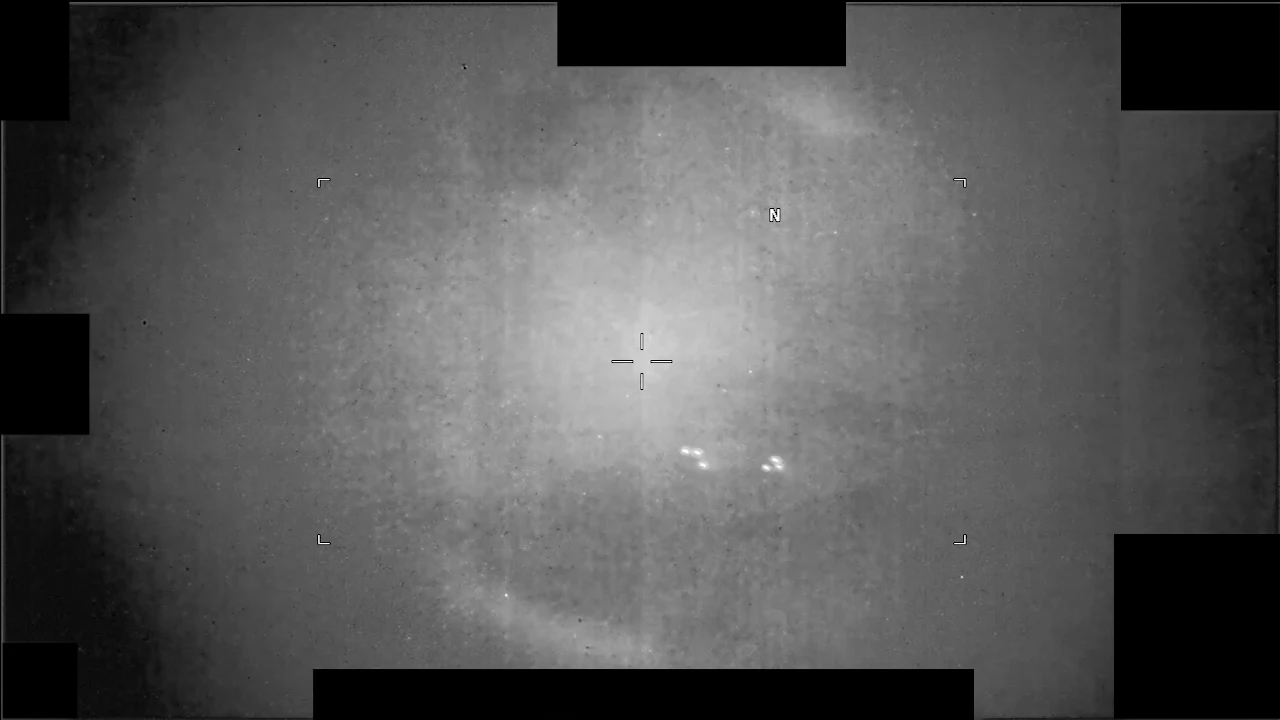
The modern files are mostly U.S. Central Command and Indo-Pacific Command sensor video with mission reports, or MISREPs, attached. The most quoted is DOW-UAP-D108, dated July 2025, describing “6X small spherical objects grouped together. Able to change directions quickly and simultaneously. Seemed to be agile, frequently changing direction.” The reporter estimated 480 mph.
What nobody quoted is the rest of the form. Its assessment block reads:
UAP showed no reaction to observer actions […] UNKNOWN if under intelligent control. NO advanced capabilities and/or materials. NO effects on persons. NONE on equipment.
Platform, sensor and location are redacted under (b)(1)(B). The matching video, DOW-UAP-PR135, is one minute of infrared. Its first frames show a lattice tower standing on a patch of sand in open water. Then a tight cluster of small bright points crosses the frame and the sensor follows them for about forty seconds. It is the image at the top of this page. A compact group of small, bright, agile objects low over the sea near a structure is, as a matter of first guess, what a flock of birds looks like on a thermal sensor, and the 480 mph figure has the same problem as every speed estimate in these files: without a known size or range, speed is one equation with three unknowns. We cannot say they were birds. Neither can the report say they were not, and it does not try.
Two cautions about the government’s own index, which is where most outlets got their numbers:
- The summaries contain copy errors. The index blurb for D109 (Middle East, 2022) repeats D108’s “six small spherical objects” and 480 mph almost word for word, while the two videos D109 accompanies say it describes objects at 80 to 180 mph. One of those summaries is wrong. Read the PDF, not the blurb.
- Dates drift. PR133 is titled 2025 but its description says the footage is from 2024. One Colorado clip is titled October 2023 and described as January 2024. The PR133 and PR150 descriptions also say a “focus box” overlay “does indicate a physical change in the environment,” which is almost certainly missing a “not.”
None of this is sinister. It is a small team summarizing hundreds of files at speed, and it is a reason to cite the document ID, not the press summary.
The Colorado phone videos
The five local law enforcement records are a transcript and four phone videos, from 27 seconds to 15 minutes long, shot by an officer in Colorado who described a light as “silent” with “red, blue, and green flashing lights.” AARO blurred the lower half of each frame to protect private information, and appended the same comment to every clip:
Cellular devices of the type used to capture this footage employ autofocus and other automated image-processing functions that may distort the apparent morphological and kinematic characteristics of distant subjects, particularly at high magnification.
That is AARO telling you, politely, what these clips are. A steady point of light, flashing red, blue and green, filmed at full zoom on a phone, is a description that also fits a bright star or planet near the horizon, where atmospheric scintillation makes it flicker through colors. Watch the first clip with that in mind. It is unresolved because nobody went back with a star chart and the time, not because it resisted one.
Tremonton, 1952: the best file in the release
The video at the top of this page is the oldest thing in the tranche, and the most complete case file PURSUE has published.
On July 2, 1952, U.S. Navy Chief Warrant Officer Delbert C. Newhouse saw a group of bright objects near Tremonton, Utah and filmed them on a handheld Bell & Howell Auto Master loaded with a 50-foot roll of 16 mm Kodachrome. He reported 12 to 14 reflective objects, exposed about 30 feet of film on them, and used the rest of the roll later that day on mountain scenery in Idaho. Release 06 includes the film (PR159), the Blue Book case file (D102), Blue Book’s photo file on it (D103), the Air Force Director of Intelligence’s flying-disc records for late 1952 (D105), and Newhouse’s own final Navy personnel record (D104), which shows he left the Navy as a Chief Warrant Officer 4 after a career as a Photographer’s Mate.
That last one is unusual. PURSUE has published the service record of the witness so that you can check the Air Force’s assessment of him, which was that he was honest, reliable, and an expert with more than 1,000 hours of aerial photography. It is the credibility half of a case, published as a primary document.
The analysis half is better still. In December 1952 Blue Book contacted General Mills, then the only known maker of “pillow balloons,” and in late December Blue Book staff, balloon specialists and General Mills representatives sat down with the film. According to the index summary of D103, their consensus was that the objects “closely resembled pillow balloons in flight.” One General Mills representative dissented: the objects seemed too bright and moved too fast. The reviewers then did something modern footage analysts should copy. They questioned the earlier calculations that had the objects moving at high speed, because those numbers “depended on the unverified assumption that the camera operator had held the camera still.” No balloon release near Tremonton was ever found. The file also weighed seabirds, citing films of gulls that show up as bright points under similar light, and the Air Force’s later assessment, recorded in D105, was that the objects were likely seabirds.
So here is a 74-year-old case with a named, credentialed witness, a physical film, a documented expert review, a recorded dissent, a documented failed check (no balloon release), and a final assessment. That is what a case file is supposed to look like, and it is a useful benchmark for every 2020s infrared clip that arrives with a redacted platform and a one-paragraph MISREP.
Two honest caveats. First, the film is not new. It has been public in some form for decades, and the case is one of the most argued-over of the Blue Book era. The new thing is the full paper trail in one place. Second, the digitized print is a mess: the government notes that from the 55-second mark it “transitions to unrelated footage appearing to show a demonstration of sewing equipment,” and that the Idaho mountain scenery the film was originally paired with is not preserved. The objects themselves are faint specks on a blue field. What survives of Tremonton is mostly the paperwork.
Ruppelt, in his own voice
The last file is the one to listen to. DOW-UAP-PR160 is an hour-long recording, with a transcript (D154), of Captain Edward J. Ruppelt, then head of the Air Force’s reorganized UFO investigation, giving a talk in Boston on March 26, 1952, four months before the Washington, D.C. radar sightings made the subject front-page news.
It opens with someone asking whether there’s anything already on the tape. Then Ruppelt lays out the numbers: about 800 reports reviewed, of which “about 20% are very good reports offered by very reliable people and are just absolutely no conclusions can be drawn.” He is careful in both directions. On balloons: “these things are not, are definitely not all balloons.” On what they are: “I’ll refer to them as ‘these things’ because we have no idea what we’re dealing with.” He notes reporting clusters around Los Alamos, Oak Ridge and White Sands and allows that they “may possibly mean something, we don’t know,” and that a seasonal peak in reports “plants a seed of doubt in your mind.”
Seventy-four years later, the U.S. government’s official position, in the language of every PURSUE file, is that unresolved cases are ones where it is “unable to make a definitive determination on the nature of the observed phenomena.” Ruppelt said the same thing, with better timing, in 1952.
Where six tranches leave us
Six releases since May 8, roughly one every three to six weeks, and 447 records. Release 04 gave us a nuclear weapons plant on lockdown over something nobody identified. Release 05 gave us a gunship crew and a video recorder that failed at the one moment it mattered. Release 06 gives us a re-run of documents that were already public, framed as a revelation, and underneath it the most complete historical case file the program has produced.
That is the useful pattern to keep in mind. The files that make headlines are rarely the files that teach you anything. The warp drive papers tell you what the DIA was willing to pay contractors to review in 2010. The Tremonton file tells you how an investigation should work, including the part where the experts disagree and nobody pretends they didn’t.
The release also landed the same week the Department of War announced its own NDA waiver for UAP witnesses, which is the development more likely to change what the seventh tranche contains. For how the whole program measures up so far, see What AARO Has Actually Published.
A note for readers of our fiction: The Sixth Tranche, published September 17, imagined a sixth release the day before the real one arrived. The real one bears no resemblance to it, which is as it should be.
Every new case, scored the same way
One email when a case file lands, with its Signal-Strength score and what would move it. No hype, no 'BREAKING', and every claim carries its source. Unsubscribe anytime.
Frequently asked
What is in PURSUE Release 06? +
Seventy-two records by the count in the government's own index (CBS News counted 71): 56 PDFs, 15 videos and one audio file, published September 18, 2026. Sixty-seven come from the Department of War and five from a Colorado law enforcement agency. The biggest block is 37 AAWSAP Defense Intelligence Reference Documents plus seven AAWSAP contract records. The rest are the 1952 Tremonton film and its Blue Book file, a 1952 Ruppelt briefing in audio and transcript, military mission reports and sensor video from the Middle East, Iraq, the Yellow Sea and the East China Sea, and four phone videos from a Colorado officer. The PURSUE database now holds 447 records.
Are the AAWSAP warp drive and wormhole papers new? +
No. The DIA released 37 of the 38 AAWSAP DIRDs to The Black Vault under FOIA on March 25, 2022, and their titles had been public since the DIA gave a list to the Federation of American Scientists in January 2019. What Release 06 adds is the program's administrative trail: the July 2008 Statement of Objectives, the September 2008 solicitation and contract award to Bigelow Aerospace Advanced Space Studies, and five contract modifications through 2010. The Pentagon itself describes the DIRDs as reference and synthesis products rather than original research.
What does the AAWSAP paper on injuries to human observers actually say? +
DOW-UAP-D128, a 38-page March 2010 DIRD with its author's name redacted, argues that some close-encounter injuries match electromagnetic field exposure. Its most detailed case is three antenna engineers who developed burns, hair loss and, in one case, signs of radiation illness after what the paper calls an accidental near-field exposure to broadband radio-frequency and microwave energy centered around 785 MHz. It also draws on a catalog of 356 cases compiled by a former MUFON director. It concludes the injuries indicate 'unconventional and advanced energy systems,' but the biophysics it describes is ordinary RF injury, and the link to anomalous craft comes from how the cases were selected, not from any measurement of a craft.
What is the Tremonton film? +
Sixteen-millimeter color film shot on July 2, 1952 near Tremonton, Utah by U.S. Navy Chief Warrant Officer Delbert C. Newhouse, a Navy photographer, who reported 12 to 14 bright objects. Project Blue Book rated him honest and expert. In December 1952 Blue Book staff, balloon specialists and General Mills representatives reviewed the film and agreed the objects resembled pillow balloons, though one General Mills representative thought they were too bright and moved too fast, and no balloon release was ever found. The Air Force later assessed the objects as likely seabirds. The released print cuts to unrelated footage of sewing equipment after 55 seconds.
Does 'unresolved' mean the objects were alien? +
No. In PURSUE 'unresolved' means the government could not make a definitive identification, often for lack of data. One of the 2025 Middle East mission reports in this release fills in its own assessment fields as 'NO advanced capabilities and/or materials,' 'NO effects on persons' and 'UNKNOWN if under intelligent control.' Unidentified is a statement about the evidence, not about the object.
Sources
- [1] Department of War, Sixth Release of Unidentified Anomalous Phenomena Files (press release)
- [2] PURSUE Release 06 database and downloads, war.gov/UFO
- [3] DOW-UAP-D128, AAWSAP DIRD, Anomalous Acute and Subacute Field Effects on Human Biological Tissues, March 2010 (primary PDF)
- [4] DOW-UAP-D108, Mission Report, Middle East, 2025 (primary PDF)
- [5] DOW-UAP-D154, Transcript of a Presentation by Captain Edward J. Ruppelt, 1952 (primary PDF)
- [6] DOW-UAP-PR159, Historical Film of Reported UFOs, Utah, 1952, DVIDS
- [7] DOW-UAP-PR135, Unresolved UAP Report, Middle East, 2025, DVIDS
- [8] LLE-UAP-PR001, Unresolved UAP Report, Colorado, 2023, DVIDS
- [9] The Black Vault, AAWSAP documentation (DIA FOIA-0159-2018, 37 of 38 DIRDs released March 25, 2022)
- [10] Pentagon releases more UFO files, including documents on secretive military program, CBS News
- [11] Pentagon releases new UFO videos, decades-old files in fresh transparency drop, The National Desk
Read next
More Disclosure →
The Sixth Tranche
A work of fiction. The Pentagon has published five tranches of UAP files at war.gov/ufo, with dates and locations redacted to protect witnesses, and says more are coming. This story imagines the sixth, and the volunteer archivist who mirrors it at two in the morning and finds one file whose metadata does not agree with the others. No sixth tranche had been published when this was written. Everything about it below is invented.
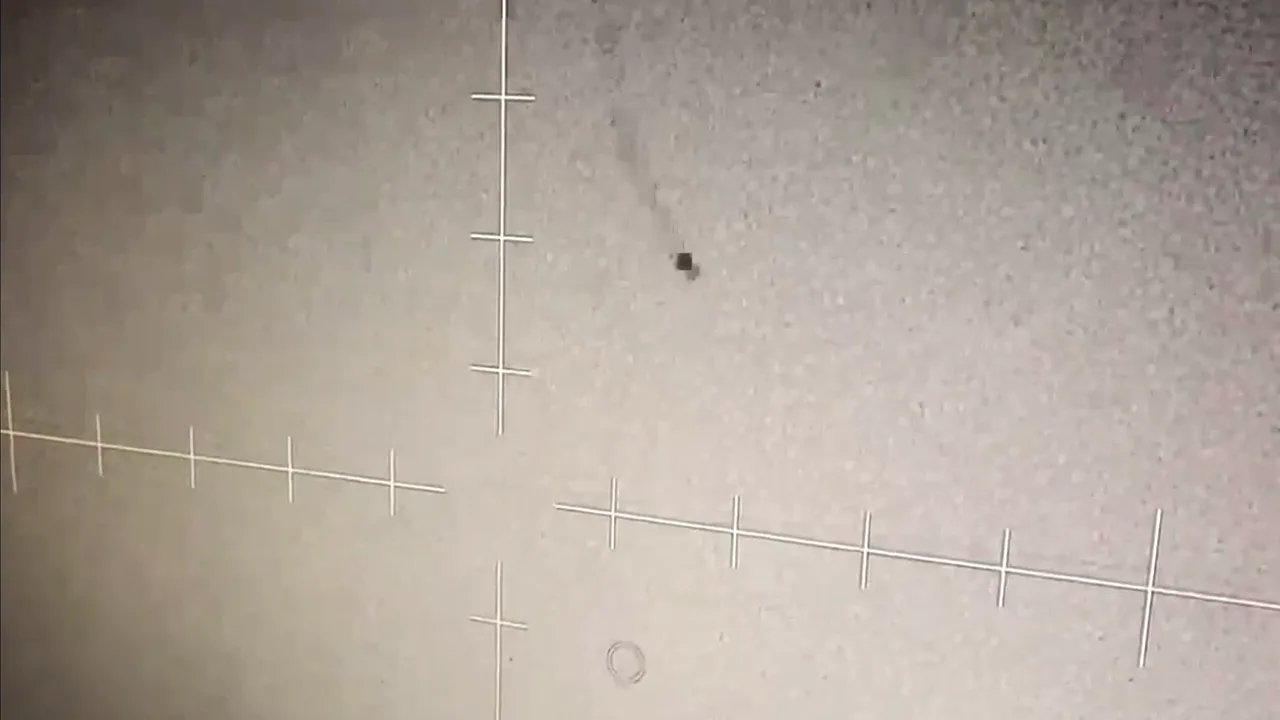
PURSUE Release 05: A Gunship Crew Watched 'Cold Orbs' Dodge Its Cannon, and the Recorder Failed
The fifth PURSUE tranche landed on August 7 with 41 files and 16 new videos. The headline is not the Middle East clip the networks played on loop. It is a declassified intelligence report describing an AC-130J crew over the Gulf of Oman watching roughly 25 instances of four-foot 'cold orbs' during a live-fire exercise, and the aircraft's video recorder failing at exactly the wrong moment.
PURSUE Release 04: A UFO Put a Nuclear-Weapons Plant on Lockdown
The fourth PURSUE tranche landed on July 10 with 40 files from five agencies. The one that matters isn't the 1949 physics conference or the shuttle images. It's a 2015 Department of Energy report describing an unidentified object over the Pantex nuclear-weapons facility that put the site on lockdown, and that two officers chased without ever identifying what it was.
Follow the thread
New disclosure reporting, physics breakdowns, and case files, in your inbox. Sources or it didn't happen. No spam, unsubscribe anytime.