The Warp Drive Is Real Math: What Alcubierre Actually Proposed
In 1994 a physicist showed that faster-than-light travel does not violate relativity, if you move space instead of the ship. The catch is the fuel bill, and the catch keeps shrinking.
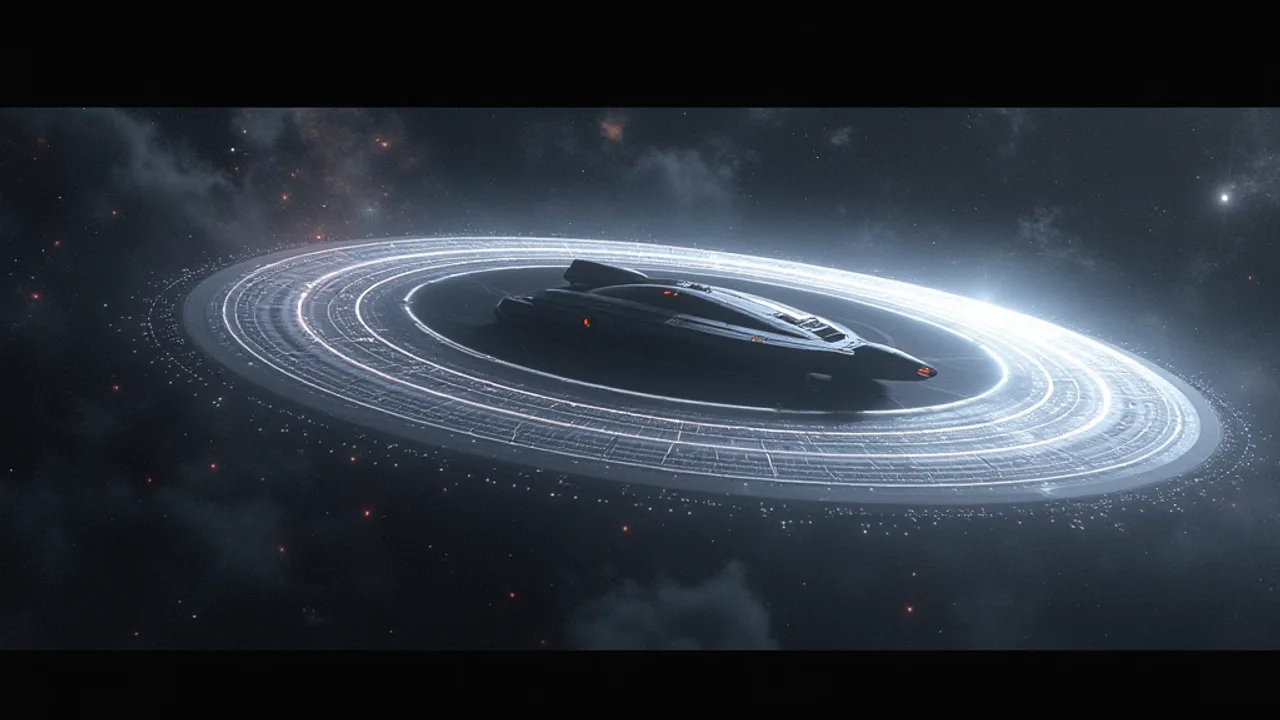 AI illustration
The phrase “warp drive” arrives pre-loaded with rubber foreheads and streaking starfields, which is exactly why most people miss that it is also a peer-reviewed solution to the Einstein field equations. It has been one since 1994, when a Mexican theoretical physicist named Miguel Alcubierre wrote it down.
His insight was a sidestep. Special relativity forbids a ship from moving through space faster than light. It says nothing about how fast space itself can move, and we already have evidence space can move arbitrarily fast, because that is what cosmic inflation and the expansion of the universe do every day, carrying distant galaxies away from us faster than light without anything locally breaking the speed limit.
The trick
Alcubierre’s metric describes a “bubble” of flat spacetime. Behind the bubble, space is expanded; in front of it, space is contracted. The ship sits inside, in a calm pocket, not moving relative to its local space at all, it feels no acceleration, no time dilation, no inertia. The bubble surfs a wave of its own making. To an outside observer the whole package crosses a distance faster than a photon would; to the crew, nothing strange happens.
This is not a loophole someone snuck past the referees. It is a valid geometry. The equations are consistent. General relativity permits it.
The catch
Permits is not the same as builds. To curve spacetime that way, the original metric required negative energy density, exotic matter, the kind we have only ever produced in vanishing quantities in the lab via the Casimir effect. Worse, early estimates of how much you would need were absurd: more mass-energy than the entire observable universe, in some calculations.
For two decades that number was the gravestone. The math worked; the budget did not.
The catch keeps shrinking
Then the estimates started falling. Refinements to the bubble’s geometry, thinning its walls, reshaping the field, dropped the requirement from universe-sized to, in some treatments, something on the order of a large planet, then smaller. Not buildable. But no longer a joke.
In 2021 the problem got genuinely interesting. Erik Lentz argued for soliton solutions that could, in principle, be sourced by conventional positive energy, no exotic matter at all. The same year, Alexey Bobrick and Gianni Martire published a general framework for “physical warp drives,” reframing the whole class of solutions and showing that subluminal warp shells are constructible with ordinary matter, while mapping precisely what a superluminal one would still demand.
The frontier has moved. The question is no longer “does relativity allow it”, it always did. It is “how much, and of what.”
Why this belongs on a UAP site
Because the five observables describe exactly the kinematics a warp metric would produce: no acceleration felt by the occupant, no inertia, no sonic boom, instantaneous direction changes. A craft enclosed in a pocket of locally-flat spacetime would not need to obey the aerodynamics of the medium it appears to be crossing, because as far as it is concerned, it is not moving through that medium at all.
This is not a claim that any reported object is a warp craft. It is a narrower, more useful point: the performance envelope witnesses keep describing is not physically forbidden. It maps onto a solution we already have on paper. The reason we cannot build it is an engineering constraint, the energy condition, and that constraint has been eroding steadily for thirty years.
Textbook propulsion says you cannot get there from here. The Alcubierre metric says you can; it just hands you a bill you cannot yet pay. The interesting decade is the one where the bill gets quoted in numbers an engineer, rather than a cosmologist, is allowed to laugh at.
Every new case, scored the same way
One email when a case file lands, with its Signal-Strength score and what would move it. No hype, no 'BREAKING', and every claim carries its source. Unsubscribe anytime.
Sources
- [1] Miguel Alcubierre, 'The warp drive: hyper-fast travel within general relativity' (Classical and Quantum Gravity, 1994)
- [2] Bobrick & Martire, 'Introducing physical warp drives' (Classical and Quantum Gravity, 2021)
- [3] Lentz, 'Breaking the warp barrier: hyper-fast solitons in Einstein-Maxwell-plasma theory' (2021)
Read next
More Science & Physics →
Element 115 and the Lazar Claim: The Story That Made Its Own Test, and Failed It
Bob Lazar's 1989 account is the rare UFO claim specific enough to check. Physics checked it. Element 115 exists, it was made in 2003, and it lasts less than a second.
The Five Observables, In Plain Physics
The AATIP-era taxonomy of UAP performance, anti-gravity lift, instant acceleration, hypersonic without signature, low observability, trans-medium travel, translated out of acronym soup.
PURSUE Release 06: The Pentagon Re-Released the AAWSAP Papers. The Best File Is From 1952.
The sixth PURSUE tranche landed on September 18 with 72 records, 15 videos and an hour of 1952 audio. The headlines went to 37 warp-drive and wormhole studies and a paper on 'injury to human observers.' Those studies have been public since a FOIA release in March 2022. What is actually new is the contract paperwork behind them, a set of mission reports that grade their own objects as having 'no advanced capabilities,' and the complete Air Force file on the 1952 Tremonton film, dissent included.
Follow the thread
New disclosure reporting, physics breakdowns, and case files, in your inbox. Sources or it didn't happen. No spam, unsubscribe anytime.