What AARO Has Actually Published, and the Caveats Buried in the Data
The Pentagon's UAP office has now released annual reports, a historical-record volume, and a working definition of 'anomalous.' Read past the headline 'no evidence of aliens' and the office's own numbers tell a more careful story, one that hinges on a single archived word: unresolved.
 AI illustration
AARO's own FY2024 report states it has 'discovered no evidence of extraterrestrial beings, activity or technology,' but that finding covers only the roughly 700+ cases it could fully analyze. The same report says over 900 additional reports lack sufficient data to resolve and are held in an open archive, not debunked, just unresolved for now.
The most quoted sentence the Pentagon’s UAP office has ever written is also its most misread. AARO, the All-domain Anomaly Resolution Office, states, in report after report, that it has “discovered no evidence of extraterrestrial beings, activity or technology.”
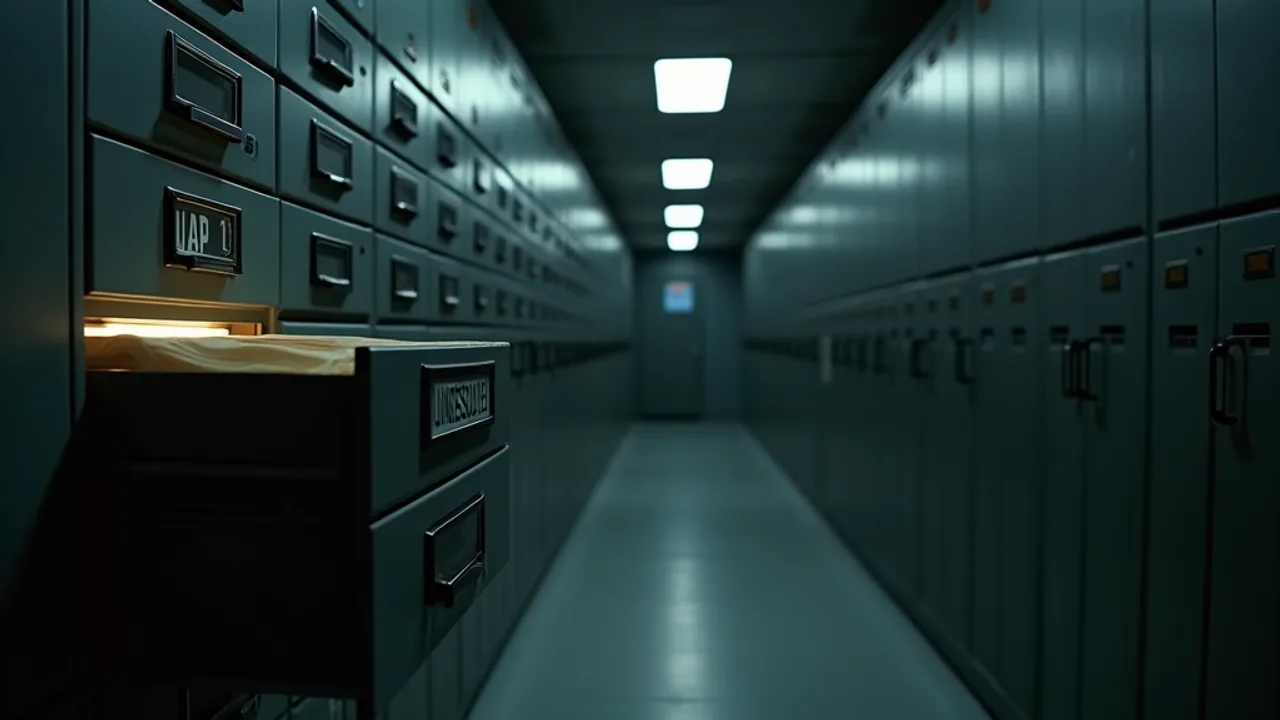
Read carefully, that is not a finding about the sky. It is a finding about AARO’s own filing cabinet. And the office’s own numbers tell you exactly how much is still in the drawer marked unresolved.
The numbers, as AARO reports them
In its FY2024 Consolidated Annual Report, delivered to Congress and released publicly on 14 November 2024, AARO logged 757 new UAP reports for the period 1 May 2023 to 1 June 2024, against a running total of more than 1,600 to date.
Director Jon Kosloski, an NSA veteran who took the office over in August 2024, was direct about what happened to most of them. Hundreds resolved to “commonplace objects such as balloons, birds, drones, satellites and aircraft.” A cluster of “interesting activity in the sky,” reported over several months, turned out to be Starlink satellite flares once analysts correlated time, direction and location.
That is the part of the story the office is proud of, and it should be. This is what a functioning triage operation looks like.
The word doing the heavy lifting: archive
Here is the line that the “no evidence of aliens” coverage tends to skip:
“Over 900 reports lack sufficient scientific data for analysis and are retained in our active archive. These cases may be reopened and resolved should additional information emerge to support analysis.”
More than nine hundred. Not debunked, not explained, shelved for lack of data. AARO’s resolution rate looks impressive only if you forget that the denominator quietly excludes the cases nobody could analyze. “No evidence” is true precisely because the hardest cases never reached the evidence stage.
Kosloski said as much when he drew the boundary of his own interest: “we’re focusing on the truly anomalous where we don’t understand the activity.” He told reporters there are “interesting cases that I, with my physics and engineering background and time in the [intelligence community], I do not understand and I don’t know anybody else who understands.”
That is a sitting Pentagon office director, on the record, saying some of the caseload defeats him. It is a very different sentence from “nothing to see here,” and both came out of the same briefing.
What “anomalous” actually means to them
AARO’s informal working definition is worth memorizing, because it sets the bar the whole enterprise is measured against. Anomalous means “beyond state-of-the-art today, and beyond where we think that we could get in the next couple years.”
Note what that excludes. A foreign adversary’s slightly-better drone is not anomalous; it’s an intelligence problem for someone else’s desk. AARO explicitly hands resolved human-made objects off to the relevant base, it named Langley Air Force Base, and keeps only the residue. The office is, by design, a machine for producing a smaller and smaller pile of genuinely unexplained events. The interesting question is whether that pile ever reaches zero. So far it hasn’t.
The reports worth reading in full
Three documents anchor everything AARO has said:
- The annual Consolidated Reports, which carry the caseload statistics and the flight-safety notes, including the FY2024 admission that aircrews filed two reports citing flight-safety concerns and three describing pilots being “trailed or shadowed by UAP.”
- The Historical Record Report, Volume 1 (March 2024), AARO’s congressionally-directed audit of decades of U.S. government UAP involvement, the report that concluded most “secret program” claims trace to misunderstandings of conventional programs, and which critics argue leaned on the absence of evidence it was structurally unable to obtain.
- The office’s own case-resolution reports and imagery at aaro.mil, where the “Middle East 2024” clip sits, still flagged unresolved.
We grade these the way we grade everything on this site: against their own sourcing. On that standard AARO’s data work is solid and its rhetoric is slippery. The statistics are real. The reassurance is a summary of a filtered subset, presented as a summary of the sky.
Why it still matters
The disclosure fight of 2026, the PURSUE file drops, the whistleblower testimony, the legislative push that began with the Schumer amendment, keeps circling back to one institutional question: who gets to call a case closed, and on what evidence?
AARO answered it in writing. Closed means resolved to a mundane cause. Everything else is archived. The next time a headline tells you the Pentagon found “no evidence,” check which pile it’s counting, and remember that nine hundred-plus cases are sitting in the other one, waiting for data that the office, by its own account, has not yet been able to collect.
Every new case, scored the same way
One email when a case file lands, with its Signal-Strength score and what would move it. No hype, no 'BREAKING', and every claim carries its source. Unsubscribe anytime.
Sources
- [1] AARO, FY2024 Consolidated Annual Report on UAP (full PDF)
- [2] DefenseScoop, New AARO chief unveils annual caseload analysis (Kosloski briefing, Nov 14 2024)
- [3] NBC News, Pentagon received hundreds of new UAP reports, says no evidence of extraterrestrial activity
- [4] All-domain Anomaly Resolution Office, official site (case resolution reports, imagery)
- [5] Wikipedia, All-domain Anomaly Resolution Office (Historical Record Report, March 2024)
Read next
More Disclosure →
What Rep. Luna Actually Said About the 'Next' UFO Disclosure, and What X Turned It Into
Rep. Anna Paulina Luna told Glenn Beck 'without a doubt, the phenomenon's real' and teased an announcement 'soon.' Within 48 hours that became Pandora's box, crash retrievals, EBE remains, and a viral claim that Trump gives a disclosure speech on July 8. Here's what she said, on the record, and what didn't come from her at all.
Grusch's 'Sentient Plasmoid' Line: What Was Actually Said at the June 9 Capitol Presser
On June 9, 2026, David Grusch and four members of the House declassification task force stood on the Capitol steps to demand whistleblower immunity and the release of UFO files. The most-quoted moment, Grusch describing a 'continuum from corporeal bipedal type life to sentient plasmoid life', came in a Q&A and was printed verbatim by one outlet while the wires kept it vague. Here is exactly what was said, who said it, and how it grades against the three tests we set beforehand.
How to Watch the June 9 UAP Press Conference, and How to Tell If It Actually Matters
Tomorrow at 1 p.m. ET, David Grusch and four bipartisan members of Congress will stand on the Capitol steps to demand UAP disclosure. Here's the confirmed cast, the three things they're asking for, and a plain scorecard for separating a real legislative turn from a well-staged photo op.
Follow the thread
New disclosure reporting, physics breakdowns, and case files, in your inbox. Sources or it didn't happen. No spam, unsubscribe anytime.