Nuremberg 1561: The Sky Battle That Is Really a Newspaper
A woodcut of globes and crosses fighting above a German city is the oldest image in the UFO canon. The artefact is genuine and datable. Almost everything said about it since is not.
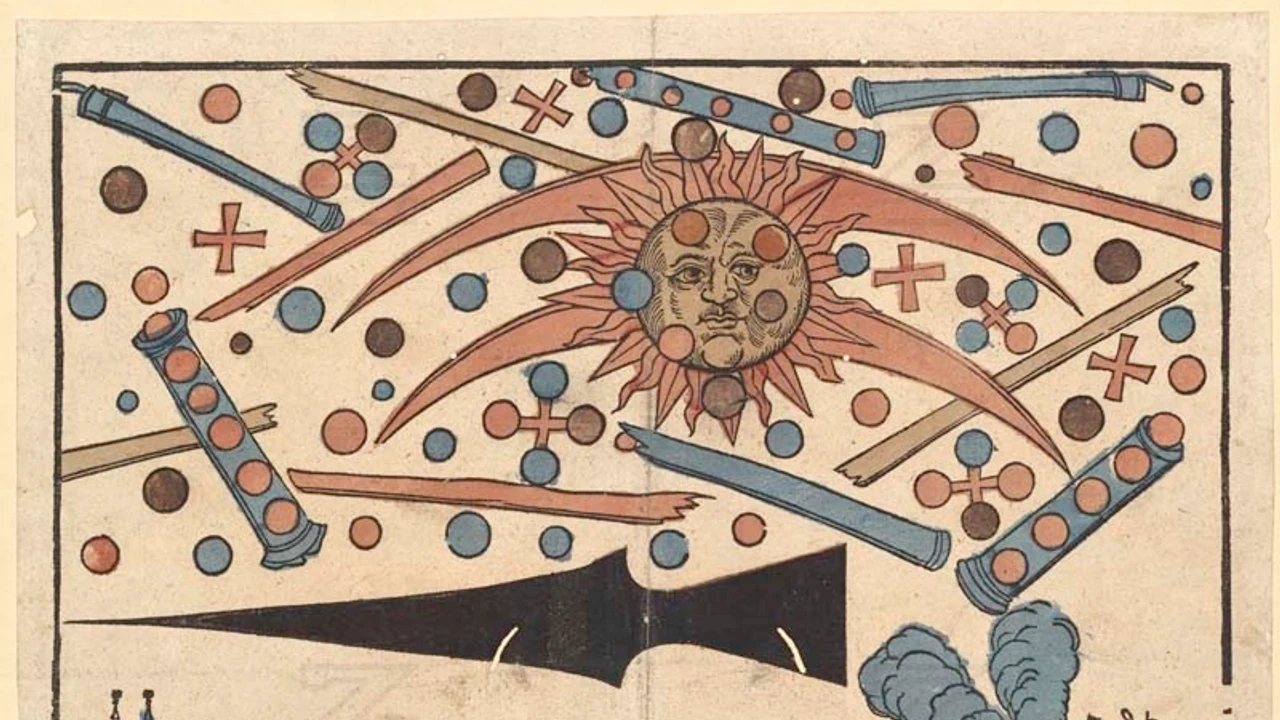
The 1561 Nuremberg celestial phenomenon is known from a single illustrated news broadsheet printed by Hans Glaser in April 1561, now held in the Wickiana collection at the Zentralbibliothek Zürich. It describes globes, crosses and rods appearing to fight in the sky at dawn on 14 April 1561, and interprets the event as a divine warning. No independent contemporary record of the event has been produced, and the described elements match a complex atmospheric ice halo display, including sun dogs, light pillars and crosses.
You have seen this one even if you have never heard of it. Red and black spheres, crosses, two long rods, a great black spear, all tangled above a small walled city with a river running through it. It is the image that gets captioned “medieval UFO battle” roughly once a fortnight somewhere on the internet.
The picture is real. It has a shelfmark, an archive, a printer and a date. That is more provenance than most of the modern canon can manage, and it is worth being precise about what the provenance covers.
What the artefact is
A single sheet, about 26 by 38 centimetres, printed in Nuremberg in April 1561. Woodcut at the top, text below, set by Hans Glaser. It survives in the Wickiana, the collection assembled by the Zurich clergyman Johann Jakob Wick, who spent nearly thirty years buying up news sheets and pasting them into what became twenty four volumes of wonders, crimes, comets and executions. It is now held at the Zentralbibliothek Zürich.
So the document is genuine, dated within days of the event it reports, and it has never been out of institutional custody in a way that matters. Excellent. Now read what kind of document it is.
It is a tabloid
The Flugblatt was a commercial product. Printers sold single sheets on the street, and the reliable sellers were monsters, murders, comets and signs from God. Wunderzeichen, wonder signs, were an established genre with an established structure: dramatic celestial event, vivid woodcut, and a closing passage telling the reader that God is warning this sinful city to repent.
Glaser’s sheet follows that structure exactly, closing on precisely that moral. This does not make it a lie. It makes it a document written inside a frame that shaped both what was noticed and how it was described, produced by someone with a commercial interest in the strangeness of the thing being described.
The nearest modern equivalent is not a police report. It is a front page.
What it actually says
The German is more restrained than the English retellings. At dawn on 14 April, in the sky, many men and women saw globes, Kugeln, some blood red, some bluish, some black, together with crosses, and two great rods, Stangen, within which more globes stood. These moved back and forth against one another for about an hour, as though fighting. Then they grew weary, fell from the sun toward the earth as if burning, and were consumed in great smoke. Afterwards a great black spear like object was seen.
Modern versions upgrade this vocabulary steadily. Rods become cylinders, cylinders become tubes, tubes become mother ships. Globes become spheres, spheres become craft. The black spear becomes a triangular craft. None of that is in the 1561 text, and the drift is measurable if you line up the retellings by decade. The internet’s UFO legends mostly grow this way, one adjective at a time.
The natural candidate
A complex ice halo display accounts for the inventory with unusual neatness.
Cold dawn air with high cirrus produces hexagonal ice crystals, and those produce a catalogue of optical effects that people who live indoors almost never see: sun dogs, two bright mock suns flanking the real one, which are frequently reddish on the inner edge; the 22 degree halo; sun pillars, vertical columns of light standing above and below the sun, which are a straightforward reading of two great rods; the parhelic circle, a horizontal white band that crosses the pillar and produces, at the intersection, a cross. Rare crystal orientations add arcs, secondary crosses and additional mock suns.
Halo displays also change. As the sun rises and the cirrus shifts, elements brighten, dim, appear to move relative to one another, and finally dissolve, over the course of roughly an hour. To an observer with no optical theory available, watching bright shapes drift against each other and then fade, “they fought until they were exhausted and fell” is not a foolish description. It is a good faith description in the only vocabulary that existed.
Two caveats keep this from being a closed case. The woodcut is not a photograph, and its layout is composed for the page rather than for accuracy, so matching individual elements to individual halo features is guesswork. And a comparable Basel broadsheet from 1566 describes black spheres before the sun, which reads more like a different phenomenon entirely, possibly a flock, possibly nothing.
The scoring
Witnesses: weak. The claim that many people saw it is made by the document itself and by nothing else. No city record, no council minute, no letter, no diary has been produced by anyone citing this case, and Nuremberg in 1561 was a literate, well governed city that recorded a great deal.
Instrumentation: none, and in 1561 that is not a criticism, it is a fact.
Official record: weak. A printed sheet in a private collection is a primary source, not an official one.
Stands up to scrutiny: weak. A well understood atmospheric phenomenon explains the reported elements, and the genre explains the framing.
Total 3 out of 12. Thin tier.
Why keep it
Because it is the field’s oldest surviving exhibit and its cleanest demonstration of an argument we make constantly about newer cases. What people report is limited by what they have language for. In 1561 the sky was a theatre where God posted notices, so the shapes fought a battle and delivered a warning. In 1897 the same impulse produced airships crewed by American inventors. In 1947 it produced discs, and by 1980 it produced structured craft in forests.
The interpretation changes with the century. That is the strongest single argument that the interpretation is ours.
Which does not settle whether something was in the sky. It settles what the broadsheet can tell us about it, which is less than the internet believes and more than nothing.
See the full ranking at the case index.
Every new case, scored the same way
One email when a case file lands, with its Signal-Strength score and what would move it. No hype, no 'BREAKING', and every claim carries its source. Unsubscribe anytime.
Sources
- [1] The Public Domain Review, Celestial Phenomenon Over Nuremberg, April 14th 1561
- [2] Zentralbibliothek Zürich, the Wickiana collection of broadsheets
- [3] Swisscollections catalogue record, Himmelserscheinung über Nürnberg vom 14. April 1561
- [4] Wikimedia Commons, high resolution scan of the Glaser broadsheet
Read next
More History & Lore →
Rendlesham Forest: The Night the Cold War Brushed Up Against Something Else
Three nights in December 1980, a USAF nuclear base in Suffolk, and a memo so calm it became the loudest thing in the archive.
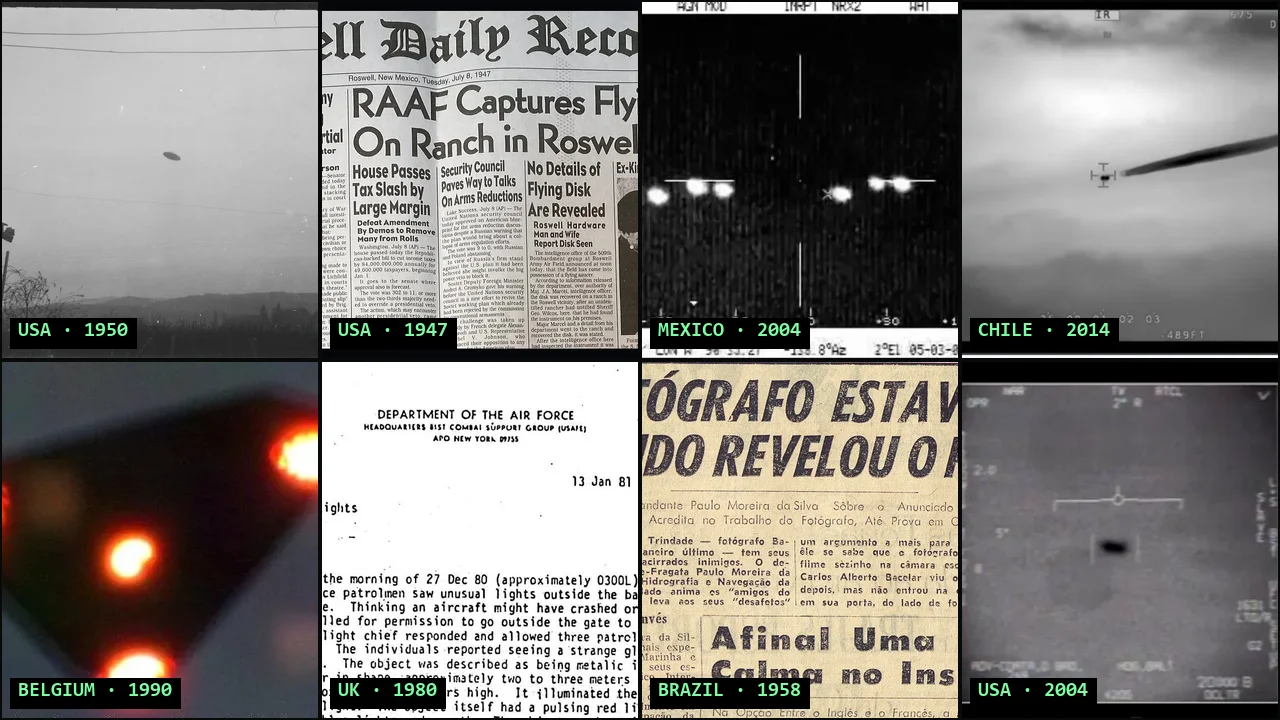
The World's UFO Hotspots, Country by Country: Where the Encounters Cluster, and Which Ones Hold Up
The United States logs more UFO reports than anywhere on Earth, Brazil and Mexico have the loudest traditions, and France and Chile run the most serious government offices. Here is each hotspot's most famous and most infamous encounter, with the real footage and documents, scored on the same four axes.
Kelly-Hopkinsville 1955: Eleven People, Four Hours of Gunfire, and No Evidence
A Kentucky farmhouse siege that produced consistent testimony from eleven witnesses, an immediate police response, and not one physical trace. The owl explanation is better than fans admit, and thinner than skeptics claim.
Follow the thread
New disclosure reporting, physics breakdowns, and case files, in your inbox. Sources or it didn't happen. No spam, unsubscribe anytime.