The Night the Mounds Open: Fairies, Ultraterrestrials and the Pentagon's Haunted Ranch
Halloween is the night the old Irish said the fairy mounds opened. Lights on the road, small beings, people taken, time lost. In 1969 and 1970 two investigators argued that the UFO encounter is the same story in a new vocabulary, and that ghosts, fairies and saucers are one phenomenon. Forty years later a U.S. defense intelligence contract paid scientists to study a Utah ranch where all three turned up at once, and the people who ran it say it followed them home.
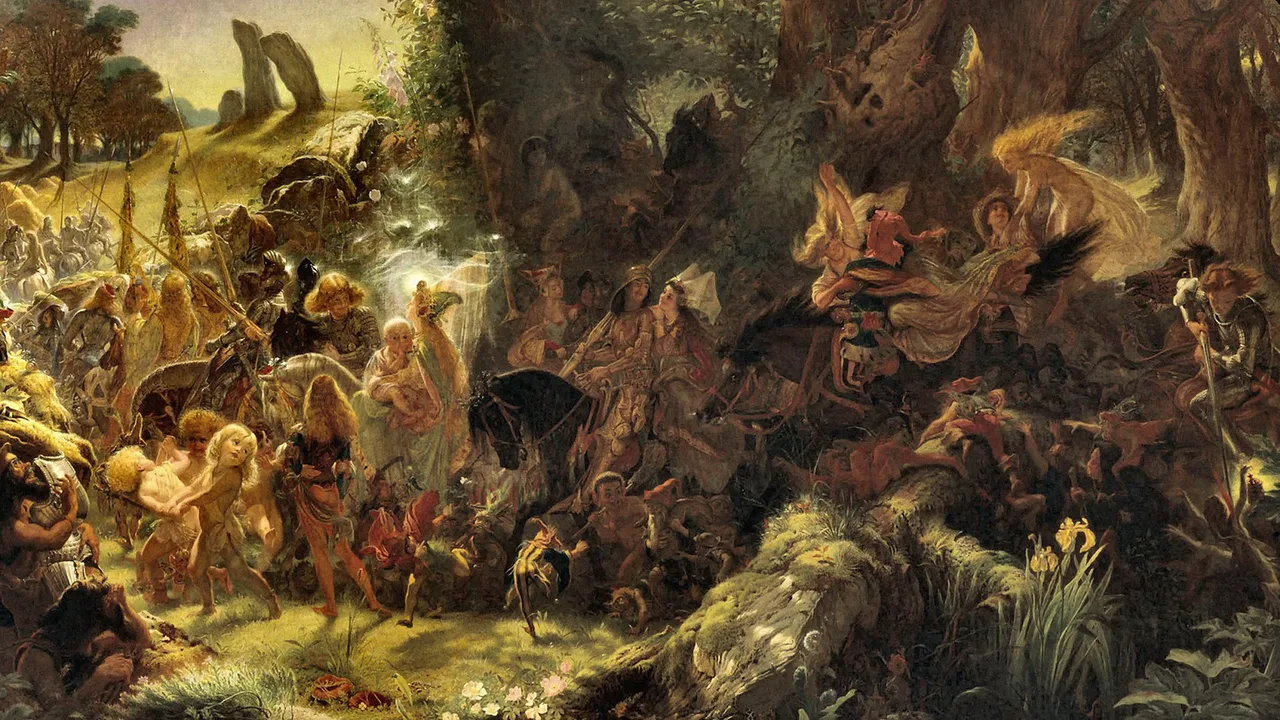
The link between fairies, ghosts and UFOs was argued most seriously by Jacques Vallée, whose 1969 book Passport to Magonia compared fairy encounters with UFO encounters, and John Keel, whose 1970 book Operation Trojan Horse said UFOs, ghosts and demons share one source. That remains a hypothesis built from witness testimony. The documented part is that a U.S. Defense Intelligence Agency contract, AAWSAP, studied a Utah ranch where lights, creatures and poltergeist activity were all reported.
A Halloween piece, and a true one. Every person, date and book below is real and sourced at the foot of the page. Where a claim is somebody’s testimony rather than a fact anyone can check, we say so in the sentence.
There is a version of this story that goes for atmosphere: the grey at the foot of the bed is just the ghost in a new costume, cue the theremin. It is fun and it is lazy, and it hides the part that is actually strange. The idea that fairies, ghosts and flying saucers are one thing was argued seriously by two investigators half a century ago. Then, in the 2000s, a defense intelligence agency paid for a study of a place where all three were reported at once.
So let’s start on the right night.
I. The night the mounds open
Halloween comes in part from Samhain, the Gaelic festival that marked the end of the harvest and the start of winter. In the medieval Irish tales, the sídhe, the hollow hills where the aos sí lived, were open at Samhain. Beings came out. People were taken in. (The modern line about the veil “growing thin” is a later gloss on this; the old stories talk about doors, not veils.)
The fairy lore that grew around those mounds, in Ireland, Scotland and well beyond, has a shape that will look very familiar by the end of this article. A traveller is led off the road by lights. He spends what feels like an evening among small, beautiful, unsettling people who offer him strange food and do not quite move like us. He comes back to find that years have passed. Sometimes he comes back changed. Sometimes a child is taken from its cradle and something else is left in its place, the changeling, which is exactly what the painting at the top of this page shows: a fairy procession at night carrying off a sleeping human baby, with the standing stones behind them.
The most famous man to write the fairies down did not, by legend, get away from them. Robert Kirk, the minister of Aberfoyle in Scotland, wrote a treatise in 1691 later published as The Secret Commonwealth, describing the people of the hills as a real, mostly invisible population living alongside us. In 1692 he collapsed and died on Doon Hill, the fairy knowe behind his church, where he walked every day. Local tradition says the body in his grave was a stand-in, and that Kirk himself was taken into the hill for telling their secrets.
Lights. Small beings. Taken from the road. Lost time. Something left in your place.
The sky had its own version long before anyone said “flying saucer.” Around 815, Agobard, archbishop of Lyon, complained that his flock believed in ships that sailed the clouds from a land called Magonia, and that he had personally stopped a crowd from stoning three men and a woman who were said to have fallen out of one.
II. Two investigators say it is all one thing
In 1969 the astronomer and computer scientist Jacques Vallée borrowed Agobard’s word for the title of Passport to Magonia. Vallée was not a crank on the edge of the subject; he had worked alongside J. Allen Hynek, the Air Force’s own UFO consultant. His book did something nobody in the nuts-and-bolts camp wanted done. It laid modern reports of UFO occupants side by side with the fairy faith, case by case, and asked whether they were the same experience described in two vocabularies.
His best-known exhibit is a plumber from Wisconsin. Around 11 in the morning on 18 April 1961, Joe Simonton of Eagle River said a silver craft had settled in his yard, that one of the small dark-haired men inside held out a jug asking for water, and that when he filled it they handed him back some pancakes, which one of them had been cooking aboard. He ate one and said it tasted like cardboard. The Air Force sent a sample for analysis. The answer, in the Food and Drug Administration’s description, was fat, starch, buckwheat hulls, wheat bran and soybean hulls: an ordinary pancake “of terrestrial origin.” Vallée’s point was the one nobody in the Air Force file had made. In Celtic tradition, the gift of food or bread from the fairies is one of the oldest motifs there is, and Simonton’s story had walked straight into it.
The journalist John Keel, fresh from a year of Mothman reports, men in black and phone calls from nobody around Point Pleasant, West Virginia (we told part of that story, as fiction with real anchors, in The Grinning Man), went further. In UFOs: Operation Trojan Horse (1970) he argued that UFOs, demons, ghosts, fairies and religious apparitions were all produced by one intelligence, which he called the ultraterrestrials: non-human beings that take whatever form a culture is ready to see. Fairies for the farmer of 1700, airships for the newspaper reader of 1897, spacemen for the atomic age. He also noticed that reports clustered in what he called “window areas,” the same patches of countryside producing lights, creatures and hauntings decade after decade. Hold that phrase; it is about to describe a ranch in Utah.
This is where the line between history and hypothesis has to be drawn, and drawn hard. That Vallée and Keel wrote these books, collected these cases and made these arguments is history. That they were right is a hypothesis. Both men built it largely from witness testimony, and testimony is precisely the kind of evidence that takes on the shape of the culture around it. The parallel between the fairy and the alien is real. What the parallel means is the open question: one phenomenon wearing different masks, or one human mind supplying the mask every time.
The occult did not only anticipate the shape of the encounter, either. It sometimes drew it. We have covered Aleister Crowley’s 1918 drawing of “Lam”, which looks uncannily like a Grey, and Jack Parsons’ Babalon Working of 1946, a magical operation performed by a rocket pioneer eighteen months before the first “flying saucer” headline. The modern version of the summoning circle is alive in CE5 groups that call down craft by meditation, which we have called ritual magic in a lab coat.
III. The Pentagon pays to study a haunted ranch
Keel’s window areas sound like folklore. Then one got a government contract.
From about 2008 to 2010 the Defense Intelligence Agency funded the Advanced Aerospace Weapon System Applications Program, AAWSAP, run by Robert Bigelow’s contractor BAASS. Part of its work concerned a ranch in Utah’s Uintah Basin where the reports were not only lights and craft but apparitions, a creature coming out of a glowing opening, mutilated cattle and poltergeist activity inside buildings. A fairy hill, a haunted house and a UFO landing site, in other words, all on one property, with a defense intelligence budget. (Our full piece on the ranch is here.)
Some of that paperwork is now public. The Pentagon’s seventh PURSUE release on 23 October included BAASS’s own April 2010 field report on “the Utah ranch,” DOW-UAP-D174. It contains a witness’s drawing of a creature, and the only biological lab result in seven tranches of released files: four hair samples, one matching a raccoon, three matching a canine sequence common in domestic dogs. BAASS’s own email put them down to the property’s dogs. We read it in full here.
The most Halloween claim of all comes from outside the released files. In Skinwalkers at the Pentagon (2021), the program’s DIA sponsor James Lacatski, the BAASS scientist Colm Kelleher and the journalist George Knapp describe what they call the hitchhiker effect: personnel who visited the ranch reporting orbs, dark figures and poltergeist events in their own homes afterwards, as if something had followed them. Kelleher has compared it to contagion. Critics call it a collection of unverified anecdotes from people with a stake in the story.
Both things are true at once. The hitchhiker effect is, as of today, the authors’ account; we have not seen it documented in any government record released through PURSUE. And it is remarkable that the staff of a U.S. intelligence program were writing up, in plain words, a haunting that follows you home. The fairy lore already had that story. Something comes back with you from the hill and takes up residence in your house. It is the oldest version there is.
IV. What actually connects them
Strip it down and the three pieces share a single shape.
A place. The mound, the window area, the ranch. Not a planet, not a dimension: a patch of ground where people say it keeps happening.
A crossing. Something comes out, or someone is taken in. The traveller led off the road, the plumber handed a pancake, the investigator who drives home from Utah and finds the lights waiting.
A costume that matches the century. The sídhe for the medieval Irish, small dark-haired men in a silver saucer for 1961, “non-human intelligence” for a Pentagon contract. Whatever is on the other end, it has always looked like what the people looking at it expected to see.
There are two honest ways to read that.
The first is Keel’s and Vallée’s. If an intelligence really is interacting with people, changing its costume every generation is exactly what you would expect it to do, and the persistence of the places and the patterns is the signal, not the noise.
The second is where the physical evidence we actually hold points. When a government contract finally sent hair from the most haunted ranch in America to a lab, it came back raccoon and dog. When the Air Force had the pancake from the saucer analysed, it came back buckwheat. Every time the story has been pinned to something you can put on a bench, it has come back ordinary, and every time, the story itself has gone on being told in the vocabulary of its century.
That is not a verdict on what people see. It is a statement of where the evidence stands.
And on Halloween, by the old reckoning, the mounds are open. If a light leads you off the road, write down the time. If somebody offers you food, do not eat it.
Every new case, scored the same way
One email when a case file lands, with its Signal-Strength score and what would move it. No hype, no 'BREAKING', and every claim carries its source. Unsubscribe anytime.
Frequently asked
Why is Halloween connected to spirits and the otherworld? +
Halloween descends in part from the Gaelic festival of Samhain. Medieval Irish tales describe the sídhe, the mounds where the otherworldly aos sí lived, as open at Samhain, so beings could pass between their world and ours. Folklorists note that the modern phrase about a thinning veil is a newer gloss on that older idea.
What did Jacques Vallée argue in Passport to Magonia? +
Vallée, an astronomer and computer scientist, argued in 1969 that modern UFO occupant reports closely resemble older accounts of fairies, elves and other folk beings: lights, small humanoids, abductions, gifts of strange food and lost time. He took the title from Agobard of Lyon, a ninth century archbishop who wrote that people believed in cloud ships from a land called Magonia. Vallée treated the parallel as a sign of one underlying phenomenon. Critics read it as evidence that witnesses describe the unknown in whatever terms their culture supplies.
What are John Keel's ultraterrestrials? +
In UFOs: Operation Trojan Horse (1970), the journalist John Keel argued that UFOs, ghosts, demons, fairies and religious apparitions are produced by a single non-human intelligence he called ultraterrestrials, which take whatever form a culture expects. It is an interpretation of witness reports, not a tested finding.
Did the Pentagon study ghosts? +
The Defense Intelligence Agency funded AAWSAP, a contract run by Bigelow Aerospace Advanced Space Studies from about 2008 to 2010, and part of that work concerned a Utah ranch with reports of lights, creatures and poltergeist activity. The claim that the phenomena followed investigators home, the so-called hitchhiker effect, comes from the 2021 book Skinwalkers at the Pentagon by people who ran the program. It is their account, not a finding in the government records released so far.
Sources
- [1] Samhain, Wikipedia (the sídhe open at Samhain in medieval Irish tales)
- [2] Robert Kirk (folklorist), Wikipedia (The Secret Commonwealth, 1691)
- [3] Doon Hill and Robert Kirk, Mysterious Britain (the legend of his taking)
- [4] Changeling, Wikipedia
- [5] Jason Colavito, Looking for the real origins of Magonia (Agobard of Lyon, c. 815)
- [6] Joe Simonton, Wikipedia (Eagle River, Wisconsin, 18 April 1961; FDA analysis; Vallée's comparison)
- [7] Interdimensional UFO hypothesis, Wikipedia (Vallée, Keel)
- [8] Operation Trojan Horse (book), Wikipedia (John Keel, 1970)
- [9] John Keel, Wikipedia
- [10] Advanced Aerospace Threat Identification Program, Wikipedia (AAWSAP and BAASS)
- [11] DOW-UAP-D174, Utah Ranch Investigation Report, April 2010 (primary PDF, PURSUE Release 07)
- [12] Skinwalkers at the Pentagon (Lacatski, Kelleher, Knapp), summary of the book's claims
- [13] A bridge too far?, Life in Jonestown (a critical reading of the hitchhiker claims)
Read next
More Esoterica →
Skinwalker Ranch: The Haunted Property the Pentagon Paid to Study
Strip away the cattle mutilations and the dire-wolf sightings and one fact survives, fully documented: the U.S. Defense Intelligence Agency funded a years-long scientific study of a single ranch in Utah. That is the part that should keep you up at night.

CE5 Is Ritual Magic in a Lab Coat: The Occult Roots of "Contact Protocols"
A growing movement says you can summon UFOs on demand using meditation, group intention, and a fixed sequence of steps. They call it CE5 and frame it as a protocol. Strip the science-adjacent vocabulary and what remains is something much older: a ritual of evocation, performed by people who would never use that word.
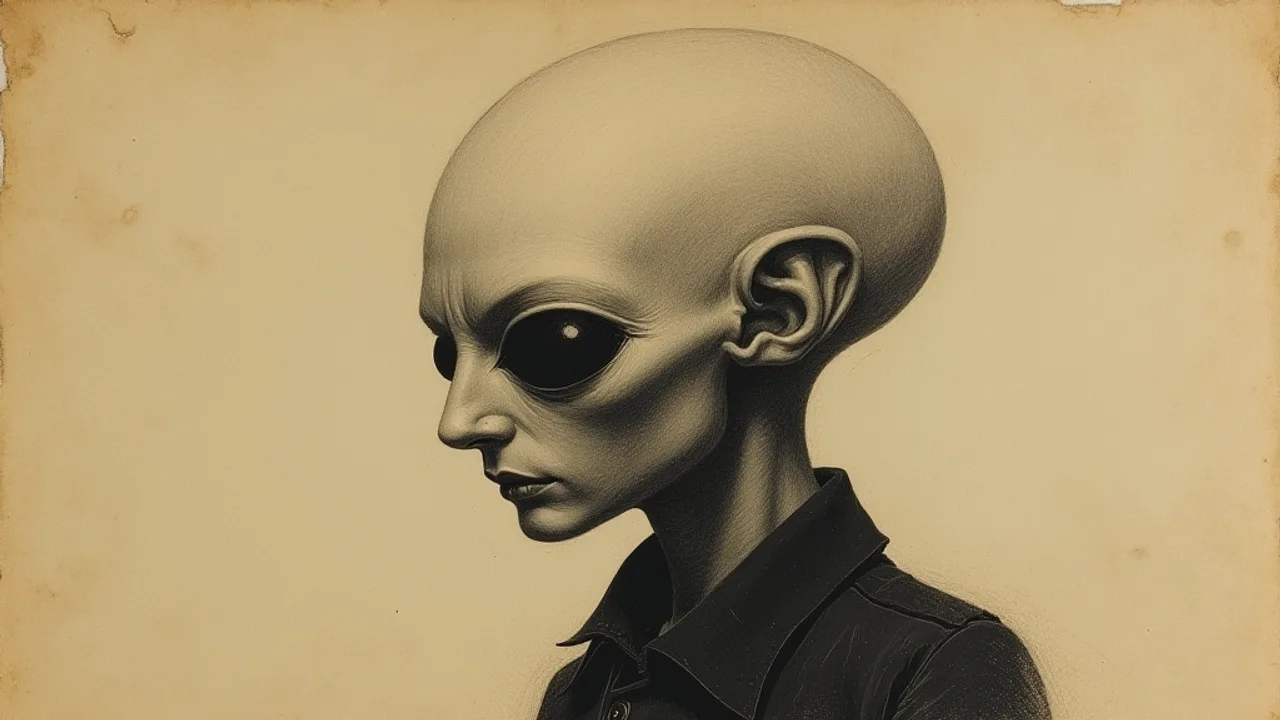
Crowley's "Lam": The 1918 Drawing That Looks Like a Grey
In 1919, Aleister Crowley exhibited a portrait of an entity he said he had contacted: a bald, bulbous-headed being with a small body and enormous eyes. It predates the abduction-era "Grey" by half a century. Either it's a stunning coincidence, or the Greys were described by occultists long before they were described by abductees.
Follow the thread
New disclosure reporting, physics breakdowns, and case files, in your inbox. Sources or it didn't happen. No spam, unsubscribe anytime.