Crowley's "Lam": The 1918 Drawing That Looks Like a Grey
In 1919, Aleister Crowley exhibited a portrait of an entity he said he had contacted: a bald, bulbous-headed being with a small body and enormous eyes. It predates the abduction-era "Grey" by half a century. Either it's a stunning coincidence, or the Greys were described by occultists long before they were described by abductees.
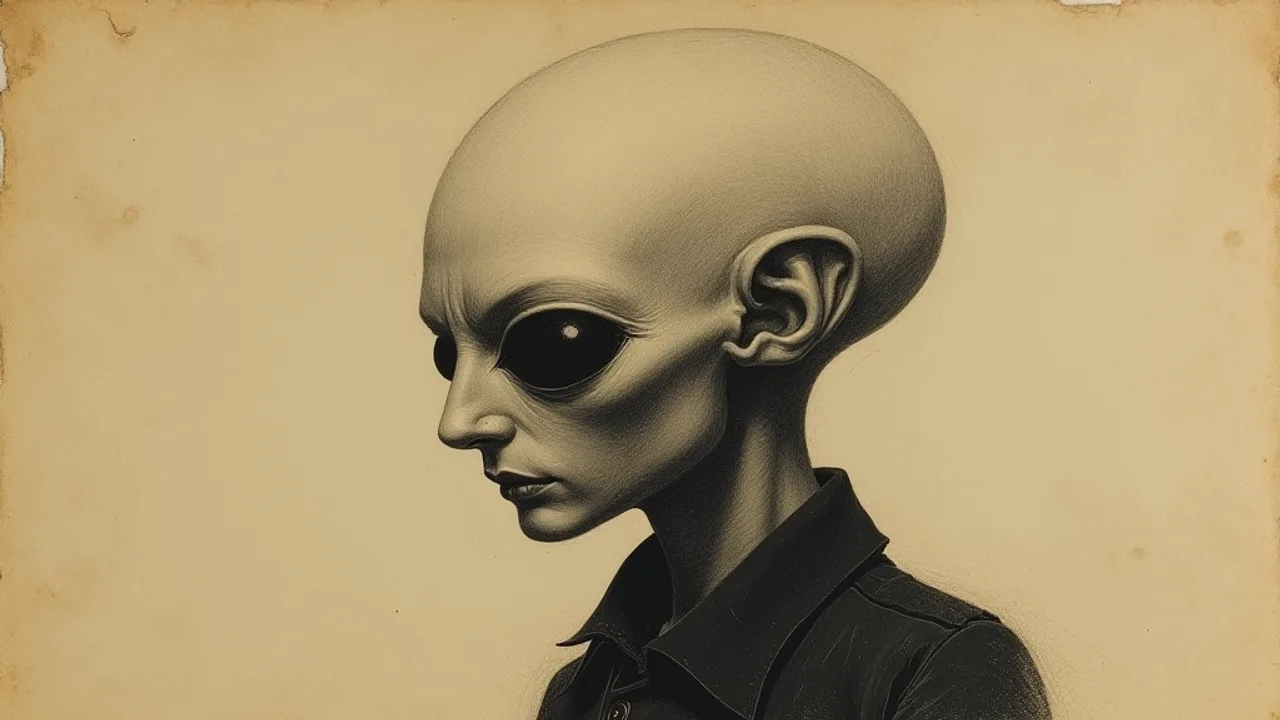 AI illustration
The image is the first thing people fixate on, and for good reason. A bald, oversized cranium tapering to a narrow chin. A small, almost vestigial body. Eyes that dominate the face. Anyone raised on a century of UFO culture recognizes it instantly: it is a Grey, the standard-issue abduction entity of a thousand reports.
Except this drawing is from 1919. Aleister Crowley, the English occultist who called himself “the Beast 666” and built the religion of Thelema, produced it as a portrait of an entity he said he had contacted during a magical operation in 1918, which he called the Amalantrah Working. He named the being Lam, a Tibetan word for “way” or “path,” and exhibited the portrait in New York with the caption identifying it as a contacted intelligence.
The half-century gap
The modern Grey enters popular consciousness in 1961, with the Betty and Barney Hill abduction, and is cemented in the 1980s by Whitley Strieber’s Communion and its cover art. Crowley’s Lam predates the Hill case by more than forty years and the Communion cover by nearly seventy. Whatever the Grey is, an occultist drew its face before the abduction phenomenon that supposedly introduced it existed.
There are two ways to take this, and they could not be further apart.
The deflationary reading
The skeptical account is clean. Crowley’s drawing is sketchy and stylized; the human brain is relentless at finding faces; and decades of cultural diffusion, Crowley’s followers were not obscure, could plausibly have seeded the later imagery. On this reading, Lam didn’t predict the Grey. Lam became the Grey, through a slow leak from occult subculture into science fiction into abduction testimony. The resemblance is real, but the arrow of causation runs through human imagination, not through contact.
That is a coherent story and it may well be the true one.
The unsettling reading
The other reading takes Crowley at something closer to his word. He did not describe building anything or seeing a craft. He described contacting an intelligence through ritual, and drawing what answered. If the Hill abductees, decades later and with no plausible exposure to an obscure 1919 New York exhibition, described the same morphology, then the consistency points at the phenomenon, not at the artist.
The question Lam forces is uncomfortable in both directions: did the occultist invent the Grey, or did he simply meet it first?
Why it belongs in the file
We are not in the business of deciding that Crowley was right. We are in the business of noticing that the visual canon of the UFO age has roots in ceremonial magic that the mainstream telling quietly omits. The Grey is treated as a product of the 1960s. Its face was on a gallery wall in 1919, captioned as a contacted entity, by a man who insisted he had reached it through ritual rather than radar.
Lam is the cleanest single artifact of the UFO-occult overlap, because it is not an argument. It is a picture. You can look at the 1919 drawing and the 1987 Communion cover side by side and decide for yourself which reading the resemblance supports, and neither one is comfortable.
Every new case, scored the same way
One email when a case file lands, with its Signal-Strength score and what would move it. No hype, no 'BREAKING', and every claim carries its source. Unsubscribe anytime.
Sources
Read next
More Esoterica →
'Taken' at 24: The 2002 Spielberg Abduction Series That Now Reads Like a 2026 Briefing
Steven Spielberg Presents Taken, a 20-hour, Emmy-winning miniseries from 2002 about Roswell, a hidden government program, and a multi-generational hybrid breeding project, now lines up unnervingly well with what whistleblowers are telling Congress in 2026. We score it element by element: where the fiction matches the current claims, where it's still pure TV, and the uncomfortable possibility nobody raises, that the resemblance runs backwards.

DMT Entity Contact: The Most Repeatable Encounter Report in the Field
Thousands of people describe meeting the same kinds of beings, on schedule, under laboratory conditions. That is either the strongest contact data we have or the clearest proof that consistency is not corroboration.
Crop Circle Messages, Decoded: An A-Z of What the Famous Formations Are Supposed to Mean
Most crop circles are made by people with planks and rope, that part is settled. The interesting question is the other one: why do so many of them read like messages, and what have people decoded out of them? Here is a field guide to the most famous formations, the meanings attached to them, and an A-to-Z of the recurring motifs, every interpretation labeled as interpretation, not fact.
Follow the thread
New disclosure reporting, physics breakdowns, and case files, in your inbox. Sources or it didn't happen. No spam, unsubscribe anytime.