PURSUE Release 08: The DIA Praised the UFO Program's Reports, Then Called Them 'Limited Value'
The eighth PURSUE tranche is 40 documents and three CENTCOM videos. Its centre is the Pentagon's own paper trail on Harry Reid's 2009 bid to put the AAWSAP/AATIP program under a restricted special access program, and DIA's two verdicts on the same reports, thirteen months apart. Also inside: a 538-page Bigelow contractor report that talks about recovered hardware, 'EBE tissue samples' and a ranch where phenomena seemed to be 'game playing', a 2023 radar track at 1,650 mph, Kelly Johnson's flying saucer, and the 1952 CIA memos on using saucers for psychological warfare.
PURSUE Release 08, published by the U.S. Department of War on November 20, 2026, contains 43 records: 40 PDFs (34 from the Department of War, 6 from the CIA) and three CENTCOM infrared videos from the Middle East dated 2020, 2023 and 2026. Its most consequential files are the Defense Intelligence Agency's internal record on the AAWSAP/AATIP program: Senator Harry Reid's June 2009 request for a restricted special access program, DIA's November 2009 finding that nothing delivered justified one, an October 2009 DIA review calling the contractor's reports positive 'some exceptionally so', and a December 2010 memo saying DIA had judged them 'of limited value'. The release also includes a 538-page Bigelow Aerospace Advanced Space Studies report from July 2009 and an AARO slide on a 2023 radar track at an implied 1,650 mph, which AARO says the data cannot confirm was a single object.
The eighth PURSUE tranche went up on war.gov/UFO on Thursday, November 20, 2026. It is 43 records: 40 PDFs and three short videos from U.S. Central Command. The database now holds 521 files. It also closes a small mystery from last month. Release 07 skipped document numbers D165 and D172. Both are here, and D172 turns out to be 538 pages long.
Most of the early coverage went to the oldest material, a 1952 CIA briefing and a 1953 sighting by Lockheed’s legendary chief engineer. Both are in this piece. But the files that matter most are a handful of dull-looking memos from 2009 and 2010, because they are the Pentagon’s own record of what it thought about the program that started the modern UFO disclosure story, and they do not agree with each other.
We read all 40 documents, 841 pages, and watched the three clips frame by frame. Here is what is in them, what is new, and what is old paper with a 2026 release stamp.
Reid asks for a secret program
In 2008 Senators Harry Reid and Daniel Inouye added $10 million to a supplemental appropriation for the Defense Intelligence Agency to study “foreign advanced aerospace weapon threats” out to 40 years ahead. DIA ran the contract as the Advanced Aerospace Weapon System Applications Program, AAWSAP. The only bidder, and the winner, was Bigelow Aerospace Advanced Space Studies, BAASS, in Las Vegas. Reid’s office called the effort AATIP, and that is the name that reached the New York Times in 2017.
On June 24, 2009, Reid wrote to Deputy Secretary of Defense William Lynn III (DOW-UAP-D183). He said the program had already identified “several highly sensitive, unconventional aerospace-related findings,” and asked for a Restricted Special Access Program with a “Bigoted Access List,” a roster of the only people allowed to know.
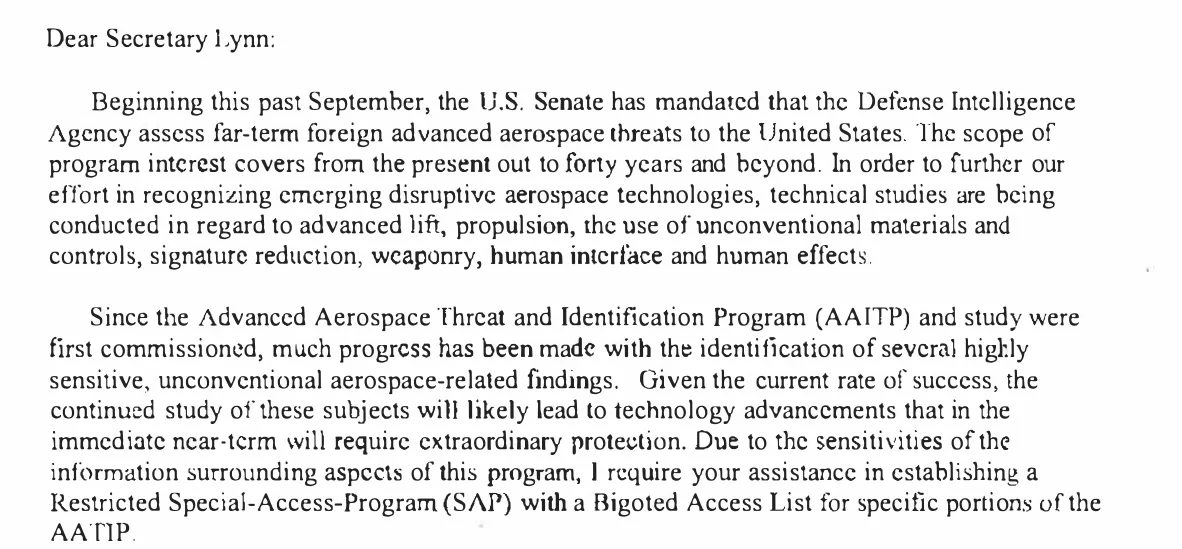
DOW-UAP-D183, page 1. U.S. government work, public domain.
The letter is more pointed than its famous line. It says even conventional special access protocols “will not adequately ensure that all aspects of the project are properly secured.” It says the “nuanced manner in which some of these technologies will be collected, engineered and applied by the U.S. may require senior level government approval.” And it describes the “associated exotic technologies” as involving “quantum mechanics, nuclear science, electromagnetic theory, gravities, and thermodynamics.”
This letter is not new. Las Vegas reporters George Knapp and Matt Adams published a copy in 2018, and a less redacted copy in 2019 named two people on the access list. The PURSUE version is the government’s own scan, and it is more heavily redacted than the 2019 leak: everyone on the list except Lynn, Reid, Inouye and one Senate staffer is replaced by a pseudonym such as “MP Person 1.”
What is new is everything around it.
DIA says no, in writing
Five months later DIA answered the Pentagon’s intelligence directorate, not Reid, in a two-page info memo (DOW-UAP-D185, November 13, 2009). Its conclusion is in the first paragraph: “DIA cannot find adequate justification to establish a restricted SAP.”
The reasoning is blunt. Everything delivered in the first year was unclassified “because the contractor had not established a secure facility, and program employees were being vetted for clearances.” Most of the reports drew on publicly available science, which DIA said it was “prohibited from classifying” unless it clearly related to national security. And on Reid’s headline claim, DIA wrote that it was “unaware of any report containing information sufficiently sensitive and vulnerable to require extra protection,” and assumed the senator meant “future phases of this program.”
In other words: the agency running the contract said the sensitive findings Reid described were not in anything it had been given.
That matters because the gap has been argued about for years. The Black Vault’s John Greenewald has reported that the Department could not find any reply to Reid’s letter. D185 is not a reply to Reid either. It is DIA’s internal finding, sent up the chain. It is the clearest official statement yet of why the special access program was never created.
Two verdicts on the same reports
Here is the part the summaries skipped.
BAASS commissioned 26 technical papers in its first year, on topics that included antigravity, warp drives, traversable wormholes and the effects of fields on biological tissue. On October 30, 2009, DIA’s Defense Warning Office sent the Director a review of them (DOW-UAP-D188). The Director had asked for it on May 15, the memo says, “after your meeting with Senator Harry Reid.” Eight papers were reviewed by fellow authors and five by outside reviewers, three of them at Sandia National Laboratories.
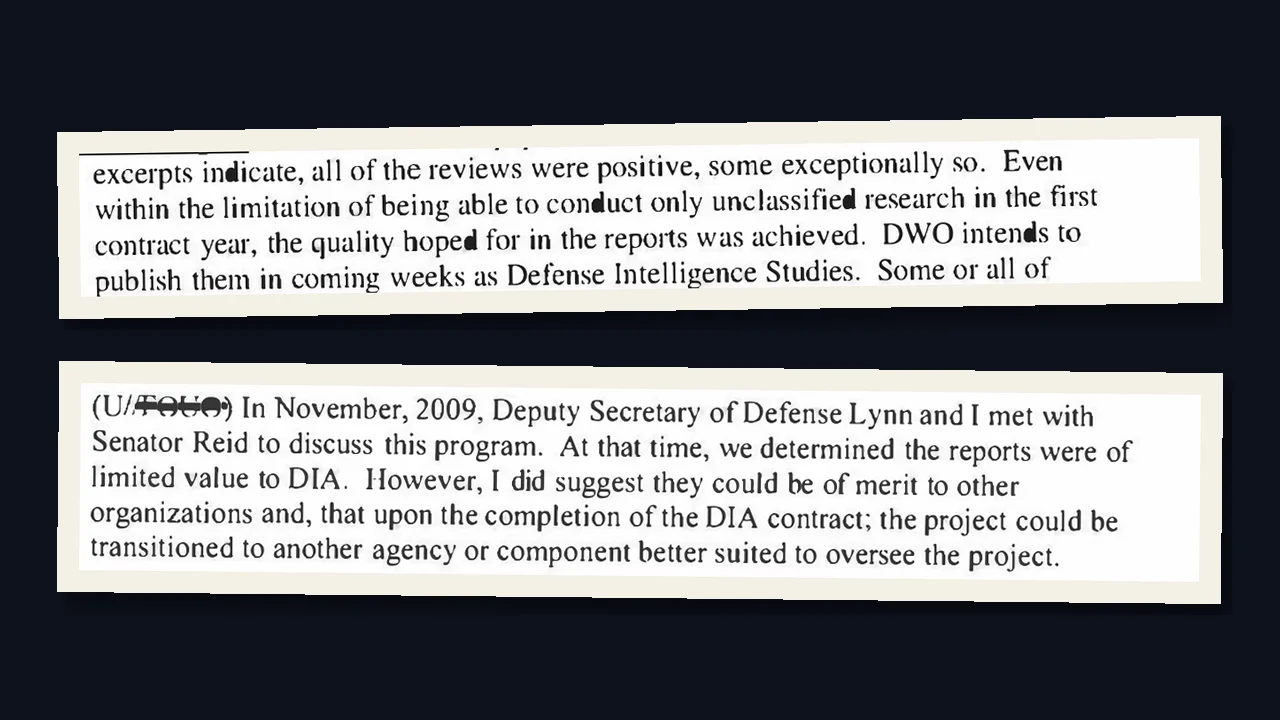
The verdict: “all of the reviews were positive, some exceptionally so. Even within the limitation of being able to conduct only unclassified research in the first contract year, the quality hoped for in the reports was achieved.” DIA said it intended to publish them “in coming weeks as Defense Intelligence Studies,” and expected Congress to fund a second year at $12 million.
Thirteen months later, DIA Director Lt. Gen. Ronald Burgess wrote a summary of the program for the Pentagon’s acquisition chief (DOW-UAP-D186, December 2010). One paragraph recounts a November 2009 meeting: “Deputy Secretary of Defense Lynn and I met with Senator Reid to discuss this program. At that time, we determined the reports were of limited value to DIA.”
Both memos are about the same 26 reports. One was written shortly before that meeting and says they were good. The other, written a year after it, says the Director and the Deputy Secretary had judged them of limited value.
There are innocent readings. “Good science” and “useful to an intelligence agency” are not the same test; Burgess even adds that the reports “could be of merit to other organizations.” But the plain fact is that the office that reviewed the work praised it, and the leadership account that followed does not mention that review at all. Anyone who has argued that the program was a waste, or that it was buried, now has an official document on their side.
One more thing the government got wrong. The war.gov index blurb for DOW-UAP-D187, a talking paper prepared before Reid visited the DIA Director on January 5, 2009, says the paper “notes that DIA assessed the program to have produced reports of limited value.” It does not. The one-page paper says the contract “is proceeding on schedule and within cost,” and that DIA’s acquisition office rated BAASS’s twelve project plans “very good to excellent.” The “limited value” line comes from the December 2010 memo. The index has it 23 months early.
Inside the 538-page contractor report
DOW-UAP-D172 is the BAASS Ten-Month Report, covering September 2008 to July 2009. Program veterans described parts of this effort in their 2021 book Skinwalkers at the Pentagon, but as far as we can find, the report itself has never been published. Every page carries a banner saying it is proprietary to BAASS. Names are blacked out hundreds of times; places, dates and base names are mostly left in.
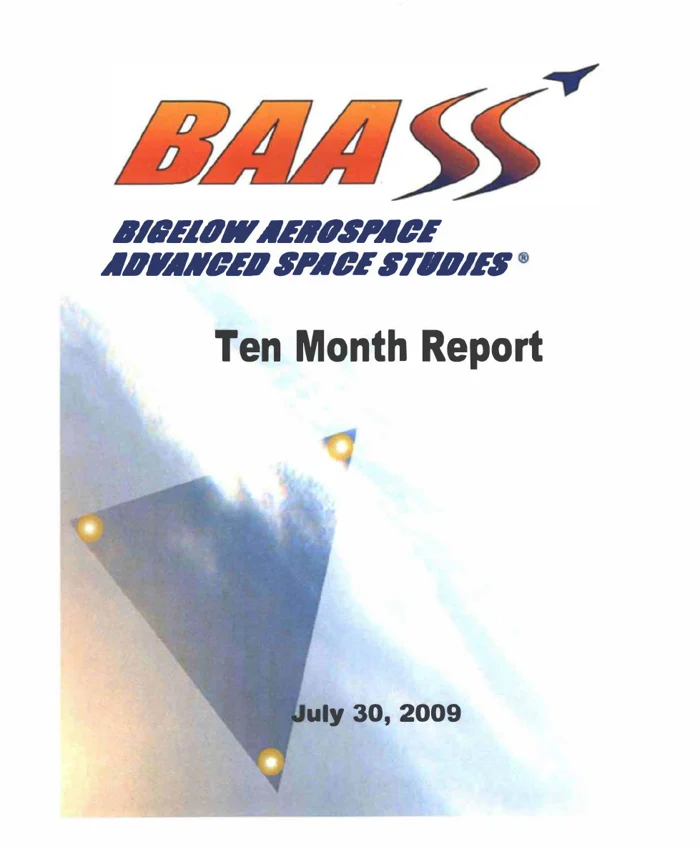
The report’s cover. DOW-UAP-D172, page 3. Released by the U.S. Department of War.
It is not the 26 science papers. It is a management report on everything else BAASS was doing, and it reads nothing like the tidy threat-assessment contract DIA described to Congress. Some of what it says, with PDF page numbers:
- Staff. About 47 full-time employees hired in ten months, including investigators (p. 8, p. 17).
- Clearances. On January 29, 2009, the Defense Security Service told BAASS “a security clearance at the TOP SECRET level is hereby granted your facility” (p. 12), and the sponsor “facilitated the expeditious granting of TS/SCI security clearances” to its senior staff “because of the highly sensitive information that BAASS is tasked to procure and research” (p. 13).
- Recovered hardware. The report describes a planned underground vault, driven by “a BAASS priority to pursue and acquire recovered hardware and biological samples from the corporate world and/or from private individuals and groups located elsewhere, including Brazil” (p. 9). Our Release 07 piece covered an earlier version of the vault plan.
- A database of 237,000 events. BAASS merged nine databases, including UFOCAT, MUFON, Project Blue Book and a redacted pilot database, into a system called CAPELLA with “over 237,000 UAP events” (p. 223).
- Destroyed files. BAASS says DIA told it that in the early 1990s the agency “had destroyed thousands, perhaps millions, of paper files (some of which doubtless pertained to reports on the performance of advanced aerospace vehicles)” (p. 192).
- Nuclear sites. A “Northern Tier” project on Malmstrom, Minot, Wurtsmith and Loring, the 1960s and 1970s missile and bomber bases, is the most heavily redacted part of the report, with whole pages blacked out (pp. 314 to 396).
- The Utah ranch. The ranch now known as Skinwalker, then owned by the BAASS administrator, is described as having “a multi decade history of anomalous phenomena,” including about seventy incidents and the “unexplained death and disappearance of dozens of animals” (p. 164). Three military observers, from the Air Force, Navy and Marine Corps, spent June 30 to July 2, 2009 there. The report says they felt a “distinct drop in temperature,” one saw “a shadowy humanoid figure,” and each saw a differently shaped bright object over the same ridge (pp. 165 to 168, pp. 478 to 480).
- Brazil. A team went to Colares, site of the 1977 “chupa-chupa” scare, and recorded a local doctor’s account of burns and “micro-drilled marks” on patients (p. 412).
The report has pictures too, and they are the first photographs from the Utah ranch that PURSUE has published. At the end of the ranch section, under the heading “Interesting and Unexplained Photos,” BAASS printed five frames with its own captions: “Unknown Object under the Bird,” “Daylight Orb over the Pole,” “Unknown Object on the Horizon,” “Strange Orb High In the Sky (Moon was not visible),” and “Orb jumping off the ‘Bull Trailer’” (pp. 171 to 175).
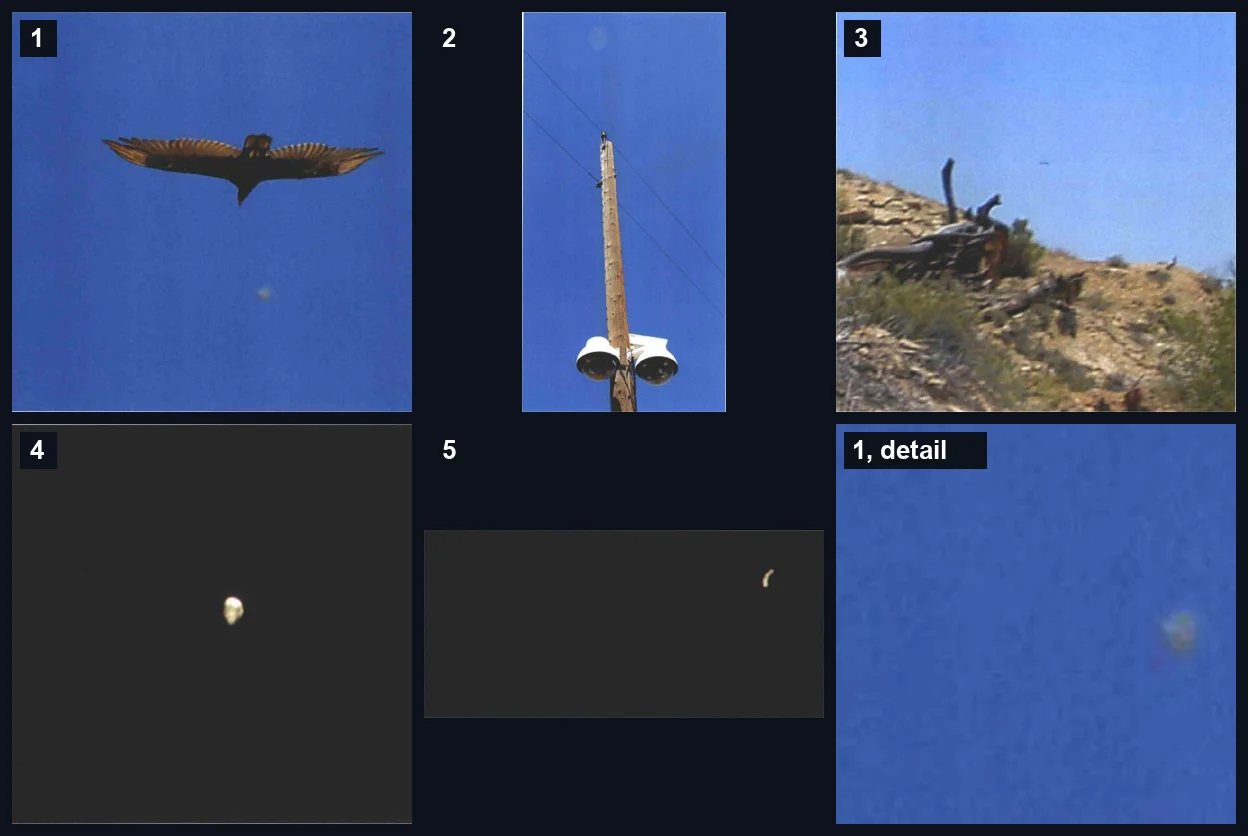
DOW-UAP-D172, pages 171 to 175, in order, cropped by NHIAnomalous. Panel six enlarges the blob under the bird in photo 1. Captions are BAASS’s; the report offers no analysis of any of them.
Look closely and they are what most anomaly photos are: a soft blob, a speck, a bright smear in the dark. The blob under the bird is a few pixels across. The report gives no dates, cameras or exposure details for any of them, and does not say whether anyone ruled out dust, insects, lens flare or a reflection. They matter less as evidence than as a window on what a DIA contractor was putting in front of its sponsor.
The Brazil chapter is better documented. BAASS reproduces pages from the Brazilian Air Force’s 1977 Colares investigation, Operação Prato, which it calls “Operation Plate.” One print carries its own data strip: Baía do Sol, off Colares Island, December 10, 1977, 20:30, a Yashica camera with a 400 mm lens at 1/30 of a second, object altitude 300 metres, distance 3,000 to 3,500 metres (p. 404). The next, a bright orange oval, is captioned “location and date unknown” (p. 405).
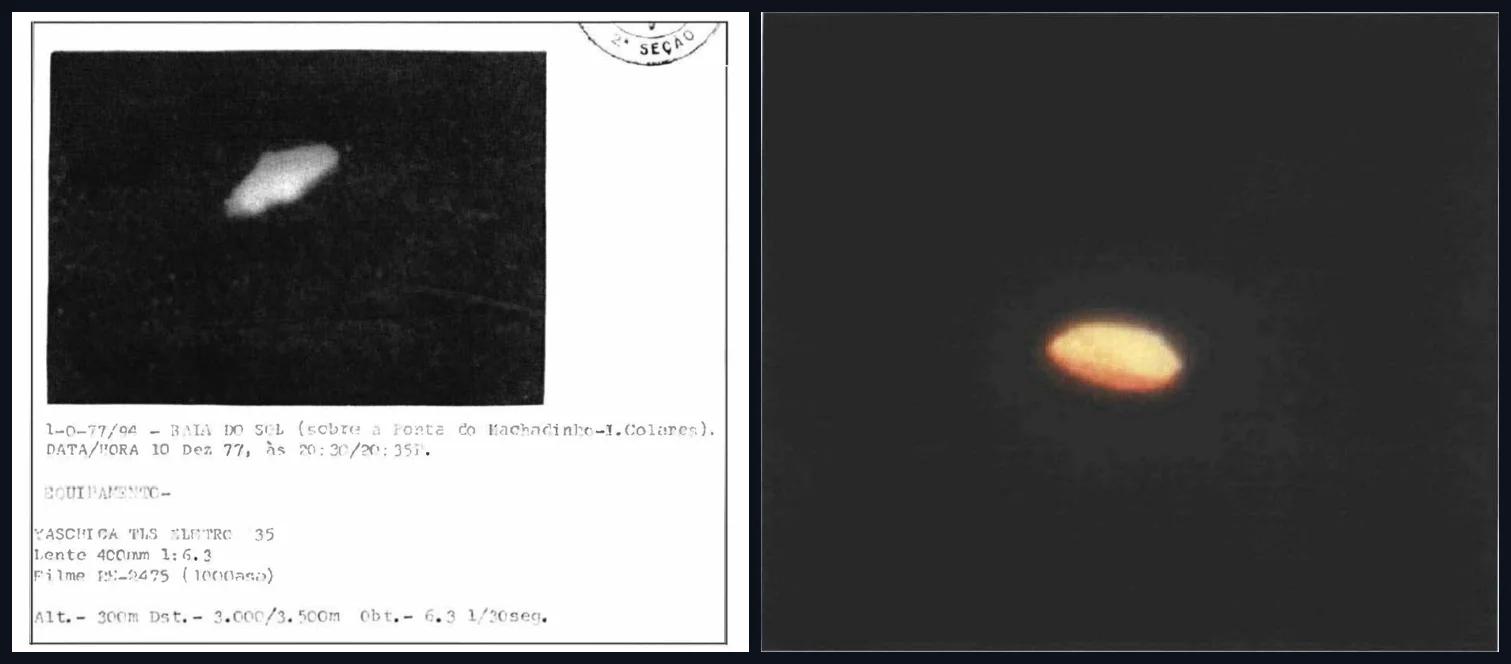
Operação Prato prints as reproduced by BAASS. DOW-UAP-D172, pages 404 and 405. Released by the U.S. Department of War.
These are not new. The report itself notes that Brazil’s National Archive released Prato material, including a Super 8 film, to a Brazilian ufology group, and these prints have circulated since. Note the exposure, too: a thirtieth of a second through a 400 mm lens is long enough for any camera shake to smear a point of light into a streak or an oval. What is new is seeing them inside a U.S. defence contractor’s report to the DIA.
Then the strategic plan for 2010, which is the strangest material PURSUE has released so far.
On the ranch, the report concludes that its 13-year record “appears to indicate interactions with dozens of different human observers,” and that “they may be instructional in intent, with a definite game playing component” (p. 481). It proposes consciousness research there.
It says senior figures in industry and government “have been given access to the extremely closely guarded information that the United States possesses regarding the physical evidence (hardware and biological samples) of advanced aerospace vehicles and their pilots” (p. 494).
And it lists, as a goal: “Launch search to obtain EBE tissue samples.” The plan quotes one of its own contractors: “under the hypothesis that biological material of potentially non-human origin has been recovered,” BAASS “will lobby for access to medical samples” at the Armed Forces Institute of Pathology, the Army’s Fort Detrick commands and Dugway Proving Ground (p. 496).
Read those lines carefully. They are a contractor’s claims and plans, written in the contractor’s voice, in a report the contractor wrote about itself. Nothing in Release 08 shows that BAASS saw hardware, obtained a tissue sample, or confirmed that anyone else had. The “physical evidence” sentence asserts that unnamed people have been given access; it does not say BAASS was, and it cites nothing. In Release 07, the only biological material BAASS actually produced, four hairs from the Utah ranch, tested as raccoon and dog.
What D172 does establish is narrower and still important: the Pentagon-funded contractor was openly planning to look for recovered craft and “EBE” tissue, in a report delivered to DIA, in 2009. That is the same period in which DIA told the Pentagon the program had produced nothing sensitive.
The two pictures may both be honest. D185 says the first-year deliverables, the 26 papers, were unclassified, and the contractor had no secure facility yet. D172 says BAASS held a Top Secret facility clearance from January 2009. A facility clearance is a paper eligibility; approved storage for classified material is a separate step. The government’s files do not settle which was true when. They do show that DIA judged the program on the science papers, while the contractor’s own report was about something much larger.
A radar track at 1,650 mph
The newest document in the tranche is one AARO slide, DOW-UAP-D165, about an event in the western United States in 2023.
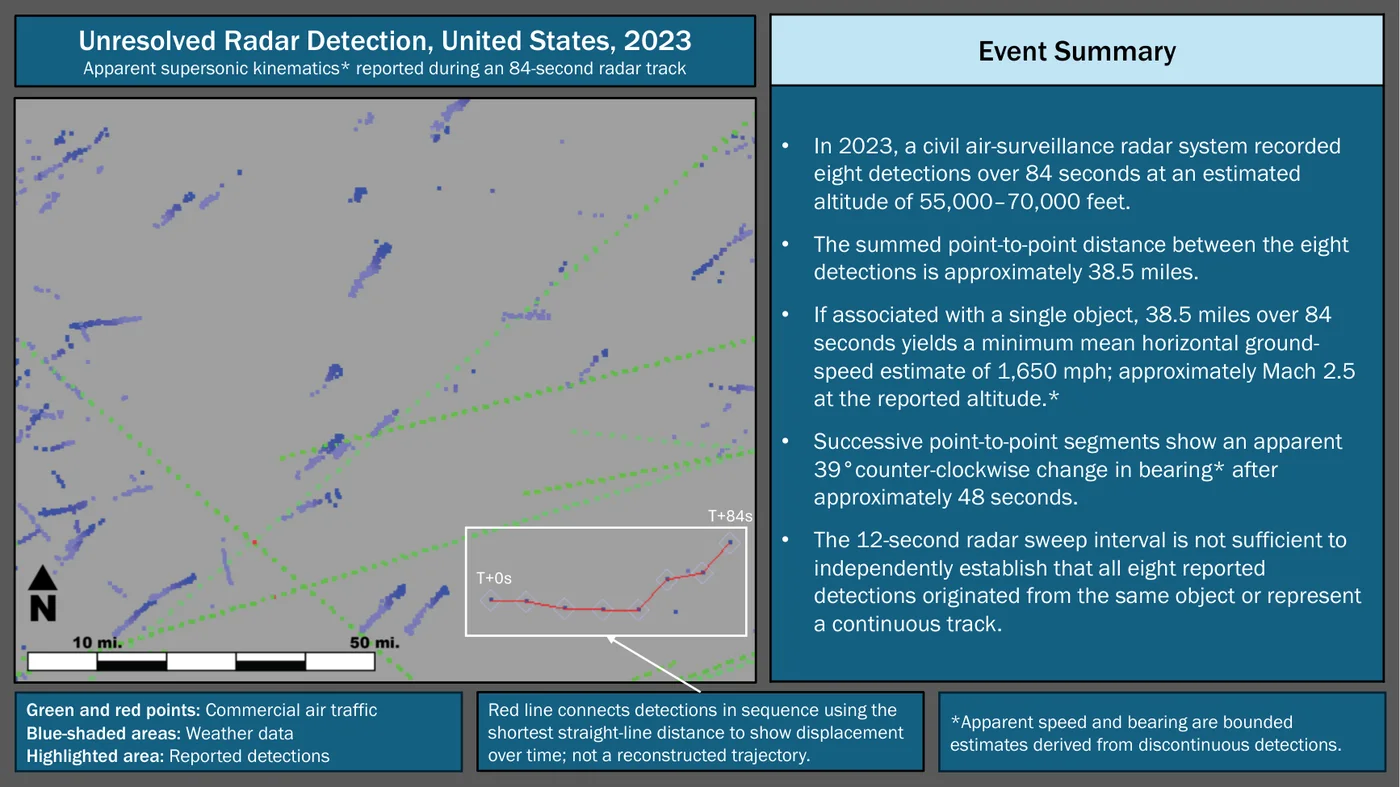
DOW-UAP-D165. U.S. government work, public domain.
A civil air-surveillance radar logged eight detections over 84 seconds at an estimated 55,000 to 70,000 feet. Joined in order, they span about 38.5 miles. If they were one object, that is a minimum average of 1,650 mph, roughly Mach 2.5, with a 39 degree turn to the left after about 48 seconds.
AARO undercuts its own headline in the same slide. The radar sweeps every 12 seconds, which “is not sufficient to independently establish that all eight reported detections originated from the same object or represent a continuous track.” The red line is “not a reconstructed trajectory.” The map also shows weather returns scattered across the area. The slide does not say how altitude was estimated, which matters, because a basic primary radar return carries no height on its own.
This is the honest version of a fast-mover story: eight dots, a possibility, and an analyst saying out loud that the data cannot carry it.
Three CENTCOM clips
The videos are short and, like nearly every PURSUE military clip, mostly redaction boxes.

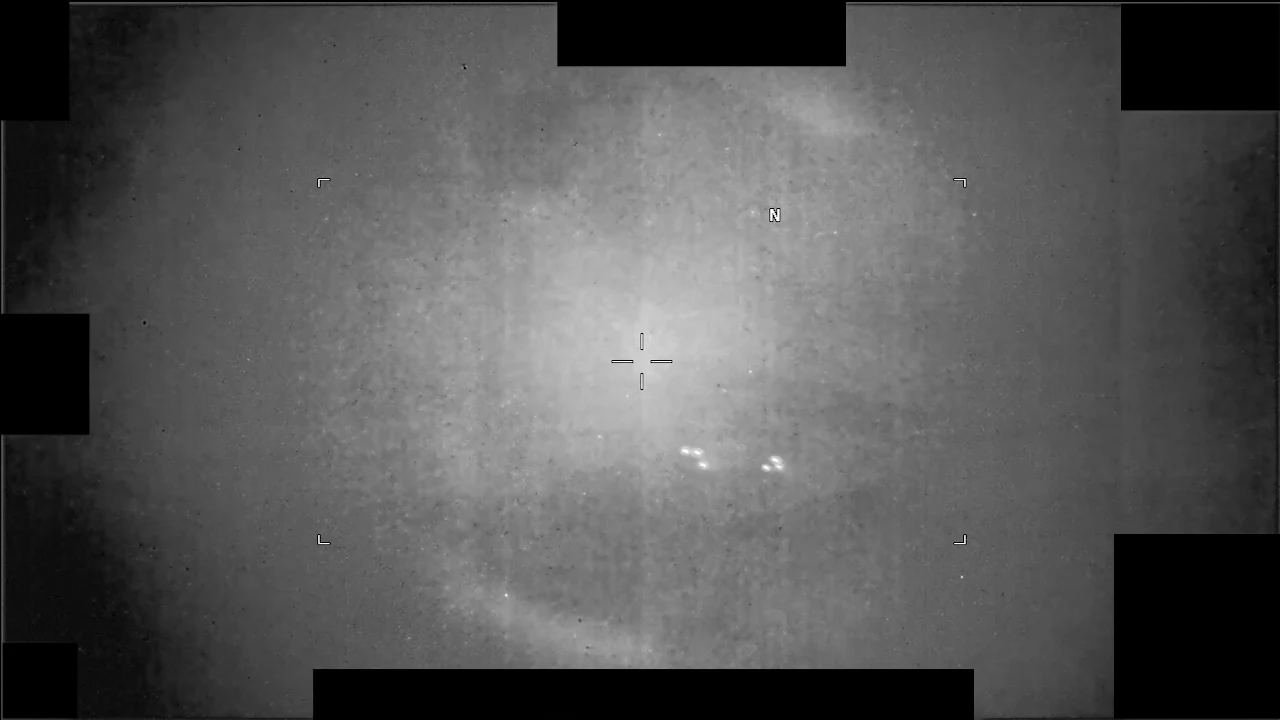
PR166 (2020, 21 seconds). A small bright contact enters from the right with a faint streak trailing it, and the sensor zooms to keep it centred. At points two separate specks are visible. This is the oldest of the three and the lowest resolution (720 by 480). It is also the first PURSUE clip we have checked whose audio track is not digital silence. Every clip we measured from Releases 03 and 06 was flat at minus 91 decibels, and so are the other two clips in this release. This one has a steady tone at about 1,185 hertz from start to finish, the same level every second. There are no voices or cockpit sounds we could detect. It is almost certainly equipment noise, not a recording of the event.

PR168 (2026, 55 seconds). Filmed this year, which makes it one of the most recent videos in the database. AARO’s description says the sensor tracks “multiple areas of contrast,” then zooms on two and “intermittently loses contact.” In practice the contacts sit near the noise floor; at normal size most viewers will see grey sky.

PR169 (2023, 14 seconds). A single small point. In the frames we sampled it drifts off the crosshair rather than sitting on it.
AARO’s descriptions of all three end with the same disclaimer: nothing in them reflects “an analytical judgment, investigative conclusion, or factual determination.” The government’s index files all three under incident dates in 2005 (7/12/05, 7/18/05, 7/15/05), which contradicts the years in their own titles. It is a data-entry error, but it is now in the official database.
The CIA in 1952: saucers as a weapon of the mind
Six CIA documents from the summer and autumn of 1952, when a wave of sightings over Washington put flying saucers on the front pages, show the agency deciding how seriously to take them.
These are not new to historians. Versions of the 1952 CIA saucer memos have been in the agency’s FOIA collection since the late 1970s. The PURSUE scans are stamped “Approved for Release 2026.” Still, read in one sitting they are remarkable.
On August 1, an analyst named Edward Tauss told his superiors that fewer than 100 “reasonably credible” reports were unexplained, and that they probably would be with more data. But “so long as a series of reports remains ‘unexplainable’ (interplanetary aspects and alien origin not being thoroughly excluded from consideration),” intelligence should keep watching. And he “strongly urged” that “no indication of CIA interest or concern reach the press or public, in view of their probable alarmist tendencies” (CIA-UAP-D026).
By the autumn the question had become psychological warfare. In a draft memo, CIA Director Walter Bedell Smith told the Psychological Strategy Board he was sending the National Security Council a proposal, and suggested the board “discuss at an early board meeting the possible offensive or defensive utilization of these phenomena for psychological warfare purposes” (CIA-UAP-D025). The attached background notes that the agency’s MIT consultants thought the answer would be found “on the margins or just beyond the frontiers of our present knowledge,” and that “nuclear waste products” might be a factor. The Air Force’s map of unexplained reports showed “a high incidence of reported cases near atomic installations and Strategic Air Command bases,” the paper adds, “but this might be expected because of the greater number of alert observers in such places.”
On October 13, S. Q. Reber, the assistant director for intelligence coordination, pushed back (CIA-UAP-D028). It was “far too early” for psychological warfare planners “to start planning how the United States might use U.S. Flying Saucers against the enemy.” Then the line that has always made this memo famous: once intelligence finished a National Estimate, “there will be the time and basis for a public policy to reduce or restrain mass hysteria.”
The government’s 2026 index blurb paraphrases that as a public policy “intended to reduce or restrain public concern.” The memo says hysteria.
Two weeks later, on October 28, an official CIA diary records that “Mr. Clark” reported new saucer information, “particularly reports of sightings on the ground by relatively reliable observers,” and that several scientists had delivered papers on “a possible means of propulsion which would not involve noise and flare” (CIA-UAP-D029). The diarist agreed to brief the Air Force. The chain ends, in the record released so far, with an undated request for approval in principle to convene a panel of leading scientists (CIA-UAP-D024). In January 1953 the CIA did convene one, the Robertson Panel, which recommended a public education effort to strip saucers of their mystery.
Kelly Johnson’s saucer, filed as a cloud
On December 16, 1953, Clarence “Kelly” Johnson, Lockheed’s chief engineer and later the designer of the U-2 and SR-71, watched a dark elliptical object hang motionless over Point Mugu from his ranch near Agoura for at least three minutes, then leave “in a long shallow climb.” At the same moment a Lockheed test crew in a Navy Super Constellation saw what looked like “a very large flying wing” in the same spot and could not close on it at 225 mph (DOW-UAP-D206).
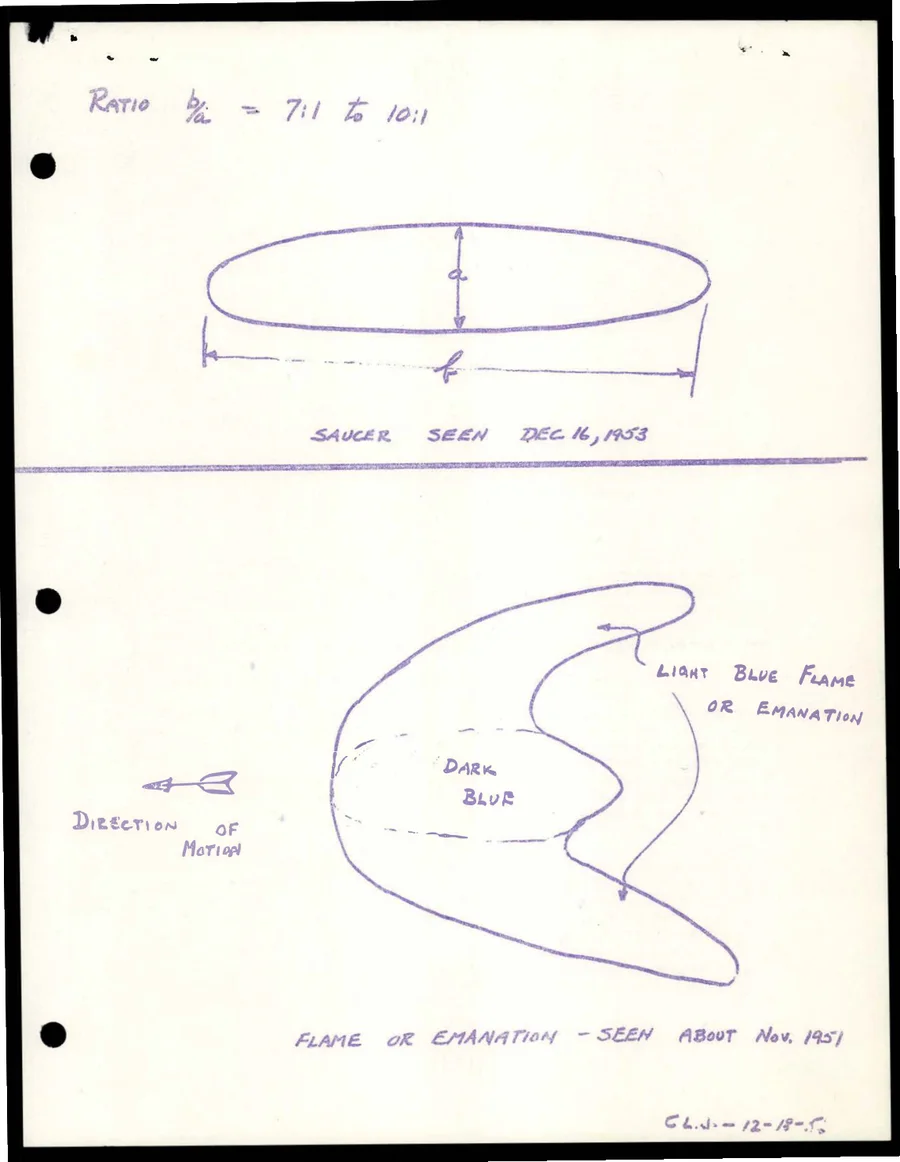
Kelly Johnson’s own sketch, dated December 18, 1953. DOW-UAP-D206. Public domain.
Johnson’s signed statement is the best thing in the tranche. He describes interrupting test engineer Rudy Thoren before Thoren could say when or where he had seen his object, so he could check whether they matched. They did. He adds a second sighting from about 1951, a light blue “flame or emanation” moving fast with no noise. And he ends: “for at least five years I have definitely believed in the possibility that flying saucers exist,” and “I am now more firmly convinced than ever that such devices exist, and I have some highly technical converts in this belief as of that date.”
Every new case, scored the same way
One email when a case file lands. Sources or it didn't happen. Unsubscribe anytime.
The Air Force officer who forwarded the report wrote that Johnson had been “most reluctant to write the report in the first place,” because people who say they have seen saucers are not usually considered “logical and practical hard-headed engineers.”
The Project Blue Book record card at the front of the same file has the Air Force’s answer.
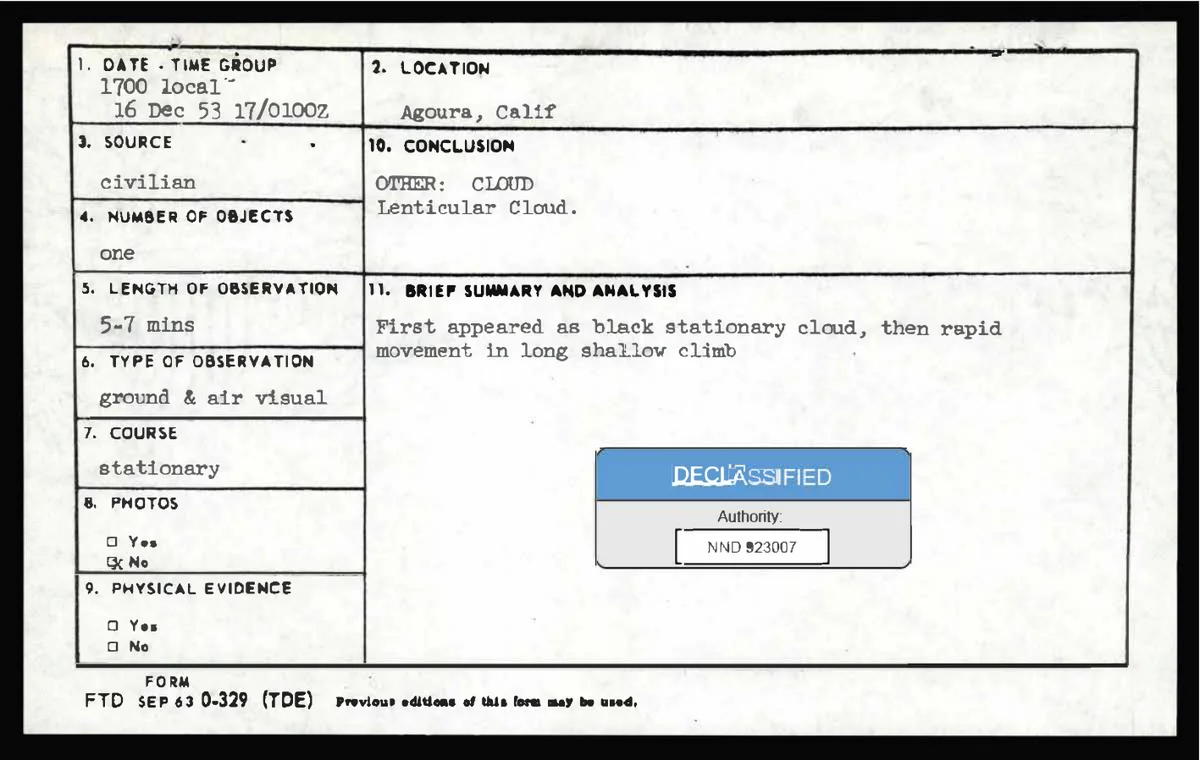
DOW-UAP-D206, page 1. Public domain.
“Lenticular Cloud.” The government’s 2026 index lists the file as an “Unresolved UAP Report.” Its own card says resolved, as a cloud. Johnson had considered that himself, and rejected it because the object did not change shape and then moved off against the wind. This case was in the public Blue Book microfilm long before PURSUE; the release is a better scan, not a revelation.
1957: a wave, a commitment and “PLUTO”
Seventeen of the documents are Air Intelligence Information Reports from the autumn of 1957, the weeks after Sputnik. Most are routine. Five stand out.
Levelland, Texas (DOW-UAP-D191). The famous night of November 2 and 3, when several drivers said a glowing object stalled their engines and killed their lights. Blue Book publicly called it ball lightning. The field officer who wrote this report did not. He listed St. Elmo’s fire, ball lightning and burning gas as possibilities, judged the first witness credible, and concluded that “insufficient knowledge of the above phenomena exists at this organization to completely resolve this sighting. Therefore, this sighting is forwarded as unresolved.”
Kearney, Nebraska (DOW-UAP-D192). On November 5, grain buyer Reinhold Schmidt said he had boarded a landed craft and talked with its crew, who spoke German among themselves. Schmidt later became a well-known contactee on the lecture circuit. The Air Force file records that two psychiatrists interviewed him, that the county board committed him to the state mental hospital that evening, and that the officer concluded the story had “no basis in fact.” His name, arrest record and psychiatric commitment are printed unredacted, in a release whose stated policy is to redact to protect “the identity of eyewitnesses.” Schmidt died decades ago and made himself public, but he is not the only one. At least two other files in this release print witnesses’ full names and home addresses, and a 1966 file (DOW-UAP-D212) blacks out a letter writer’s name under the privacy exemption while printing, a few pages later, the photo business card of a local UFO club director with his home address and phone number. We have removed names and addresses from the sketches below.
Trinity Site, New Mexico (DOW-UAP-D193). Army military police patrols at Stallion Site Camp, north of White Sands, reported a bright descending object near the bunkers and a pulsing red and white light near the site of the first atomic bomb test. The Air Force put them down to a moonset and Venus.
Indian Trails, Michigan (DOW-UAP-D197). Two observers on the Lake Erie shore described a silver-grey, bell-shaped object with a row of lights or portholes and a high-pitched hum. One of them drew it, with a size estimate of 120 feet.
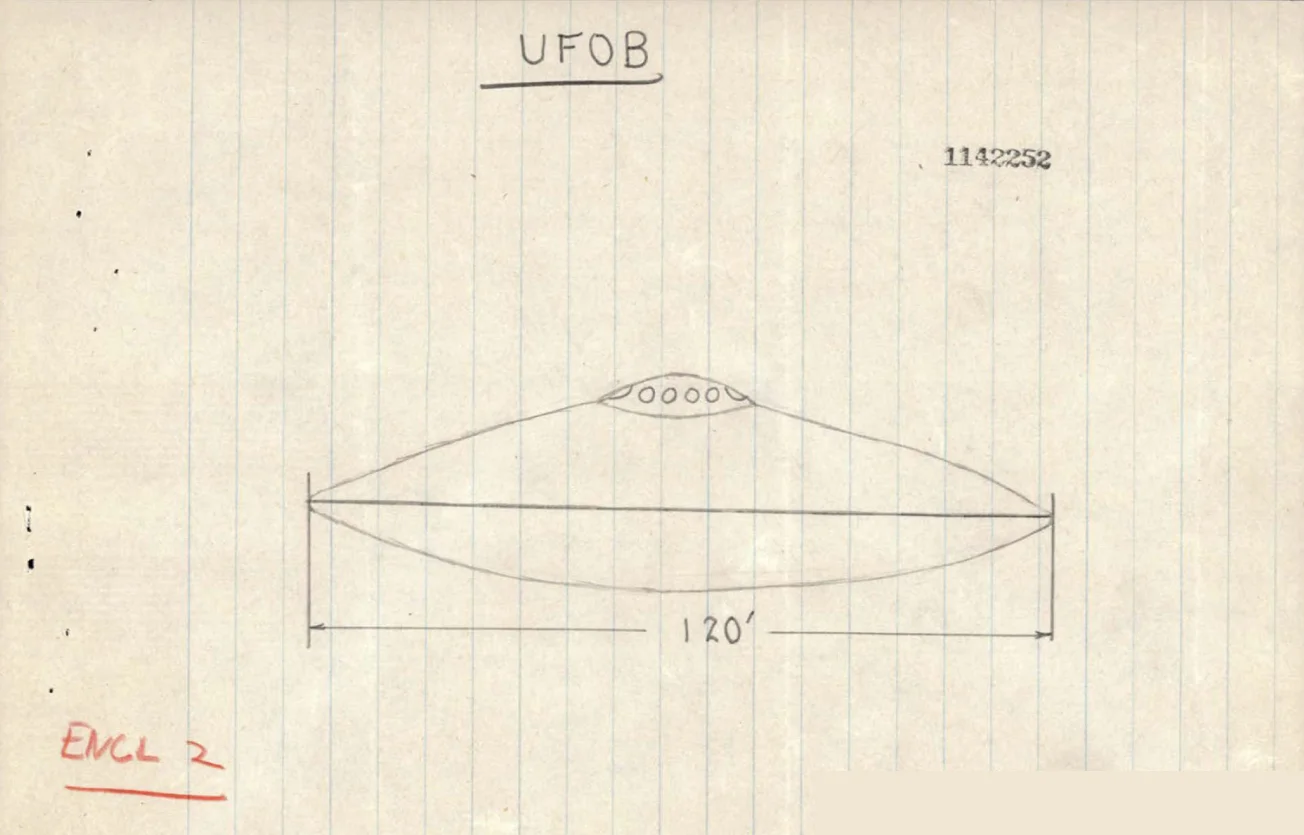
Witness drawing, October 1957. DOW-UAP-D197, page 6. Witness name and address removed by NHIAnomalous. Public domain.
Moses Lake, Washington (DOW-UAP-D196). Tower crew at Larson Air Force Base watched a bright, silvery circular object for an hour and forty minutes. The air defence controller, “Igloo Control,” saw it too, had no radar track, and said they “believed object to be PLUTO,” so no intercept was needed. AARO’s comment says this cannot mean the planet, which is invisible to the naked eye, and admits the report “does not define ‘PLUTO’ or establish its precise operational meaning.” Nearly seventy years on, nobody can say what the air defence system decided that object was.
One more from the batch: in December 1956, near Ube, Japan, an Air Force F-86D pilot on a practice intercept got a radar return bigger than the other jet’s, closed to about five miles, saw something “best described as the upper half of a sphere,” and watched the return leave the top of his scope at an estimated 1,500 to 1,800 knots, a figure the report notes was beyond what the radar could directly measure (DOW-UAP-D205).
And the oldest picture in the release. On June 17, 1949, a driver near Grand Central Airport in Glendale, California, reported two bright metallic ovals that crossed the valley slowly, tilted, and shot off to the northwest (DOW-UAP-D213). The Air Force decided they could have been aircraft. The witness’s pencil drawing shows the road, the telephone poles and the hills, with a long chain of small ovals across the sky. It appears to plot the objects’ positions along their path rather than a swarm. In the right of the frame, the witness also drew an ordinary aeroplane.
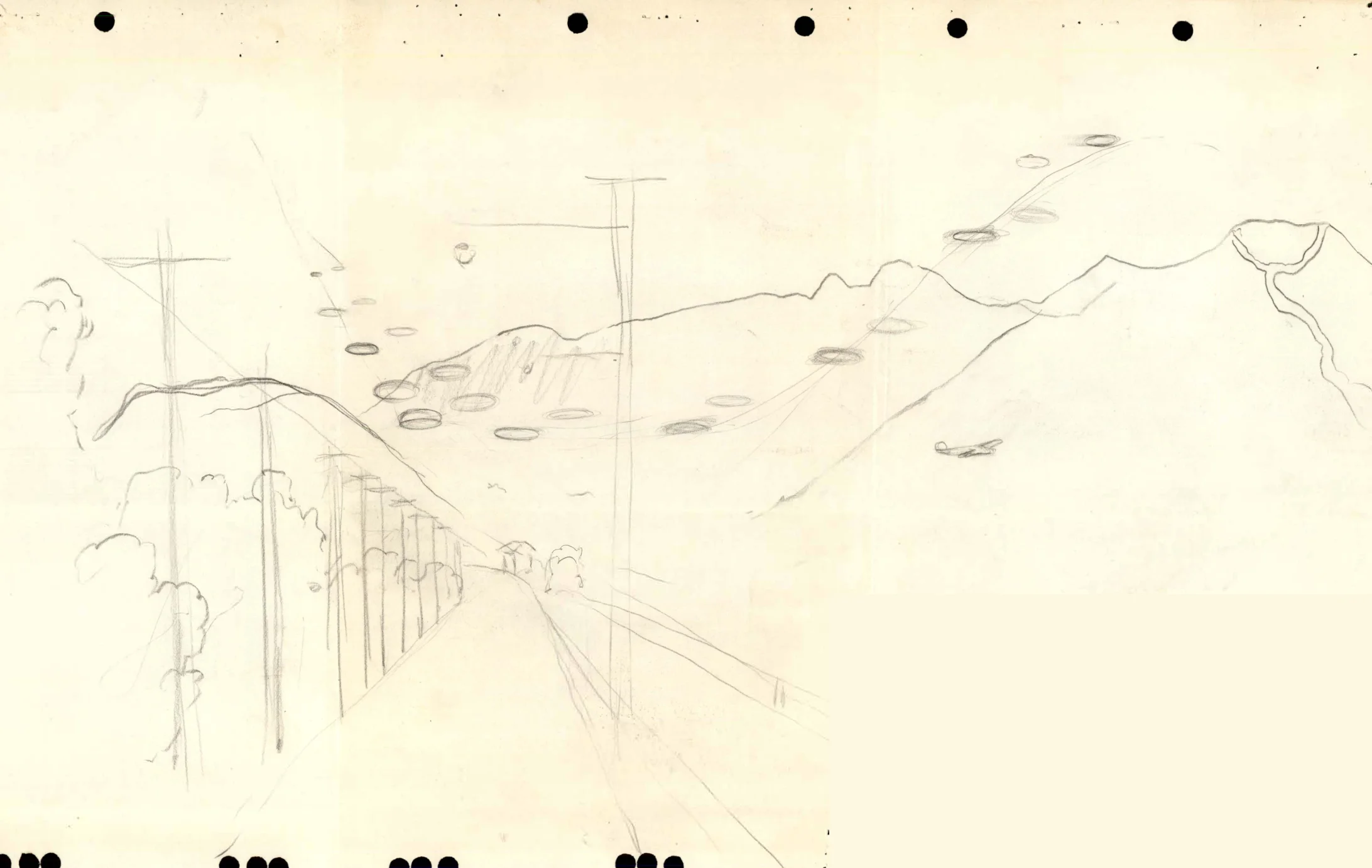
Witness drawing, Glendale, California, June 1949. DOW-UAP-D213, page 8. Witness name and address removed by NHIAnomalous. Public domain.
What’s new, what’s not
Strip out the recycled material and Release 08 is smaller than 43 records suggests.
Already public before: Reid’s letter (2018, 2019), the 1952 CIA memos (1970s FOIA), and the 1950s Air Force cases (Project Blue Book microfilm). The AAWSAP statement of work (DOW-UAP-D182) is solicitation material from DIA’s August 2008 request for proposals, which drew one bidder.
New, or new in this form: DIA’s November 2009 finding against the special access program, its October 2009 review of the papers, the Burgess memo, the two talking papers, the full 538-page BAASS report, the 2023 radar slide and the three CENTCOM videos.
Errors in the government’s own index: the D187 blurb dates the “limited value” finding 23 months too early; the D028 blurb softens “mass hysteria” to “public concern”; D206 is filed as unresolved when its card says lenticular cloud; D203, an Upland, California case, is located in “Canada”; and the three videos plus D165, D186 and D201 carry incident dates that do not match their contents (D186 is dated 2026). And despite the stated policy of redacting to protect eyewitnesses, some files print witnesses’ names and home addresses in full.
Where eight tranches leave us
We ask the same two questions of every tranche.
Any biological record? No. Release 08 has a contractor’s plan to search for “EBE tissue samples” and a contractor’s claim that others have seen biological evidence. It has no sample, no lab result and no chain of custody.
Any photo or video from the western U.S. cases? No. The only new western U.S. record is the 2023 radar slide. Release 07’s black triangle, and the second-night observation AARO’s index says it covered, still have no follow-up.
What Release 08 does deliver is the institutional story. A senator said the program had found things so sensitive that ordinary secrecy would not do. The agency running it said, in writing, that it had seen nothing like that. Its own reviewers said the science was good. Its Director later said the reports were of limited value. And the contractor, in 538 pages the public had never seen, was describing a ranch that seemed to play games with observers and a plan to find alien tissue in Army labs.
Each of those things is now an official Pentagon record. Which one describes the program best is still the question.
NHIAnomalous read all 40 documents in the Release 08 bundle and the government’s index. The BAASS report is a poor-quality scan; every quote from it was checked against the scan’s text layer, and garbled passages against the page image. Page numbers are PDF pages, which run six ahead of the report’s printed numbers. Audio levels were measured with ffmpeg on the official MP4s.
Read next
More Disclosure →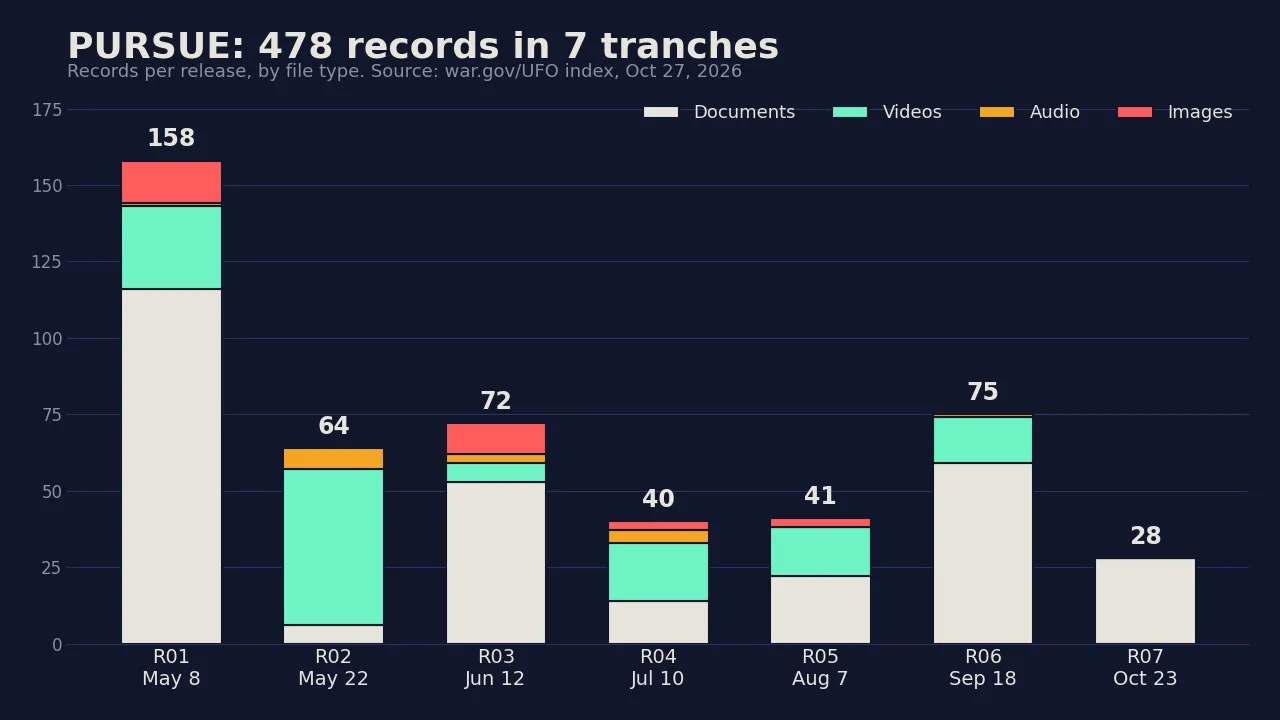
The PURSUE Scoreboard: Eight Tranches, 521 Records, and What Is Still Missing
Six and a half months, eight releases, 521 records in the government's own index. We counted all of them: what kind of file, which agency, which decade, how many are marked unresolved, and how many are flagged as redacted. Then we scored the program against the two questions we ask of every tranche. One biological record, and it was a raccoon. A contractor's plan to look for alien tissue, and no tissue. No photo or video from the western U.S. cases. Updated for Release 08.
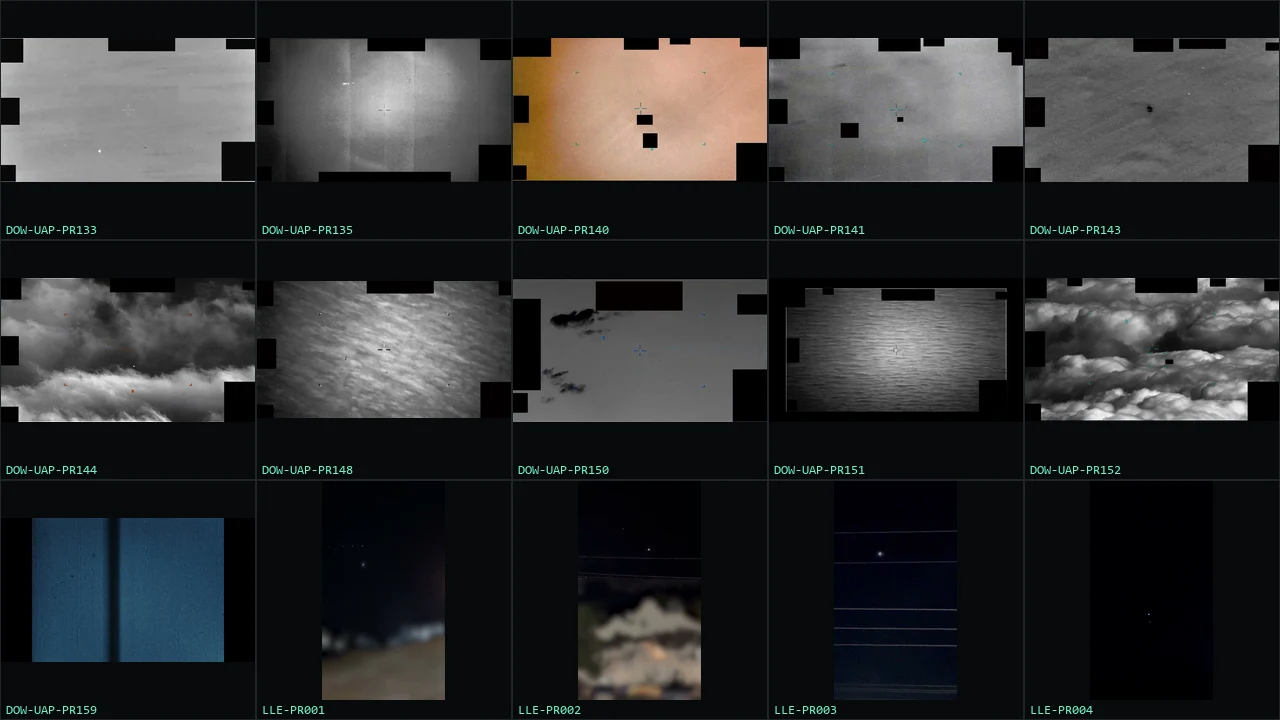
All Fifteen Videos in PURSUE Release 06, Playable and Annotated
The sixth PURSUE tranche shipped 15 videos alongside its 56 documents, and the coverage spent itself on the warp-drive papers. This is the footage itself: every clip mirrored and playable here, with what the government says each one shows, what it leaves out, and the three places where the release's own paperwork contradicts itself.
PURSUE Release 06: The Pentagon Re-Released the AAWSAP Papers. The Best File Is From 1952.
The sixth PURSUE tranche landed on September 18 with 72 records, 15 videos and an hour of 1952 audio. The headlines went to 37 warp-drive and wormhole studies and a paper on 'injury to human observers.' Those studies have been public since a FOIA release in March 2022. What is actually new is the contract paperwork behind them, a set of mission reports that grade their own objects as having 'no advanced capabilities,' and the complete Air Force file on the 1952 Tremonton film, dissent included.
Frequently asked
What is in PURSUE Release 08? +
Forty-three records published November 20, 2026: 40 PDF documents and three videos. Thirty-four documents come from the Department of War and six from the CIA. The videos are infrared and electro-optical clips that U.S. Central Command submitted to AARO from the Middle East in 2020, 2023 and 2026. The release brings the PURSUE database to 521 records. It also fills two gaps: document numbers D165 and D172, which Release 07 skipped, are both in this tranche.
Is Harry Reid's 2009 letter new? +
No. Las Vegas reporters published a copy of Reid's June 24, 2009 letter to Deputy Secretary of Defense William Lynn in 2018, and a less redacted version followed in 2019. What Release 08 adds is the government side of the exchange in one official set: two DIA talking papers prepared for the Director before meetings with Reid, DIA's October 2009 review of the contractor's reports, its November 2009 finding against a restricted special access program, and a December 2010 memo from DIA Director Ronald Burgess. None of these is a letter back to Reid.
Did the DIA think the AAWSAP reports were worthless? +
The record says two different things. An October 30, 2009 DIA memo to the Director says all of the outside reviews of the first-year reports 'were positive, some exceptionally so' and that DIA planned to publish them as Defense Intelligence Studies. A December 2010 memo signed by Director Ronald Burgess says that in November 2009 he and Deputy Secretary Lynn met Reid and 'determined the reports were of limited value to DIA.' The government's own index blurb for a January 2009 talking paper attributes the 'limited value' finding to that earlier paper, but the January 2009 paper does not say it; it says the contract was on track and rates the contractor's plans 'very good to excellent.'
What is the 1,650 mph radar track? +
DOW-UAP-D165 is a single AARO slide about a 2023 event in the western United States. A civil air-surveillance radar logged eight detections over 84 seconds at an estimated 55,000 to 70,000 feet. If all eight were one object, it covered about 38.5 miles, a minimum average of 1,650 mph, roughly Mach 2.5, with a 39 degree turn after about 48 seconds. AARO's slide says the radar's 12-second sweep is not enough to show the detections were one object or a continuous track, and it calls the case unresolved because of insufficient data.
Do the Release 08 videos show anything? +
Each shows small points of contrast on a grey infrared or electro-optical field: a single contact with a faint streak behind it (2020, 21 seconds), two faint contacts the sensor keeps losing (2026, 55 seconds), and a single small point (2023, 14 seconds). Large black boxes redact the on-screen data. AARO's descriptions make no finding about what any of them are. The 2020 clip is the first PURSUE video we have checked whose audio track is not digital silence, but it carries only a steady electronic tone with no voices.
Sources
- [1] PURSUE database, war.gov/UFO (Release 08, November 20, 2026)
- [2] Release 08 documents bundle (official zip, 40 PDFs)
- [3] Release 08 videos bundle (official zip, 3 MP4s)
- [4] PURSUE index CSV (all releases)
- [5] Pentagon releases eighth batch of declassified UFO files, LiveNOW from FOX
- [6] New Pentagon files reveal 1953 sighting of dark, elliptical UFO, Interesting Engineering
- [7] Harry Reid writes letter to Deputy Secretary of Defense requesting AATIP become a SAP, The Black Vault timeline
- [8] Six and a half years later, the DoD's reply to Harry Reid's AATIP memo remains missing, The Black Vault
- [9] DIA FOIA Electronic Reading Room, Harry Reid letter
Follow the thread
New disclosure reporting, physics breakdowns, and case files, in your inbox. Sources or it didn't happen. No spam, unsubscribe anytime.