All Fifteen Videos in PURSUE Release 06, Playable and Annotated
The sixth PURSUE tranche shipped 15 videos alongside its 56 documents, and the coverage spent itself on the warp-drive papers. This is the footage itself: every clip mirrored and playable here, with what the government says each one shows, what it leaves out, and the three places where the release's own paperwork contradicts itself.
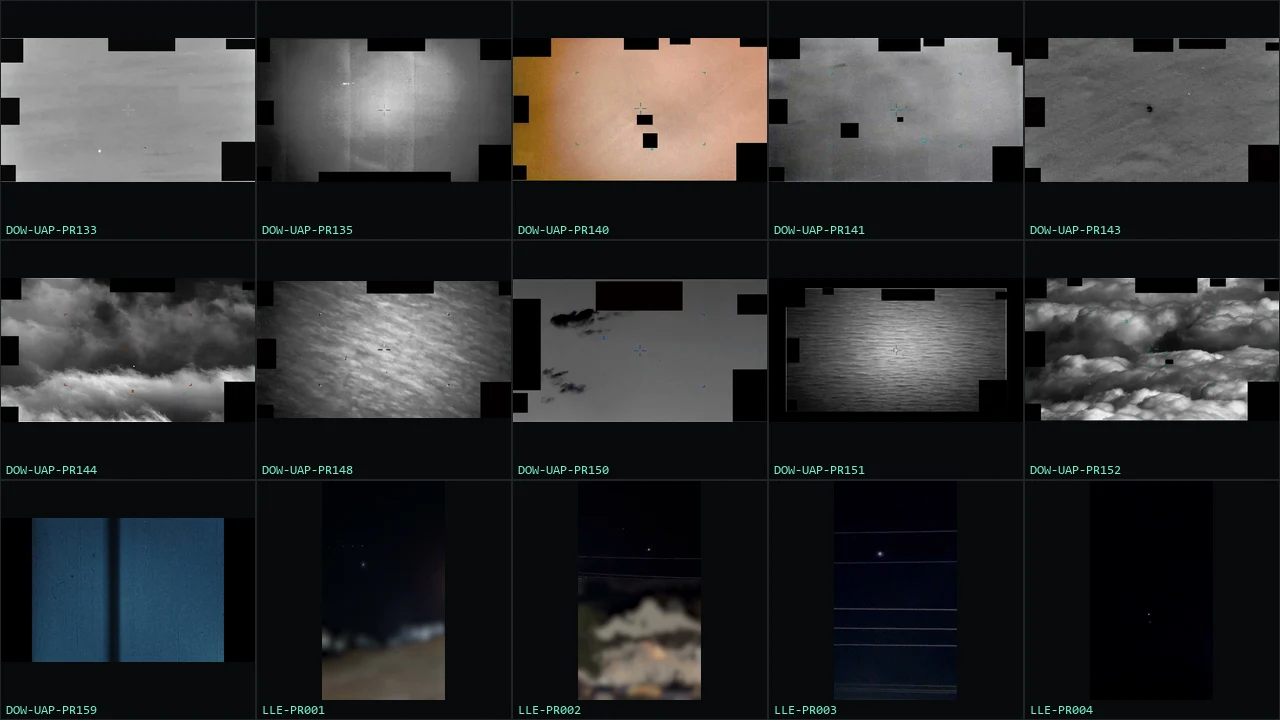
PURSUE Release 06, published by the U.S. Department of War on September 18, 2026, contains 15 videos: four infrared and electro-optical sensor clips submitted by U.S. Central Command from the Middle East (2022 to 2025), six sensor clips submitted by U.S. Indo-Pacific Command from the Yellow Sea and East China Sea in 2023, one digitized 1952 Project Blue Book film from Tremonton, Utah, and four phone videos from a Colorado law enforcement officer. Every clip's audio track is digital silence. None of them is labeled as evidence of non-human craft: in PURSUE, 'unresolved' means the government could not identify the object, not that it concluded anything about what it was.

The Department of War published its sixth tranche of UAP files on September 18, 2026. The documents took the coverage, because the documents mentioned warp drives. The papers were eight years old and had been public since a 2022 FOIA release, which is the part most of the coverage skipped.
The 15 videos in the same tranche got a sentence each, if that. Four days later, the government’s own download counters on DVIDS showed most of these clips had been pulled fewer than fifteen times. So here they all are, mirrored and playable, with what the government says each one shows.
A word on how to watch them. These are sensor feeds, not cinema. What a tracking camera does when it zooms, refocuses, or loses lock produces motion in the frame that belongs to the camera and not to the object, and AARO’s own descriptions spend most of their length telling you which is which. Read that carefully and a lot of the drama drains out. What survives is more interesting.
The CENTCOM set: four clips from the Middle East
The longest of these runs just under five minutes and is the only clip in the tranche with a speed estimate attached to a quoted crew description. The paired mission report, DOW-UAP-D107, records the object as looking like “a white round orbit” moving as fast as 500 miles per hour.
Watch what the sensor operator is doing rather than the dot. The magnification cycles repeatedly, the pan speed keeps changing, and at 2:29 the system’s automatic tracking reticle engages and fails to establish a lock, then disengages. A failed auto-track is not evidence of anything exotic, but it is the one moment in the clip where the sensor tells you something the operator did not choose.
Note the filing, too. The government’s index titles this file Unresolved UAP Report, Middle East, 2025, while the description published with it says the footage was collected in 2024. Both dates come from the same release.
The second CENTCOM clip is the one that led our coverage of the tranche: six small spheres, flying in a group, from a mission report that estimates 480 miles per hour and calls them “seemingly agile.”

The remaining two are the same 2022 encounter recorded twice, and they are the most technically useful pair in the release, because they were shot on a sensor that switches between infrared and electro-optical modes. The mission report, DOW-UAP-D109, puts the object between 80 and 180 miles per hour.


Why that matters: an object that shows up in both thermal and visible light is harder to explain as a sensor artifact, because the two sensors fail in different ways. This is the same argument that made the Navy’s 2004 Nimitz footage durable. It is not proof of anything, but it is the kind of cross-check that the single-sensor clips in this tranche cannot offer.
PR141 is also the clearest look at how much of these files is painted out. The sensor telemetry, normally the most informative part of a targeting pod frame, sits under black rectangles for the entire runtime.
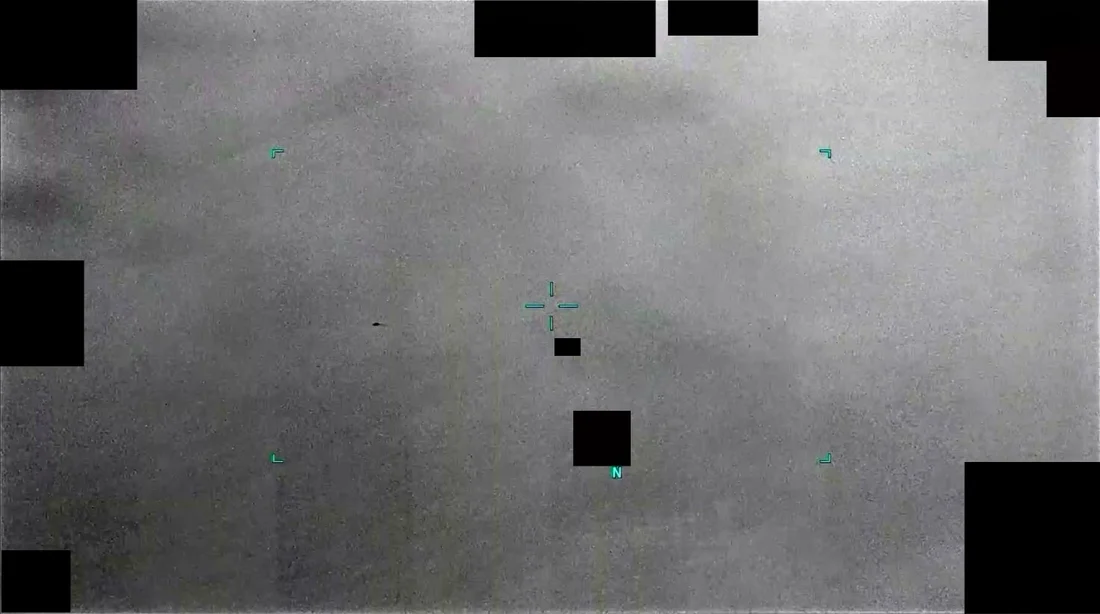
Frame from DOW-UAP-PR141. The black blocks are the government’s redactions of its own sensor readouts: altitude, heading, range, time. Public domain.
The INDOPACOM six: the Yellow Sea and the East China Sea, 2023
Six clips in this release came from U.S. Indo-Pacific Command, five over the Yellow Sea and one over the East China Sea, all from 2023. Not one of them was published with a mission report, a witness statement, or a speed estimate. They are footage and nothing else, which is why they were easy to ignore and also why they are worth listing. Five of the nine Yellow Sea videos PURSUE has ever published arrived in this one tranche, and not one of the six has a document attached to it anywhere in the database.


The sixth is the one AARO annotated most heavily, and the only clip in the tranche where the government explains an on-screen element before anyone can misread it. A rectangular “focus box” appears at eight seconds. In the last six seconds the aircraft’s own structure swings into the sensor’s line of sight and smears the right half of the display.

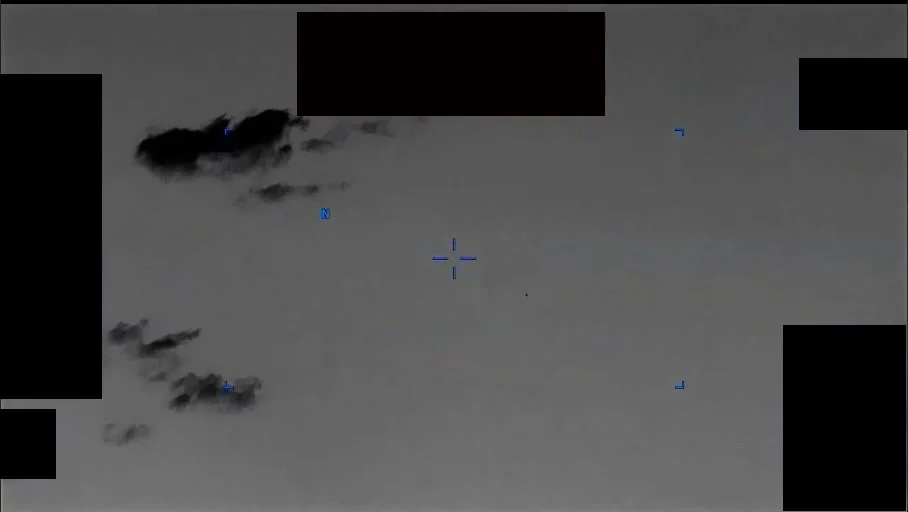
Frame from DOW-UAP-PR150, in the stretch AARO flags for its focus-box overlay. Black blocks at the edges are the government’s redactions. Public domain.
That focus-box sentence contains the release’s oddest error. The published description reads: “This display element is a graphical component of the sensor system and does indicate a physical change in the environment.” The sentence exists to warn readers that the box is an artifact of the display, so the word it needs is “not,” and the word is missing. The same broken sentence appears in the PR133 description. It is a typo rather than a disclosure, but it is a typo in the one line written to stop people misreading the footage.
The 1952 film
The oldest video in the tranche is the Tremonton film: 16mm Kodachrome shot on July 2, 1952 by Navy Chief Warrant Officer Delbert C. Newhouse, who reported 12 to 14 bright objects and sent the reel to the Air Force. Project Blue Book rated him honest and expert, reviewed the film with balloon specialists in December 1952, and settled on pillow balloons, with one dissenter who thought the objects were too bright and too fast. No balloon release was ever found. The Air Force later preferred seabirds.

Watch to the end. At 55 seconds the released print cuts to unrelated footage of sewing equipment, which is what a reel of home movie film looks like when nobody cut it up for the archive.
The Colorado four
For the first time, PURSUE published material from a local police department. A Colorado officer filed four videos with AARO, describing the object as silent and as showing red, blue and green flashing lights. AARO blurred the lower half of each frame to protect privacy, and attached a standing caution: phone autofocus and automatic image processing can distort how a distant light appears to move and what shape it appears to be, especially at high zoom.


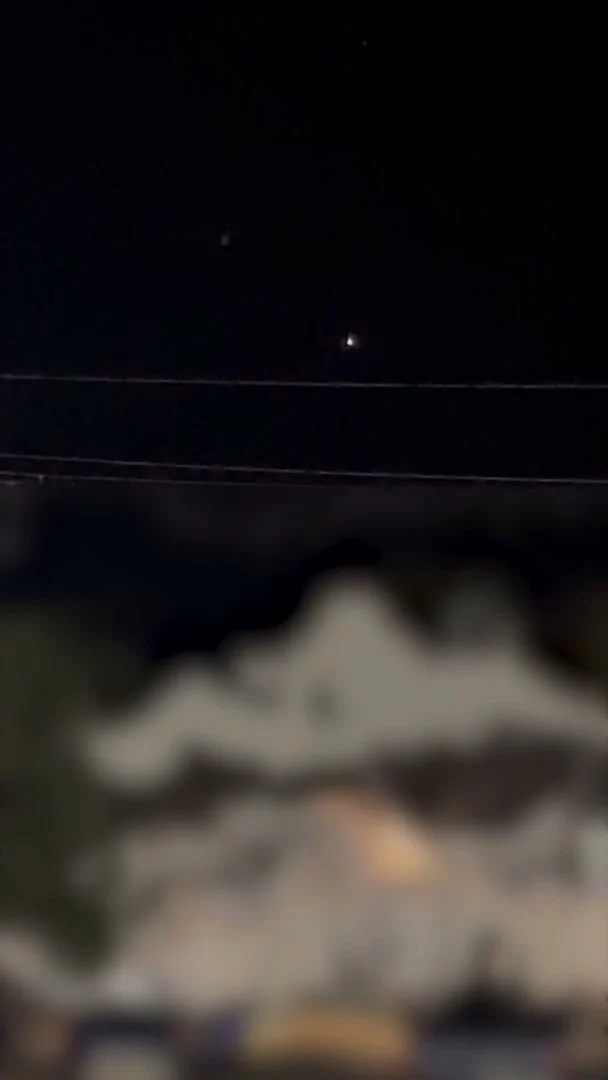
Frame from LLE-UAP-PR002. The blur across the lower half is AARO’s, applied before release. Public domain.


PR002 is now the longest single video in the PURSUE archive. Fifteen unbroken minutes of a light that does not do anything is not a dull file, it is a useful one: a light that holds position for a quarter of an hour while the camera shakes is behaving like something very far away, and the footage is long enough to test that. Two moments in PR004 make the same point from the other direction. At 36 seconds and again at 88 seconds a vehicle approaches and the phone’s automatic processing visibly reacts, which is a reminder that half of what changes in the frame is the camera adjusting to the street.
The fourth clip also carries the release’s second internal contradiction. Its title files it under the October 2023 Colorado report, while its own description says the footage was shot in January 2024, and it is the only one of the four paired with a document, LLE-UAP-D001.
What none of these videos have
All fifteen carry an audio track, and all fifteen of those tracks are digital silence, measuring minus 91 decibels from first frame to last. That is the reading of an empty channel, not of a quiet room. It has been true of PURSUE footage since the first tranche.
For the military clips this mostly costs you the crew chatter that made the 2004 Nimitz video persuasive, since the “look at that thing” is half the evidence that the people in the aircraft were surprised. For the Colorado clips it costs more. The officer’s central claim is that the object was silent. The only file that could support or sink that claim was stripped before release.
The runtimes, at least, check out. Every clip’s duration matches the length the government states in its own description, to the second, so nothing was quietly trimmed between the index and the file. The Tremonton reel is the single exception, and the government says so in the open.
None of this makes the tranche a disappointment. It makes it what PURSUE has been all along: a real archive, released in good faith, with the most informative layer of each file removed first, and a public that has so far downloaded most of it fewer than fifteen times.
Every new case, scored the same way
One email when a case file lands, with its Signal-Strength score and what would move it. No hype, no 'BREAKING', and every claim carries its source. Unsubscribe anytime.
Frequently asked
How many videos are in PURSUE Release 06? +
Fifteen. Four were submitted by U.S. Central Command and show sensor footage from the Middle East between 2022 and 2025. Six were submitted by U.S. Indo-Pacific Command and show infrared footage over the Yellow Sea and the East China Sea in 2023. One is a digitized 16mm film shot near Tremonton, Utah on July 2, 1952 and reviewed by Project Blue Book. Four are phone videos submitted by a Colorado law enforcement officer, the first local police material ever published through PURSUE.
Do the Release 06 videos have sound? +
No. Every clip carries an audio track, and every one of those tracks is digital silence measuring minus 91 decibels end to end, which is what an empty channel reads. This has been true of the footage in earlier tranches too. It means the cockpit or bystander audio that would normally corroborate a sighting, including the Colorado officer's own claim that the object was silent, cannot be checked against the released file.
What is the longest video in the release? +
LLE-UAP-PR002, fifteen minutes of a Colorado officer's phone video of a single light, is the longest video published through PURSUE to date. AARO blurred the bottom half of the frame to protect privacy, and added a note warning that phone autofocus can distort how a distant light appears to look and move.
Does 'unresolved' mean the object was extraterrestrial? +
No. In PURSUE, unresolved means the government could not make a definitive identification, usually for lack of data. The video descriptions published with these clips carry a standing disclaimer stating that nothing in them should be read as an analytical judgment, investigative conclusion, or factual determination about the event.
Where can I download the original files? +
Every clip is public domain and hosted by the government on DVIDS, linked in the sources at the foot of this article, and indexed at war.gov/UFO. The copies embedded here are mirrors of those originals, re-hosted so they play without leaving the page.
Sources
- [1] Department of War, Sixth Release of Unidentified Anomalous Phenomena Files (press release, September 18, 2026)
- [2] PURSUE database and downloads, war.gov/UFO
- [3] DOW-UAP-PR133, Unresolved UAP Report, Middle East, DVIDS
- [4] DOW-UAP-PR135, Unresolved UAP Report, Middle East, 2025, DVIDS
- [5] DOW-UAP-PR140, Unresolved UAP Report, Middle East, 2022, DVIDS
- [6] DOW-UAP-PR141, Unresolved UAP Report, Middle East, 2022, DVIDS
- [7] DOW-UAP-PR143, Unresolved UAP Report, Yellow Sea, 2023, DVIDS
- [8] DOW-UAP-PR144, Unresolved UAP Report, Yellow Sea, 2023, DVIDS
- [9] DOW-UAP-PR148, Unresolved UAP Report, East China Sea, 2023, DVIDS
- [10] DOW-UAP-PR150, Unresolved UAP Report, Yellow Sea, 2023, DVIDS
- [11] DOW-UAP-PR151, Unresolved UAP Report, Yellow Sea, 2023, DVIDS
- [12] DOW-UAP-PR152, Unresolved UAP Report, Yellow Sea, 2023, DVIDS
- [13] DOW-UAP-PR159, Historical Film of Reported UFOs, Utah, 1952, DVIDS
- [14] LLE-UAP-PR001, Unresolved UAP Report, Colorado, 2023, DVIDS
- [15] LLE-UAP-PR002, Unresolved UAP Report, Colorado, October 2023, DVIDS
- [16] LLE-UAP-PR003, Unresolved UAP Report, Colorado, October 2023, DVIDS
- [17] LLE-UAP-PR004, Unresolved UAP Report, Colorado, October 2023, DVIDS
Read next
More Disclosure →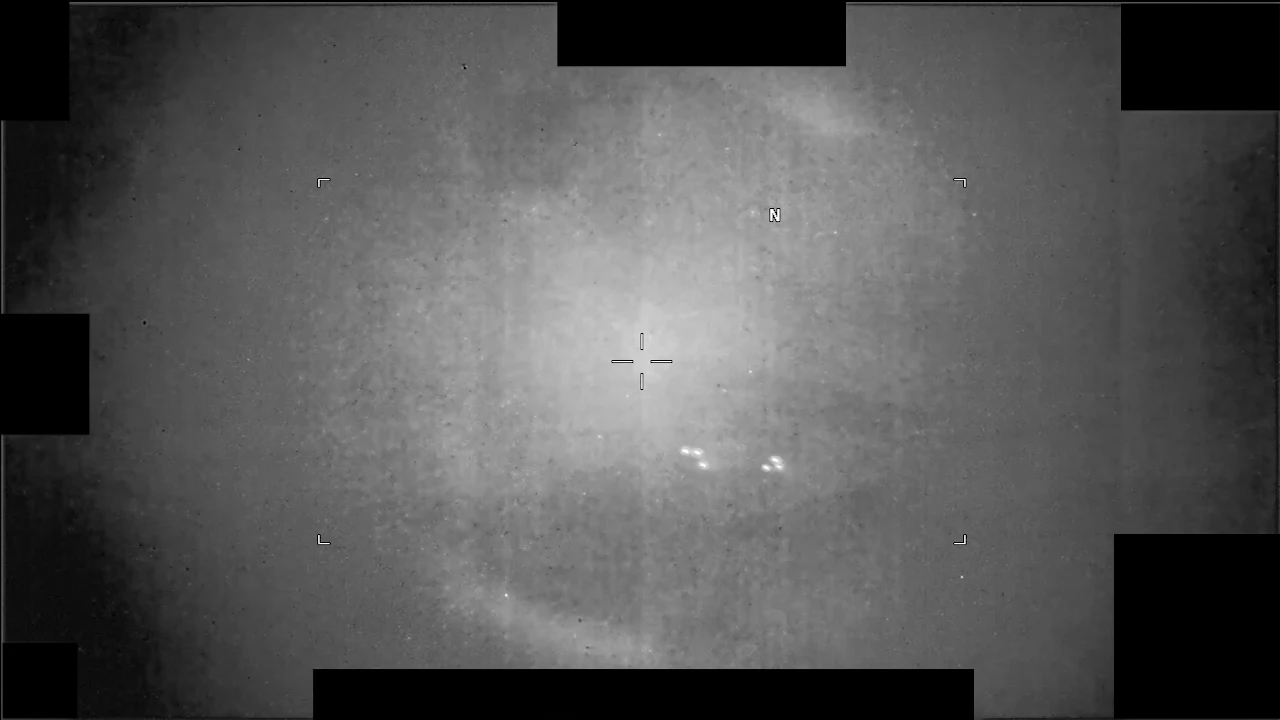
PURSUE Release 06: The Pentagon Re-Released the AAWSAP Papers. The Best File Is From 1952.
The sixth PURSUE tranche landed on September 18 with 72 records, 15 videos and an hour of 1952 audio. The headlines went to 37 warp-drive and wormhole studies and a paper on 'injury to human observers.' Those studies have been public since a FOIA release in March 2022. What is actually new is the contract paperwork behind them, a set of mission reports that grade their own objects as having 'no advanced capabilities,' and the complete Air Force file on the 1952 Tremonton film, dissent included.
PURSUE Release 05: A Gunship Crew Watched 'Cold Orbs' Dodge Its Cannon, and the Recorder Failed
The fifth PURSUE tranche landed on August 7 with 41 files and 16 new videos. The headline is not the Middle East clip the networks played on loop. It is a declassified intelligence report describing an AC-130J crew over the Gulf of Oman watching roughly 25 instances of four-foot 'cold orbs' during a live-fire exercise, and the aircraft's video recorder failing at exactly the wrong moment.
PURSUE Release 04: A UFO Put a Nuclear-Weapons Plant on Lockdown
The fourth PURSUE tranche landed on July 10 with 40 files from five agencies. The one that matters isn't the 1949 physics conference or the shuttle images. It's a 2015 Department of Energy report describing an unidentified object over the Pantex nuclear-weapons facility that put the site on lockdown, and that two officers chased without ever identifying what it was.
Follow the thread
New disclosure reporting, physics breakdowns, and case files, in your inbox. Sources or it didn't happen. No spam, unsubscribe anytime.