Orb Morphology: From Foo Fighters to PURSUE's "Orbs Launching Orbs"
The glowing sphere is the most persistent form in the entire UAP record, older than the flying saucer, more common than the triangle, and now central to the declassified files. What does it mean, physically, that the phenomenon keeps showing up as a ball of light?
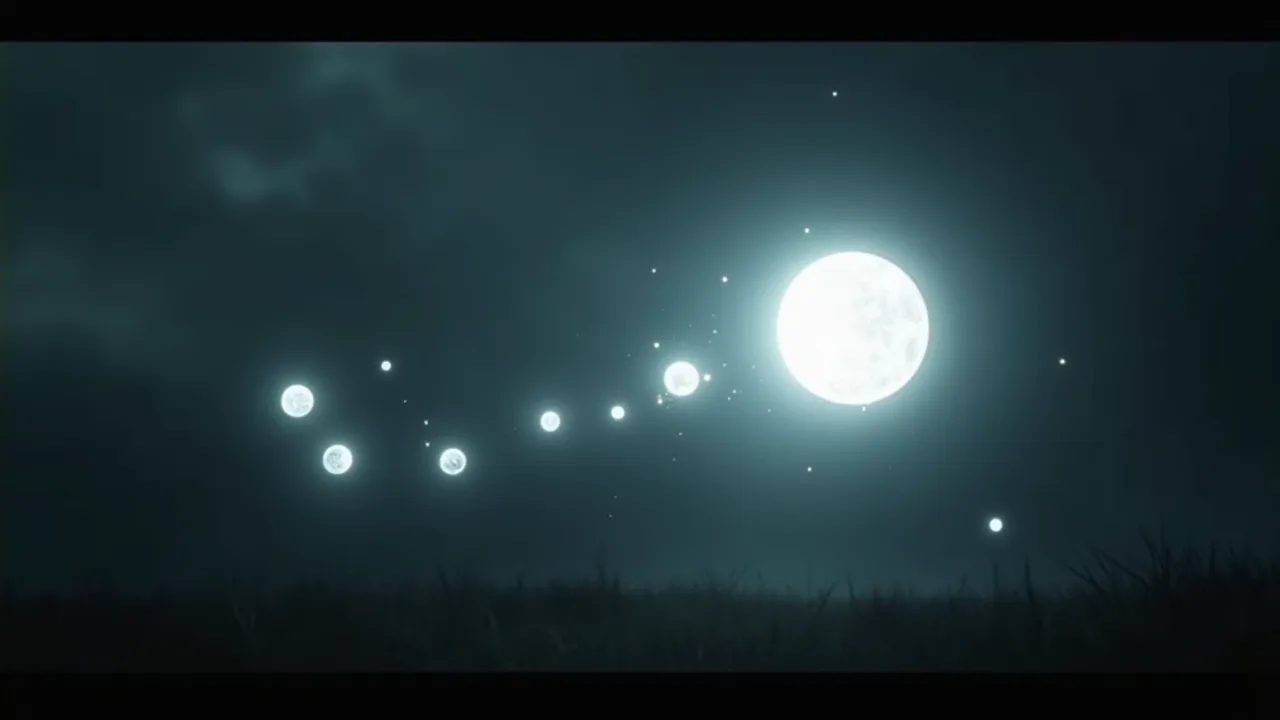 AI illustration

If you sort the UAP record by shape rather than by decade, one form dominates everything. Not the saucer, that was a brief, culturally specific fashion that peaked in the 1950s. Not the black triangle of the 1980s and ’90s. The constant, from the 1944 foo fighters tracked by Allied bomber crews to the 2026 PURSUE files, is the orb: a self-luminous sphere, basketball-sized to much larger, often white or gold or a deep burnt orange, frequently pulsing or shifting color.
It is the boring answer and the interesting one at the same time. Boring, because a featureless ball of light is the single easiest thing to mistake, fake, or misperceive. Interesting, because if you were designing an object to minimize recoverable information, no fixed silhouette, no panel lines, no exhaust, no scale reference, you could not do much better than a glowing sphere.
Why a sphere is the worst-case witness problem
A sphere has no orientation. It gives an observer nothing to range against. You cannot tell a small orb up close from a large orb far away, and you cannot tell which way it is “facing” because it has no front. This is precisely why orb reports are simultaneously the most numerous and the least evidentially useful in the catalog: the form that shows up most often is the form that surrenders the least data.
Every conventional explanation lives in this gap. Ball lightning, plasma, ignited gas, drones with diffuse lighting, lens flare, distant aircraft seen through atmospheric distortion, all of them produce “glowing sphere,” and all of them are real phenomena that account for a large share of sightings. A responsible morphology has to start by conceding that most orbs are something ordinary seen badly.
The part that resists the easy answer
What the easy answer struggles with is behavior. A foo fighter that paces a B-17 at altitude. An orb that holds rigid formation with others. And the line from the PURSUE law-enforcement reports that should be studied carefully: orbs observed launching other orbs.
Ball lightning does not deploy sub-units. Lens flare does not have offspring. The “orbs launching orbs” report describes a parent-object releasing daughter-objects, a structured, hierarchical behavior that is hard to map onto any of the standard atmospheric explanations.
The orb is not interesting because it glows. It is interesting because of what some of them are recorded doing, and behavior is the one thing a featureless sphere cannot hide.
What would actually settle it
Morphology alone never closes a case; it only tells you where to point the instruments. For orbs, the decisive measurements are the ones that don’t depend on shape: spectroscopy of the emitted light (is it thermal, plasma, or something with structured emission lines?), and simultaneous multi-sensor tracking to fix true size, speed, and acceleration. The AATIP “five observables”, instantaneous acceleration, transmedium travel, no propulsion signature, are observables precisely because they survive the orb’s refusal to show a silhouette.
The phenomenon, across eighty years of records, keeps choosing the form that tells us least. The work is to measure the things it cannot help revealing anyway.
Every new case, scored the same way
One email when a case file lands, with its Signal-Strength score and what would move it. No hype, no 'BREAKING', and every claim carries its source. Unsubscribe anytime.
Sources
Read next
More Science & Physics →
Jake Barber's Nine Craft Classes, and the 'Divine Feminine' He Felt Inside the Eightgon
Skywatcher's Jake Barber didn't just claim to summon UAPs, he sorted them into nine craft classes, from the drifting 'Jellyfish' to the eight-sided 'Eightgon' he says he ferried by helicopter. And during that retrieval he describes being 'possessed by the most beautiful spirit,' a loving feminine presence. That detail rhymes, uncomfortably closely, with the female entity Chris Bledsoe calls 'the Lady.' This is a sober look at both the taxonomy and the woman in the machine.
The Reported-NHI Field Guide: Every Claimed Non-Human Type, Graded by Provenance
Greys, Nordics, Reptilians, Insectoids, Tridactyls, and, as of June 2026, 'sentient plasmoid life.' Pop catalogs list a dozen alien races as if they were equally real. They are not equally evidenced. This is a field guide that logs each reported non-human type, ties it to the specific cases it actually comes from, and sorts the whole gallery into three honest tiers of provenance, from investigated physical encounters down to channeled starseed lore.
The Buga Sphere: Colombia's Mystery Orb and the Company It Keeps
A metal sphere the size of a melon, filmed drifting over a Colombian town, then handed to researchers who said it had three internal layers, no welds, and a core full of microspheres. The materials claims are genuinely odd. The names attached to the case are exactly why you should keep one hand on your wallet.
Follow the thread
New disclosure reporting, physics breakdowns, and case files, in your inbox. Sources or it didn't happen. No spam, unsubscribe anytime.