Hal Puthoff: The Physicist Who Has Been in the Room for Every Chapter of UFO Disclosure
Navy officer at the NSA, Stanford laser physicist, Scientologist, CIA psychic spy program founder, zero-point energy theorist, chief scientist of the Pentagon's AAWSAP study, To The Stars cofounder, and now the man saying the U.S. holds four kinds of non-human beings. No one else connects all of it. This is the full record of Hal Puthoff, with the documents, what they actually show, and what his critics say.
 AI illustration
Harold E. 'Hal' Puthoff, born June 20, 1936, is a Stanford trained physicist who co-founded the CIA funded remote viewing research at Stanford Research Institute in 1972, later served as chief scientist for Bigelow Aerospace Advanced Space Studies on the Defense Intelligence Agency's 2008 to 2012 AAWSAP program, and co-founded To The Stars Academy in 2017. He appears in the 2025 documentary The Age of Disclosure and has said publicly that the U.S. has recovered 'more than 10' non-human craft and, in May 2026, that recovery personnel described 'at least four' types of beings, while stating, 'I have not had direct access to that.' None of those recovery claims has been confirmed by any official record. The Pentagon's AARO has said it found no evidence of recovered extraterrestrial technology, and a 1995 CIA commissioned review concluded the remote viewing program never produced information used to guide intelligence operations.
If you could pick one person to stand behind every chapter of the modern UFO story, from the Cold War psychic spies to the Pentagon’s secret UFO study to the 2025 documentary that told millions of people the government has bodies, you would pick Hal Puthoff. He was there for all of it. Not near it. In it.
He turned 90 in June, still runs his lab in Austin, still gives interviews, and still saying things that would end most careers. In May 2026 he told a podcast audience that people involved in recoveries had described “at least four” types of non-human beings. A year before that he told Joe Rogan the U.S. had recovered “more than 10” craft.
Some readers treat him as the most credible voice in disclosure. Others treat him as the movement’s longest running problem. Both camps are working from the same documents. So here they are, in order.
Part 1: The Navy, the NSA and the laser
Harold Edward Puthoff was born in Chicago on June 20, 1936. He took a bachelor’s and a master’s in electrical engineering at the University of Florida, finishing in 1958, and went into the Navy. As an officer he was assigned to the Naval Security Group and then the National Security Agency, where, in his telling, he worked on making computers faster with optics. “I worked for the National Security Agency,” he said on The Diary of a CEO in 2026, an unusual credential to lead with on a UFO podcast, and he leads with it on purpose.
He went to Stanford in the 1960s and finished a PhD in electrical engineering in 1967, with a thesis on the stimulated Raman effect as a tunable laser. With his advisor Richard Pantell he wrote Fundamentals of Quantum Electronics (Wiley, 1969), a real graduate textbook. This matters for everything that follows. When Puthoff talks about physics, he is not an amateur. He is a trained laser physicist with a security clearance background, and that is exactly why government money kept finding him.
Part 2: Scientology and the “wins”
This is the part his admirers skip. In the late 1960s Puthoff became involved in Scientology and, by his own published account, reached the advanced level OT VII by 1971. He wrote up his “wins” for a 1971 church publication, describing experiences of the kind Scientology calls exteriorization, which he would later study under another name: remote viewing. In a 1974 piece for the church magazine Celebrity he said Scientology gave him “a feeling of absolute fearlessness.”
In 1977 the San Francisco Chronicle reported that Puthoff and two of his star subjects, Ingo Swann and Pat Price, were high ranking Scientologists. Puthoff broke with the church in the late 1970s and has since described his involvement as minor, a framing journalist Tony Ortega disputes. The connection does not prove anything about the data. It does explain where the idea came from, and why critics have never let it go.
Part 3: SRI and the psychic spies
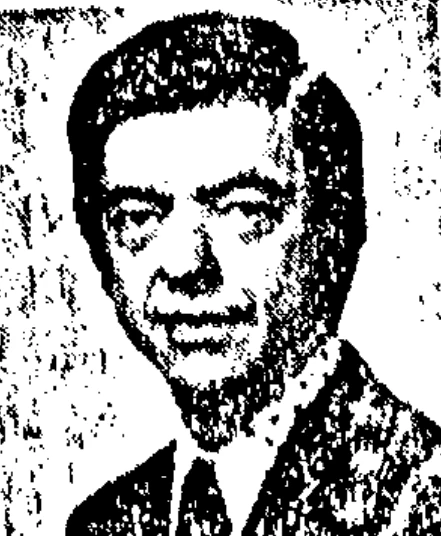
Hal Puthoff, as he appears in a document in the CIA’s declassified reading room. Public domain, via Wikimedia Commons.
In 1972 Puthoff joined Stanford Research Institute (SRI) in Menlo Park, and with fellow physicist Russell Targ he began testing people who claimed psychic abilities. The CIA funded it. A CIA file records a visit to “Dr. H. Puthoff and Mr. R. Targ” at SRI in August 1976. Over the next two decades the effort moved through the CIA, the Defense Intelligence Agency and the Army under a string of code names, ending as Stargate. Puthoff ran the SRI side until 1985. In 2026 he summed it up himself: “it grew into more than a two-decade program, millions of dollars.”
The subjects became legends. Uri Geller, the spoon bender. Ingo Swann, the New York artist who, on Puthoff’s telling, “saw” a thin ring around Jupiter in 1973, six years before Voyager 1 found one. Pat Price, a former police commissioner from Burbank. Later, Joseph McMoneagle, whom Puthoff credits with describing a giant new Soviet submarine before it appeared: “about a month later, out rolls this unbelievably giant submarine.”
In 1974 Targ and Puthoff published in Nature, the world’s leading science journal, under the title “Information transmission under conditions of sensory shielding.” It was the high water mark of academic respectability for the field, and it ran with an unusual editorial caution attached.
The crane
The single most famous result from SRI is a drawing. In July 1974, Pat Price was given geographic coordinates and asked to describe what was there. The site was URDF-3, a secret Soviet facility near Semipalatinsk in Kazakhstan, which U.S. intelligence knew from satellite photos. Here is Price’s sketch, dated July 10, 1974, exactly as it sits in the CIA’s own file:
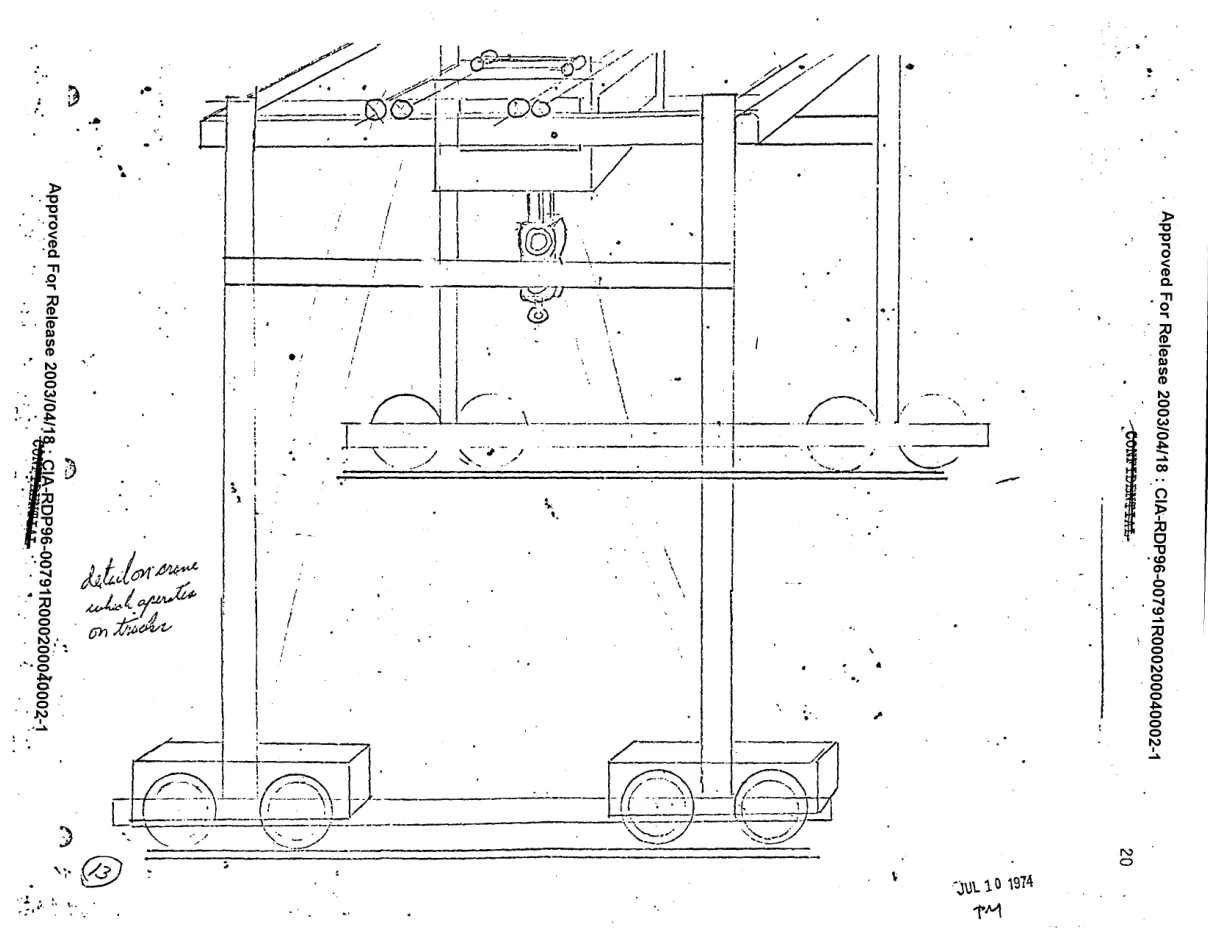
Pat Price’s sketch of a gantry crane at URDF-3, July 10, 1974. From “An Analysis of a Remote-Viewing Experiment of URDF-3,” CIA-RDP96-00791R000200040002-1, approved for release 2003. U.S. government document, public domain.
Puthoff has told this story for fifty years. “He described this giant crane that rolled over the top of a building,” he told Rogan in 2025. And the crane really was there.
Now read what the CIA analyst actually wrote, in a report dated December 4, 1975. It starts with the verdict: “The remote-viewing experiment of URDF-3 by [Price] proved to be unsuccessful.” The analyst does give the crane its due, calling it “the most positive evidence yet for the remote-viewing experiment” and writing that “it seems inconceivable to imagine how he could have drawn such a likeness to the actual crane at URDF-3 unless: 1) he actually saw it through remote viewing, or 2) he was informed of what to draw by someone knowledgeable of URDF-3.”
Then come the problems. Price had mentioned a crane on day one. That evening an experimenter phoned him and “told [him] to concentrate on the crane.” The next day he drew it. Meanwhile he described “several landmark-type objects that simply did not exist at URDF-3,” including a 500 foot antenna. The analyst’s point is brutal and fair: if you name enough objects, one will be there, and an intelligence user “would not know how to differentiate the fact from the fiction.” The conclusion: “the data is inconclusive to validate Price’s capability of remote viewing.”
That one document is the whole Puthoff debate in miniature. A real hit. A leading phone call. A lot of misses. And two people who read the same pages and come away certain of opposite things.
What the reviewers found
Outside SRI, the results did not hold. Psychologists David Marks and Richard Kammann tried to replicate the remote viewing experiments in the late 1970s and could not. Worse, they found the transcripts given to judges contained cues, such as dates and references to earlier sessions, that could let a judge match transcripts to targets without any psychic ability at all. Targ and Puthoff declined to hand over the transcripts; Marks and Kammann got copies from a judge. In 1981 Marks published in Nature again, under the title “Sensory cues invalidate remote viewing experiments.” When the cues were removed, he reported, the results fell to chance. The magician James Randi went after the Geller tests in particular.
The government’s own ending came in 1995. The CIA commissioned the American Institutes for Research to review the program. Statistician Jessica Utts concluded the lab data showed a real effect. Psychologist Ray Hyman said that was premature. On the question that mattered to the people paying, the AIR report found that remote viewing information had never been used to guide an intelligence operation, and concluded that continued use was not warranted. Stargate closed that year.
Puthoff has never accepted that verdict, and he still argues on air that remote viewing “is a talent that many people could demonstrate.”
Part 4: Energy from empty space
“Organic Biofield Sensor,” SRI final report by H. E. Puthoff and R. Fontes, November 1975. A reminder that the SRI years were not only about psychics. Via Wikimedia Commons, tagged public domain.
In 1985 Puthoff left SRI and founded the Institute for Advanced Studies at Austin, later folded into EarthTech International, Inc. Its mission was the one he has chased ever since: energy and propulsion from the quantum vacuum.
Quantum theory says empty space is never truly empty. It seethes with “zero-point” fluctuations. Puthoff’s bet was that those fluctuations are not just a curiosity but the hidden machinery behind ordinary physics, and maybe an energy source. He published in serious journals:
- 1987, Physical Review D: the ground state of hydrogen as a state set by zero-point fluctuations.
- 1989, Physical Review A: “Gravity as a zero-point-fluctuation force,” and a paper on the source of vacuum zero-point energy.
- 1993, Physical Review E: with Daniel Cole, “Extracting energy and heat from the vacuum.”
- 1994, Physical Review A: with Bernard Haisch and Alfonso Rueda, “Inertia as a zero-point-field Lorentz force,” which made the news pages of Science.
These are real, peer reviewed papers, and they are a big part of why physicists inside government took him seriously. They also did not hold up the way he hoped. Steven Carlip found a serious calculation error in the 1989 gravity paper in 1993. A 2009 analysis in Physical Review A concluded the inertia model does not actually show inertia arising from the zero-point field. Scientific American noted in 1997 that the long list of devices claimed to tap the vacuum had all failed.
In 1998 EarthTech also received U.S. Patent 5,845,220, for sending information using a modulated potential with no electric or magnetic field components. A 2006 law review article said it rested “on solid, albeit somewhat obscure, physics principles,” and used it as an example of how hard it is for patent examiners to tell innovation from pseudoscience.
The vacuum work is the bridge to UFOs. If you believe space can be engineered, a craft that moves without wings or exhaust stops sounding impossible and starts sounding like an engineering problem. That is precisely how Puthoff talks about it: “It’s beyond our understanding, but it’s beyond our engineering.” And in 2026: “we think we’ve come up with what it is about the science of it. It’s just that we don’t have the engineering to do it.”
Part 5: Bigelow, AAWSAP and the warp drive papers
In 1995 Puthoff joined the National Institute for Discovery Science, funded by Las Vegas hotel billionaire Robert Bigelow. In 2008 Bigelow won a Defense Intelligence Agency contract worth tens of millions of dollars, the Advanced Aerospace Weapon System Applications Program, or AAWSAP, the program better known by its later nickname AATIP. Bigelow Aerospace Advanced Space Studies (BAASS) did the work. Puthoff was its chief scientist. “I was also a consultant, chief science advisor to Robert Bigelow of Bigelow Aerospace,” he says.
AAWSAP produced 38 Defense Intelligence Reference Documents, or DIRDs, on future technology: warp drives, wormholes, invisibility cloaks, the biological effects of strange fields. Puthoff’s EarthTech coordinated many of them, and he wrote one: Advanced Space Propulsion Based on Vacuum (Spacetime Metric) Engineering, DIA-08-1003-015, dated March 29, 2010. It also appeared openly in the Journal of the British Interplanetary Society. Its premise is that empty space itself “might be engineered so as to provide energy/thrust for future space vehicles.” The DIA released 37 of the 38 DIRDs in 2022, and the Department of War republished them in PURSUE Release 06 in September 2026, which we read here.
The program also paid for research into UFO and paranormal reports at Bigelow’s Skinwalker Ranch in Utah, which we cover separately. That is where the government’s account turns sharp. The Pentagon’s All-domain Anomaly Resolution Office (AARO), in its 2024 historical report, says the DIRDs “were never thoroughly peer reviewed,” that the contractor team also “conducted UAP and paranormal research at a property owned by the private sector organization,” and that the DIA cancelled the program in 2012 “due to lack of merit and the utility of the deliverables.” AARO adds that after the program ended, its supporters unsuccessfully tried to get the Department of Homeland Security to fund a successor called KONA BLUE.
AARO’s report does not name Puthoff in those passages. It does not need to. He was the chief scientist.
Part 6: To The Stars and the 2017 turn
In 2017 Puthoff co-founded To The Stars Academy of Arts and Science with Blink-182 musician Tom DeLonge, alongside former intelligence officials including Luis Elizondo and Chris Mellon. Puthoff was the science lead, and part of his job was analyzing metal fragments said to come from UFOs. In December 2017 The New York Times revealed AATIP’s existence and published the Navy “Tic Tac” and “Gimbal” videos. That story is the moment UFOs moved from tabloids to Congress, and Puthoff was a founding partner in the company that carried it.
The metal samples never produced a published result showing anything beyond human manufacture. The videos are real Navy footage. Both things are true, and both still drive the debate.
Part 7: The claims
Since 2023, as whistleblower David Grusch and others told Congress about alleged crash retrieval programs, Puthoff has moved from scientist in the background to witness in the foreground. He was among the insiders in Dan Farah’s documentary The Age of Disclosure, which premiered at SXSW in March 2025 and went to theaters and Prime Video on November 21, 2025. Here is what he has said, in his own words, sorted by how he knows it.
Things he says he has seen:
- “Absolutely believe in UAPs because I’ve been exposed to data about them.” (Diary of a CEO, 2026)
- “We have data, but it’s classified. There’s no way to really talk about it.” (Joe Rogan Experience #2314, May 1, 2025)
Things he says he believes:
- On Roswell: “I think it was a true non-human intelligence craft that crashed.” (Rogan, 2025)
- Asked how many crashed craft have been recovered: “More than 10.” (Rogan, 2025)
- “The evidence is absolutely clear that there is some form of life with advanced technology.” (Diary of a CEO, 2026)
- That some craft “have not crashed but have been simply left in the desert, sort of like a gift or a donation.” (Diary of a CEO, 2026)
Things he says others told him:
- “Four different types of life, at least,” from people involved in recoveries. And then, immediately: “I have not had direct access to that, but I believe the people who I talk to.” (Diary of a CEO, 2026; our breakdown of the four types claim)
On why it stays hidden:
- “The compartmentalization in this area is really obscene.” (Rogan, 2025)
- Disclosure was stalled because officials “were trapped in this system that had grown up,” and he hopes “with the release of documents that’s starting to happen now, that you’ll get that evidence.” (Diary of a CEO, 2026)
That last line is worth holding him to. Seven PURSUE tranches and 478 records later, our scoreboard has found no recovered craft and no bodies in the released files. The one biological result in the whole set came from Puthoff’s own old program at Skinwalker Ranch, and it was raccoon and dog.
He also deserves credit for the honest part. “In the absence of actually getting access to the evidence, it’s very reasonable to be skeptical,” he has said. Very few people in this field say that on camera.
Part 8: The case against
The sharpest critic is the man who used to run the Pentagon’s UFO office. Sean Kirkpatrick, AARO’s first director, wrote in Scientific American in January 2024 that his office’s work was overwhelmed by “sensational but unsupported claims.” In interviews he said his team traced the crash retrieval stories back to fewer than a dozen people retelling each other’s claims, and that “true believers are not just outside of government; many of them are inside government,” and that nothing he could produce would change their minds. He did not need to list names for people in the field to recognize the AAWSAP and To The Stars alumni.
Skeptics add a pattern argument. Michael Shermer, reviewing The Age of Disclosure in Skeptic in November 2025, pointed out that the film is built on testimony and still has no physical evidence. Brian Dunning argues that Puthoff’s long record across psychics, vacuum energy and UFOs shows a scientist who believes first and tests second. Martin Gardner, decades ago, said Puthoff and Targ “imagined they could do research in parapsychology.”
Supporters have answers. AARO could only search the compartments it was allowed into, they argue, so its “no evidence” finding proves less than it sounds. And Puthoff’s defenders point out that the government kept hiring him, for twenty years at SRI and again in 2008, which is not what agencies do with cranks.
Both arguments are about trust, not evidence. The evidence question is simpler.
So who is Hal Puthoff?
Here is the most careful summary we can give.
Confirmed: He is a real physicist with real publications. He was at the NSA. He co-founded the CIA’s psychic research and ran its lab side for thirteen years. He was chief scientist on the Pentagon funded AAWSAP study and wrote one of its papers. He co-founded To The Stars. Every one of those is on paper.
Contested: Whether remote viewing ever worked. His own most famous example, the crane, sits inside a CIA report that calls the experiment unsuccessful. Whether vacuum engineering is physics or wishful thinking. The journals published him; later work knocked down key results.
Unverified: Recovered craft, “more than 10.” Four types of beings. Craft left “as a gift.” By his own account, he has not seen the bodies. No released document confirms any of it.
That is why he matters so much to disclosure. He is the bridge between the people with clearances and the public. When he says insiders believe the U.S. has non-human craft, that is almost certainly true. They do believe it. He has sat in the room with them for fifty years. Whether they are right is a question he cannot answer with his own eyes, and has said so.
The test is the one he set himself: the documents. If a PURSUE tranche, a congressional exhibit or a sworn record ever puts a recovered craft on paper, Hal Puthoff will have been right about the biggest story in history, decades early. Until then, he is the most important witness disclosure has. And he is a witness to what other people told him.
Every new case, scored the same way
One email when a case file lands, with its Signal-Strength score and what would move it. No hype, no 'BREAKING', and every claim carries its source. Unsubscribe anytime.
Frequently asked
Who is Hal Puthoff? +
Harold E. Puthoff is an American physicist, born in Chicago on June 20, 1936. He served as a Navy officer assigned to the National Security Agency, earned a PhD in electrical engineering at Stanford in 1967 and co-wrote a textbook on quantum electronics. In 1972 he co-founded the CIA funded remote viewing research at Stanford Research Institute that became the Stargate program. Since 1985 he has run a private physics lab in Austin, now EarthTech International. He was chief scientist on the Pentagon funded AAWSAP study from 2008 to 2012 and co-founded To The Stars Academy in 2017.
What has Hal Puthoff said about recovered UFOs? +
On The Joe Rogan Experience in May 2025, asked how many crashed craft have been recovered, he said 'More than 10' and said he believed Roswell was a non-human craft. On The Diary of a CEO in May 2026, he said people involved in recoveries told him there are at least four types of beings, adding, 'I have not had direct access to that, but I believe the people who I talk to.' No official record released so far confirms any recovered craft or bodies.
Did remote viewing work? +
It depends on who you ask and what you count. Puthoff and the program's supporters point to striking individual sessions, such as Pat Price's 1974 sketch of a gantry crane at a Soviet site. The CIA's own analyst called that sketch the most positive evidence in the experiment but judged the whole experiment unsuccessful because Price also described many things that were not there. A 1995 review commissioned by the CIA found that remote viewing information had never been used to guide an intelligence operation and recommended ending the program, which closed that year.
What was Puthoff's role in AAWSAP? +
He was chief scientist for Bigelow Aerospace Advanced Space Studies, the contractor that ran the Defense Intelligence Agency's Advanced Aerospace Weapon System Applications Program from 2008 to 2012. His company EarthTech coordinated many of the 38 Defense Intelligence Reference Documents the program produced, and he wrote one himself, on propulsion by engineering the vacuum. AARO later said those papers were never thoroughly peer reviewed and that the DIA ended the program over concerns about its merit.
Is Hal Puthoff a credible source? +
His credentials and his access are real. He has worked inside classified government programs for five decades and is named in the documents. But every recovery claim he has made in public is secondhand by his own account, and two of his central scientific bets, remote viewing and usable energy from the quantum vacuum, have not been accepted by mainstream science. The fair reading is that he is a well placed witness to what insiders believe, not a witness to the craft themselves.
Sources
- [1] Harold E. Puthoff (Wikipedia), biography with primary citations
- [2] Tony Ortega, The Underground Bunker, on Puthoff and Scientology
- [3] Harold E Puthoff (Psi Encyclopedia, Society for Psychical Research)
- [4] Targ and Puthoff, 'Information transmission under conditions of sensory shielding,' Nature 251, 602 to 607 (1974)
- [5] CIA, An Analysis of a Remote-Viewing Experiment of URDF-3, December 4, 1975 (CIA-RDP96-00791R000200040002-1)
- [6] Same document, full PDF with Pat Price's sketches (The Black Vault)
- [7] CIA, Visit with Dr. H. Puthoff and Mr. R. Targ, Stanford Research Institute, August 12, 1976
- [8] American Institutes for Research, An Evaluation of Remote Viewing: Research and Applications (1995)
- [9] Marks, 'Sensory cues invalidate remote viewing experiments,' Nature 292, 177 (1981)
- [10] Puthoff, 'Gravity as a zero-point-fluctuation force,' Physical Review A 39, 2333 (1989)
- [11] Haisch, Rueda and Puthoff, 'Inertia as a zero-point-field Lorentz force,' Physical Review A 49, 678 (1994)
- [12] Puthoff, Advanced Space Propulsion Based on Vacuum (Spacetime Metric) Engineering, DIA-08-1003-015, March 29, 2010 (AAWSAP DIRD)
- [13] Same paper, JBIS 63 (2010), arXiv 1204.2184
- [14] AARO, Report on the Historical Record of U.S. Government Involvement with UAP, Volume I, March 8, 2024
- [15] The Joe Rogan Experience #2314, Hal Puthoff, May 1, 2025 (transcript)
- [16] The Diary of a CEO, UFO roundtable with Hal Puthoff and Dan Farah, May 2026 (transcript)
- [17] UFO insider claims US has bodies of 4 different alien species (FOX 5 DC), May 2026
- [18] The Age of Disclosure (Wikipedia), release and cast
- [19] The Aliens Are Here (Again)! A Review of The Age of Disclosure (Michael Shermer, Skeptic)
- [20] Pentagon ex-UFO chief says conspiracy theorists in government drive spending (Kirkpatrick, via AOL)
- [21] Here's how weird Hal Puthoff really is (Brian Dunning)
- [22] Hal Puthoff portrait, CIA reading room via Wikimedia Commons (public domain)
- [23] Organic Biofield Sensor, SRI Project 3194, Puthoff and Fontes, November 1975 (Wikimedia Commons)
Read next
More Disclosure →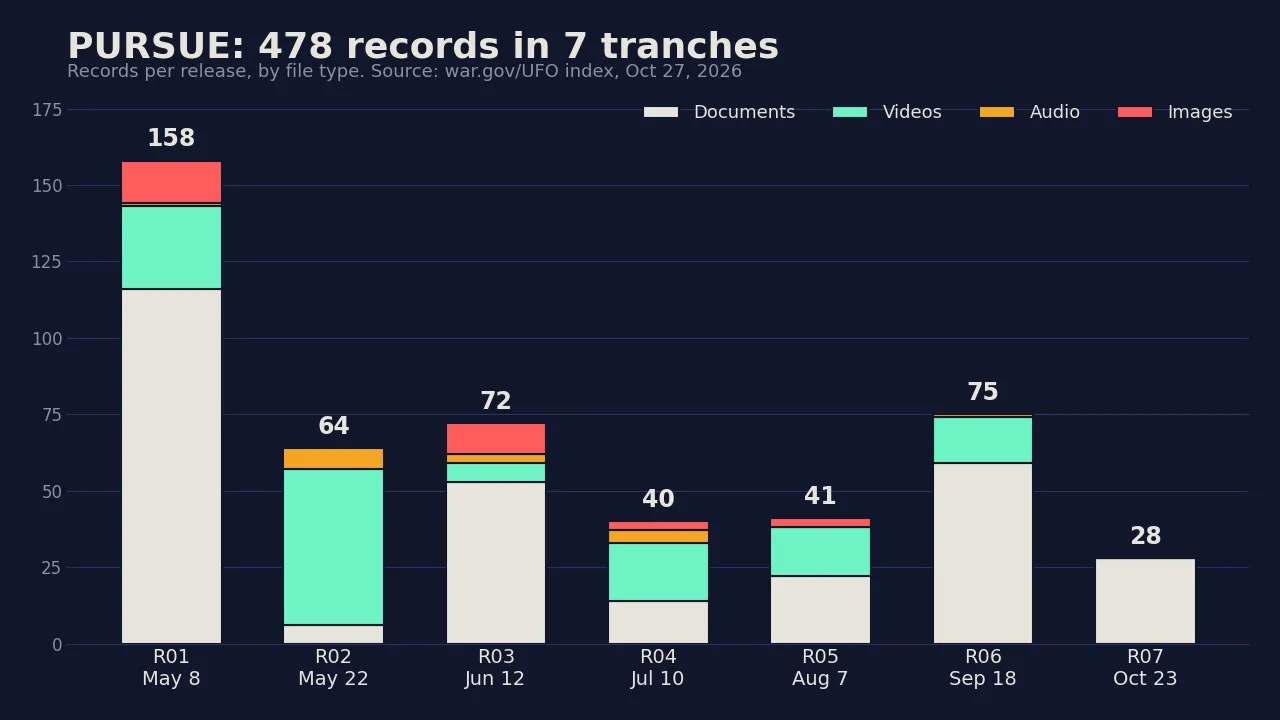
The PURSUE Scoreboard: Seven Tranches, 478 Records, and What Is Still Missing
Five and a half months, seven releases, 478 records in the government's own index. We counted all of them: what kind of file, which agency, which decade, how many are marked unresolved, and how many are flagged as redacted. Then we scored the program against the two questions we ask of every tranche. One biological record, and it was a raccoon. No photo or video from the western U.S. cases. And the tranches are getting smaller.
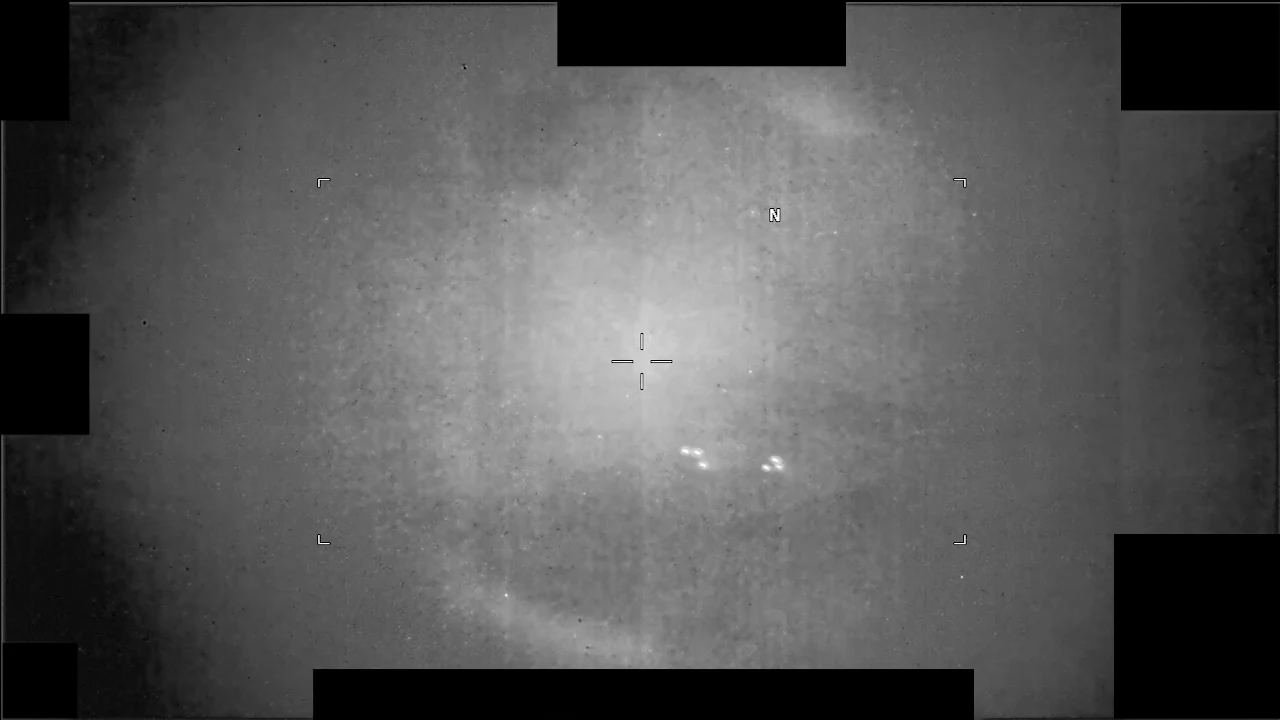
PURSUE Release 06: The Pentagon Re-Released the AAWSAP Papers. The Best File Is From 1952.
The sixth PURSUE tranche landed on September 18 with 72 records, 15 videos and an hour of 1952 audio. The headlines went to 37 warp-drive and wormhole studies and a paper on 'injury to human observers.' Those studies have been public since a FOIA release in March 2022. What is actually new is the contract paperwork behind them, a set of mission reports that grade their own objects as having 'no advanced capabilities,' and the complete Air Force file on the 1952 Tremonton film, dissent included.
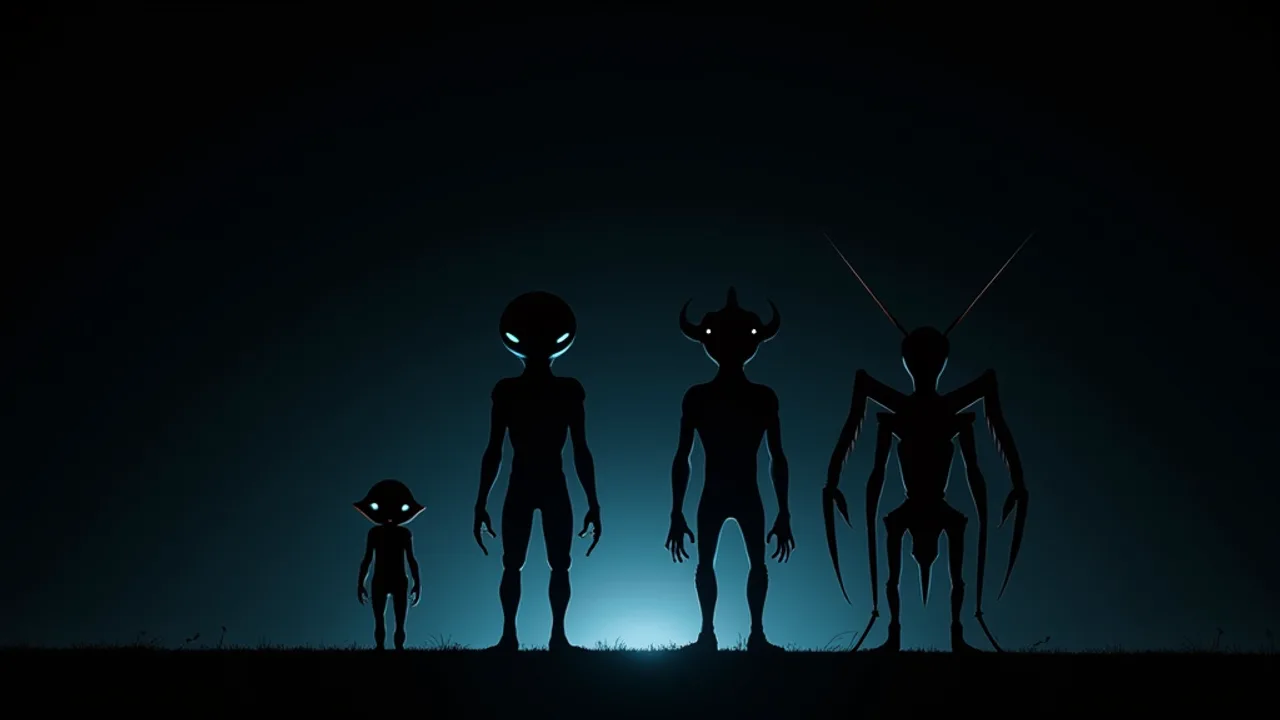
Grays, Nordics, Reptilians, Insectoids: The 'Four Types' Claim, Explained
In May 2026, physicist Hal Puthoff said people involved in alleged UFO recoveries described 'at least four separate types' of beings, and his colleague Eric Davis has named them. Here is exactly who said what, what each type is supposed to be, and what the public evidence does and does not show. No verdict, just the record.
Follow the thread
New disclosure reporting, physics breakdowns, and case files, in your inbox. Sources or it didn't happen. No spam, unsubscribe anytime.