The Nazca Mummies: Three Fingers, Real Bones, and a Question Nobody Has Closed
The tridactyl 'María' is the most famous alien corpse in the world: three fingers, three toes, a radiocarbon date near 1,700 years, and DNA its researchers say doesn't fully match anything known. Skeptics say it's a doll built from looted human bones. Believers say the imaging shows otherwise. The honest position, even now, is that nobody has actually closed the case, because the one study that could has never been run.
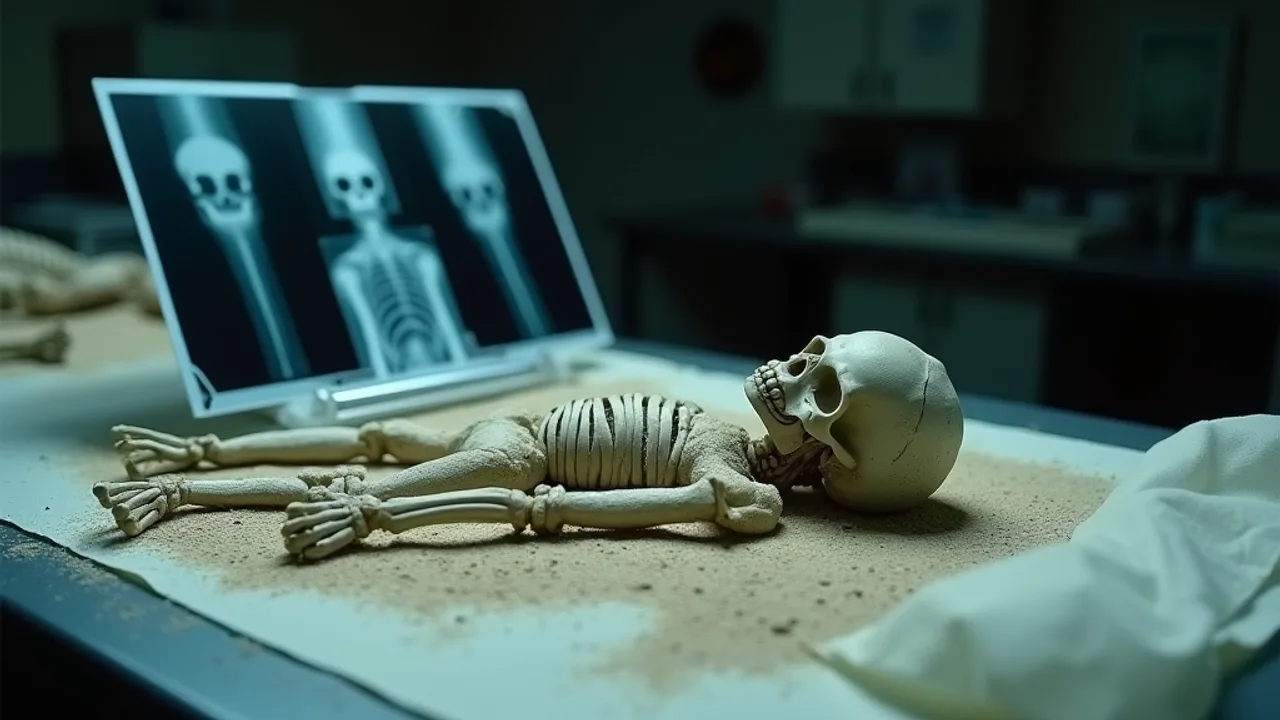 AI illustration
The Nazca 'mummies,' presented by Jaime Maussan to Mexico's Congress in 2023, are small three-fingered bodies its promoters claim are non-human, citing radiocarbon dates and DNA analysis. Independent Peruvian and international scientists who examined the specimens concluded they are dolls or altered remains assembled from human and animal bones, and no peer-reviewed study has confirmed a non-human origin, making this one of the more thoroughly disputed claims on the disclosure beat.

She has a name, María, and she is the reason a Mexican congressional chamber spent an afternoon in September 2023 staring at a small, three-fingered body in a glass case. The Nazca mummies are the most-promoted “alien remains” of the modern era. They are also, unlike a blurry sphere or a gun-camera smear, physical: you can radiocarbon-date them, X-ray them, CT them, and sequence them. A great deal of that has been done. And yet the plain truth, the one both the loudest believers and the loudest debunkers tend to talk past, is that the case is not closed. It sits in the genuinely uncomfortable middle, and it has earned that spot.
It is worth resisting the two easy exits. One is to declare María an alien because she has three fingers and odd DNA. The other is to declare her a proven fraud and move on. Neither is supported by what has actually been established. What follows is the case on both sides, and why the verdict is still open.
The case for taking it seriously
The promoters, chiefly the Mexican journalist Jaime Maussan, working with researchers connected to the Inkari-Cusco institute and a rotating cast of physicians and geneticists, make a set of specific, checkable claims, and some of them are harder to wave off than the skeptical headlines suggest.
The bodies are tridactyl in a consistent way: three elongated fingers and three toes, proportioned and articulated, not obviously a five-fingered hand with digits removed. Radiocarbon dating reportedly places several specimens in the range of 1,700 years old. Most importantly, some of the imaging, CT and X-ray work presented by the research team, has been read as showing articulated, single-piece skeletal structures, with joints, bone density gradients, and in some specimens what are described as internal features (objects characterized as eggs, implanted metals). A skeleton that articulates correctly throughout is a much higher bar to fake than a handful of bones glued into a silhouette. There are also DNA analyses, including work by geneticists outside the original team, reporting sequences with a significant fraction that does not cleanly match known references.
If even part of that holds up under independent scrutiny, María is not a doll. That is the reason the story refuses to die, and it is not pure gullibility keeping it alive.
The case for deep suspicion
Against all of that sits a serious, credentialed body of skepticism that deserves equal weight, and arguably more, given the promoters’ history.
In January 2024, Peruvian authorities and scientists, including the forensic archaeologist Flavio Estrada, presented their conclusion bluntly: the specimens they examined were assembled “dolls,” constructed from real but recombined bones, looted, genuinely ancient pre-Hispanic human and animal remains, bound together and sometimes coated in a paste of glue and diatomaceous earth. Peru has a well-documented black market in exactly this kind of grave-robbed material, which supplies both the authentic-old bones and the motive.
Read through that lens, the believers’ strongest facts soften considerably:
- A real radiocarbon date proves the bones are old. It says nothing about whether the body is a single organism or an arrangement of old parts.
- “Unmatched” DNA is exactly what degraded, contaminated, centuries-old samples handled by many people produce. Without an open chain of custody and clean controls, an unmatched read is as consistent with bad sampling as with new biology.
- And the promoters carry real baggage: the same circle has presented “aliens” before that did not survive scrutiny, has controlled physical access to the specimens, and has resisted the kind of fully independent sampling that would settle the matter. That pattern is a legitimate reason to keep one hand on your wallet, and it is the single biggest mark against the case.
A hoax built from real ancient bones would be the hardest kind to fully disprove, because half of every honest test comes back “authentic.” But the reverse trap is just as real: a genuinely anomalous specimen guarded by untrustworthy promoters would look, from the outside, almost exactly like a clever fraud. Bad messengers are not the same as a bad specimen.
Why it stays unresolved
Here is the part that actually decides the matter, and it is procedural, not biological. The case has never been subjected to the one thing that would end it: a fully transparent, independent, multi-laboratory study, shared physical samples sent blind to several institutions with no stake in the outcome, a published methodology, and the raw data released for anyone to re-analyze.
That study has not happened. The skeptics’ “doll” finding came from examining certain specimens but did not exhaust the set or silence the imaging debate; the believers’ DNA and CT claims have circulated largely within media productions and friendly venues rather than the cold machinery of peer review. Snopes, after surveying the whole mess, landed not on “false” but on “Unproven”, which is the most defensible verdict available, and notably not the same as “hoax.”
So both confident conclusions are running ahead of the evidence. “It’s aliens” outruns what any clean test has shown. “It’s definitely a fraud” outruns it too, it is a strong, well-motivated hypothesis, supported by a forensic examination and the promoters’ track record, but it is not the closed-book result the headlines imply.
What survives
What survives is a real question, not an answer. There exist physical specimens, in human hands, that could be definitively characterized tomorrow with samples and instruments that already exist, and they have not been, after years, because access has stayed controlled and no neutral consortium has been allowed to run the decisive test.
That is the actual scandal of the Nazca mummies, and it cuts against everyone: the believers who treat unreviewed imaging as proof, the debunkers who treat a partial forensic finding as the final word, and above all the promoters who hold the one thing that would resolve it and keep it just out of reach. María is not confirmed alien. She is also not confirmed fake. Until somebody neutral is handed a sample and publishes the data, the only honest thing to write under her glass case is: unknown, and deliberately kept that way.
Every new case, scored the same way
One email when a case file lands, with its Signal-Strength score and what would move it. No hype, no 'BREAKING', and every claim carries its source. Unsubscribe anytime.
Sources
- [1] Scientists assert 'alien mummies' in Peru are really dolls made of earthly bones, Reuters
- [2] Did Researchers Find a Mummified, Three-Fingered Alien in Nazca?, Snopes (rated 'Unproven')
- [3] Bizarre three-fingered 'alien mummies' are real and contain unique DNA, filmmakers say, New York Post
- [4] DNA tests and the Nazca 'alien' claim, AlphaBiolabs
Read next
More Disclosure →
The Reported-NHI Field Guide: Every Claimed Non-Human Type, Graded by Provenance
Greys, Nordics, Reptilians, Insectoids, Tridactyls, and, as of June 2026, 'sentient plasmoid life.' Pop catalogs list a dozen alien races as if they were equally real. They are not equally evidenced. This is a field guide that logs each reported non-human type, ties it to the specific cases it actually comes from, and sorts the whole gallery into three honest tiers of provenance, from investigated physical encounters down to channeled starseed lore.
What the Evidence Actually Says: We Scored Every Case on the Same Four Axes
Most UFO writing argues case by case, which makes every story sound equally strong. We did the opposite: scored every case file on the same four-part rubric and lined the numbers up. The pattern that falls out is not the one either side wants.
The UAP NDA Waiver Has a Text Now. It Is Three Paragraphs, and It Is Narrower Than the Law.
On July 27 we asked whether the reported NDA waiver would ever leave paper. It did. A two-page unclassified ODNI memorandum, ES 2026-00818, signed July 31 and addressed to eighteen named intelligence officials, gives them thirty days to appoint a PURSUE designee and tell their workforces the NDAs are off. Those thirty days end on August 30. The memo is also narrower than the statute it implements, and the only public copy is hosted by a congressman. Updated September 17: on September 14 the Department of War announced its own, separate waiver for its service members, civilians and contractors.
Follow the thread
New disclosure reporting, physics breakdowns, and case files, in your inbox. Sources or it didn't happen. No spam, unsubscribe anytime.