M.M.T.U. and the Writing on the Wall
Asked on camera what M.M.T.U. stands for, Matthew Brown refused to say. Two hours into the interview, at 2:00:23, the answer appears on screen instead, as an editor's caption pointing at a single Bible verse. What that verse says, why it had to be shown rather than spoken, and why a riddle is not evidence.
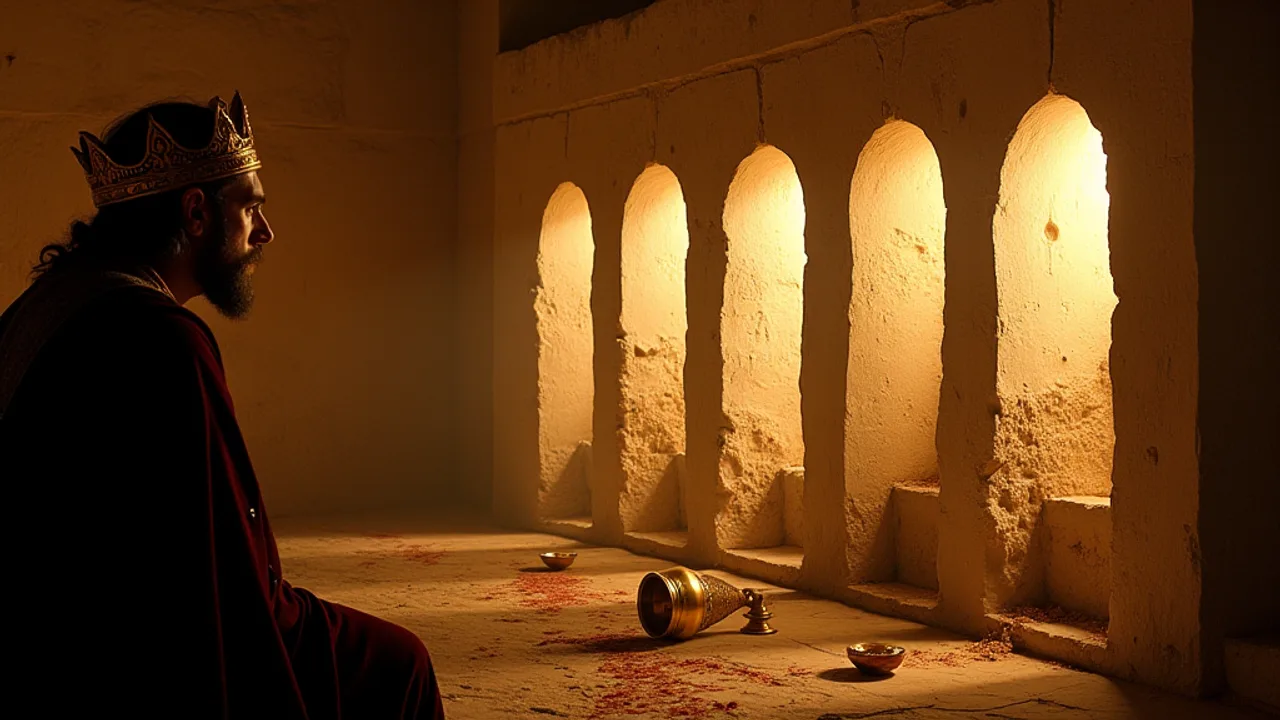 AI illustration
In an American Alchemy interview released August 29, 2026, Jesse Michels asked Immaculate Constellation whistleblower Matthew Brown what the acronym M.M.T.U. means and Brown declined to answer. Viewers report that at the 2:00:23 mark the video displays an on-screen caption reading 'Clue: Daniel 5:25', the verse containing the writing on the wall, 'Mene, Mene, Tekel, Upharsin'. The pointer is real and checkable in the published video; what Brown means by it is his claim alone and is not corroborated by any document or second witness.
The moment
Roughly two hours into a three-and-a-half hour conversation released on August 29, 2026, Jesse Michels asks Matthew Brown a direct question about a string of four letters Brown had put into public view: M.M.T.U.
Brown will not answer it.
That refusal is the interesting part, and not for the reason it first appears. Because at 2:00:23, while the question sits unanswered, the published video puts up a caption that no one in the room says out loud.
Clue: Daniel 5:25
You can go and look. The r/UFOs thread that surfaced this links straight to the second: youtu.be/yGtVzBbUvx4?t=7221. This is one of the rare claims in this field where the artifact is a URL and a stopwatch rather than a memory of a briefing, and we would encourage anyone writing about it to actually open it rather than take our word or anyone else’s. We have read the thread and the timestamp; we have not frame-verified the caption ourselves, and we will update this page when we have.
Everything after that is interpretation. Ours included.
What the verse says
Daniel 5 is the source of a phrase that has outlived its own book. Belshazzar throws a feast, drinks from vessels looted from the temple in Jerusalem, and a disembodied hand appears and writes on the plaster of the wall. The king’s face changes. His own experts, the astrologers and the diviners on the palace payroll, are brought in and cannot read it. Somebody remembers a foreigner from the captive population who has a reputation for interpreting things. Daniel is sent for.
The words are Mene, Mene, Tekel, Upharsin. Their initials are M, M, T, U.
Daniel’s interpretation, in the King James phrasing that carried the story into English, is that the kingdom has been numbered and finished, that the king has been weighed in the balances and found wanting, and that the kingdom is divided and given to the Medes and Persians. That night, the text says, Belshazzar is killed.
Two details from the scholarship on the passage matter here, and both are more interesting than the pop version.
First, the words are units of weight, and therefore of money: a mina, a mina, a shekel, and half-minas. The riddle is not a magic incantation. It is a row of currency, which is why the king’s specialists could see the letters perfectly well and still not know what they were being told. The written message was legible and unreadable at the same time. That is a much sharper idea than “spooky ghost writing”, and it is the idea the clue is borrowing.
Second, there is a pun. The last word, parsin or upharsin, plays on the verb to divide and on the name of Persia. The sentence names the successor while describing the succession.
So the verse being pointed at is, precisely, a story about a message that appears in public, that the institution’s own cleared experts are unable to interpret, that has to be handed to an outsider from a subject population, and that turns out to be an accounting: numbered, weighed, divided.
You do not have to believe a word Matthew Brown says to notice that this is an unusually well-chosen verse.
Why it was shown and not spoken
This is the part worth sitting with.
Brown declines to say the acronym’s meaning aloud. The meaning then appears in text, added in post-production, unspoken. In the story the clue points to, the message also appears in text, on a wall, unspoken, and its arrival is the event.
Read charitably, the form is the content. A man who has signed non-disclosure agreements can decline to state something and can point at something. Those are legally different acts, and people who have actually been read into compartmented programs describe navigating precisely that distinction, sometimes to the point of absurdity. Under that reading, the caption is a workaround: nothing was disclosed, a citation was provided, and the audience did the rest.
Read uncharitably, this is theater with an escape hatch built in. A refusal plus a clue costs nothing, can never be falsified, and transfers the entire burden of meaning onto the audience, who will generate more interpretations in a weekend than the speaker could have made claims in a year. If the eventual outcome matches, it was foretold. If it does not, nothing was ever asserted. This is the same machinery that powers an alternate reality game, and it is worth saying plainly that ARGs are fun and that the emotional experience of decoding one is indistinguishable from the emotional experience of receiving a genuine leak.
Both readings are available. Neither is testable. That is the problem with the whole artifact, and it does not go away because the verse is a good fit.
One more caution that the excitement has been skipping past: the caption is an editing decision. It appears in a published video produced by a channel, not in Brown’s mouth and not in his handwriting. Nobody has publicly said who put it there, whether Brown asked for it, whether Michels chose it, or whether an editor spotted the connection and added a flourish. Attributing it to Brown as a deliberate coded message from a whistleblower is an assumption, and it is currently doing a lot of unearned work in the online reconstructions.
This is a pattern, not a one-off
The reason the clue landed as hard as it did is that Brown has done this before, and in the same register.
In June 2025 he posted a long, strange public message addressed to Elon Musk, claiming that the White House has access to an AI that can accurately predict a range of future events, making accusations about the fate of early sentient AI systems, and pointing at a named naval air station and a named defense contractor. He signed it A.B.O.R.Y.M.O.N., in dotted capitals. Researchers working on that message connected the name to the outer ring of the Sigillum Dei Aemeth, the sigil associated with John Dee’s angel-scrying work, which is a very particular place to be reaching for a signature if your idiom is supposed to be Pentagon acronym soup.
That is the key to reading M.M.T.U. correctly, and most of the online decoding attempts have it backwards. People have been trying to expand the letters into four operational words, on the model of a program name. But Brown’s dotted strings are not expansions. They are citations. A.B.O.R.Y.M.O.N. is a pointer into a grimoire. M.M.T.U. is a pointer into scripture. In both cases the letters are not hiding a secret phrase, they are naming a text that already exists, publicly, that anyone can read, and that says something the speaker will not say in his own voice.
Which makes the actual content of the message, if you accept the frame at face value, a fairly grim one: your time is counted, you have been weighed, it will be divided. Not a revelation about craft or biologics. A verdict.
For what it is worth, this is consistent with what Brown has been writing in public. His Substack essays work the same way, running long surveys of Black Sea myth and folklore that read as encoded arguments about tiered non-human others, blood covenants and custodianship, rather than as direct testimony. Whatever else he is, he is a man who prefers to gesture at old texts over stating claims he can be held to. That is either sophisticated operational caution or a very effective way of never being wrong.
The rest of the interview
The riddle has eaten the coverage, so it is worth recording what else was actually claimed, with the same label attached to all of it: these are Brown’s assertions, in his own voice, uncorroborated by any document or second witness that we have seen.
He claims some publicised military UAP shootdown accounts are covers for something else, and that a real objective involves people with psionic ability being used as breeding stock toward what he characterises as a super-psychic child. He claims human minds are no longer fully sovereign, that they are being interfaced with remotely, and that dreams can be technologically influenced. He describes a classified account of a large triangular craft holding position roughly a football field above Russian naval vessels, and asserts the Russian side had foreknowledge and was waiting for it. He repeats the claim about a predictive White House AI. And he describes unwritten oral traditions inside the government concerning long-standing agreements and no-go zones with non-human intelligence, in which humanity is the junior partner.
That last one is the most consequential claim in the interview and the one getting the least attention, because it is the only one that would, if true, reframe every disclosure fight of the last five years as a negotiation the public was never party to. It is also, conveniently, described as an oral tradition, which is to say a claim constructed so that the absence of a document is evidence for it rather than against it.
Our position on all of it is the site’s usual one. Brown’s account of finding an Immaculate Constellation briefing is a matter of record, it reached the congressional record, and it is why anyone is pointing a camera at him. None of that transfers credibility to a claim about breeding programs or dream manipulation. Provenance is not proof, and a man can be exactly who he says he is and still be wrong, mistaken, misled, or working from someone else’s fiction.
What would move this
Three things, in order of how much they would change our assessment.
A statement from Brown or Michels about who added the caption. One sentence would settle whether M.M.T.U. and Daniel 5:25 is a whistleblower signalling under legal constraint or an editor making a good catch. Until then the entire coded-message reading rests on an assumption nobody has checked.
The acronym appearing in a document rather than a broadcast. If M.M.T.U. shows up in anything with a paper trail, a filing, a FOIA release, a congressional exhibit, the artifact changes category entirely.
Any independent corroboration of the Russian naval encounter. It is the only claim in the interview with a physical event, a date-shaped shape, foreign witnesses and multiple crews. It is the one that could be confirmed by someone who is not Matthew Brown. Everything else in the interview is designed, whether deliberately or not, so that it cannot be.
Until one of those lands, what we have is a well-chosen Bible verse in a caption, an audience doing the interpretive work, and a very old story about a king whose cleared experts could see the writing perfectly clearly and could not read a word of it.
Every new case, scored the same way
One email when a case file lands, with its Signal-Strength score and what would move it. No hype, no 'BREAKING', and every claim carries its source. Unsubscribe anytime.
Frequently asked
What does M.M.T.U. stand for? +
Matthew Brown has not said. The on-screen clue in the American Alchemy interview points to Daniel 5:25, whose four words are Mene, Mene, Tekel, Upharsin, which share the initials M M T U. That correspondence is the reading the clue invites, but Brown has not confirmed it in his own words.
What does Daniel 5:25 actually say? +
It is the writing that appears on the wall of Belshazzar's banquet hall in the Book of Daniel: Mene, Mene, Tekel, Upharsin. Daniel interprets the words to mean that the king's reign has been numbered and ended, that he has been weighed and found wanting, and that his kingdom will be divided and given away.
Did Brown say the clue was his idea? +
No. The caption is an editing decision in the published video and is not spoken by anyone. Neither Brown nor Michels has publicly explained who added it or on whose instruction, which is one reason it should not be treated as a statement by Brown himself.
Does the riddle prove anything about UAP? +
No. A pointer to a Bible verse conveys no new verifiable information about non-human intelligence. It is a rhetorical device, and it works the same way whether or not the underlying claims are true.
Sources
- [1] American Alchemy, "Pentagon Whistleblower UNLOADS on Alien Hybrid Breeding Programs (ft. Matthew Brown)" (YouTube)
- [2] The same episode on Spotify
- [3] r/UFOs thread that surfaced the on-screen clue, with the 2:00:23 timestamp
- [4] Book of Daniel, chapter 5 (the writing on the wall), Wikipedia
- [5] Mene, mene, tekel, upharsin, Wikipedia
- [6] Immaculate Constellation, Wikipedia
- [7] Arnett Files, decoding Brown's June 2025 message to Elon Musk (the A.B.O.R.Y.M.O.N. sign-off)
- [8] Sigillum Dei, Wikipedia
Read next
More Disclosure →
Greys vs. Reptilians: What David Grusch Actually Told Joe Rogan, and What He Didn't
On Joe Rogan Experience #2560, David Grusch described a crashed tic tac with dead greys aboard, living seven-foot reptilians that US troops shot, and Americans hurt and killed in the fight. He also said, more than once, that he never saw any of it. Here is the exchange line by line, who said what, and the other claims from a two-and-a-half-hour interview that deserve more attention than the lizards are getting.

PURSUE Release 07: The Black Triangle, Read Against the FBI's Own Version
The seventh PURSUE tranche is 28 documents and no video. The headline is a silent black triangle seen by federal agents at a western U.S. national security site in 2026. We read the AARO memo and the FBI interview side by side, and they do not tell the same story. Also inside: Skinwalker Ranch hair that DNA-tested as raccoon and dog, a contractor plan to store crash debris in an underground vault, and a 1949 letter to Kenneth Arnold that the Air Force never answered.
Orbs Launching Orbs: We Read the Whole AARO File. One Agent Says There Is Video.
A viral headline says the Pentagon released 155,000 pages of UFO documents. It did not. That number is a New York Times compilation from seven countries. The Pentagon file the story leans on is real, though, and nobody has read it in full: a signed AARO memo and five first-hand statements from federal agents who chased lights near a sensitive site in October 2023. AARO pins about 60 percent on military flares and carries 'unrecognized technology' as a pending hypothesis for the rest. It also says the agents collected no video. One agent's own statement, released in the same batch, refers to video footage twice.
Follow the thread
New disclosure reporting, physics breakdowns, and case files, in your inbox. Sources or it didn't happen. No spam, unsubscribe anytime.